

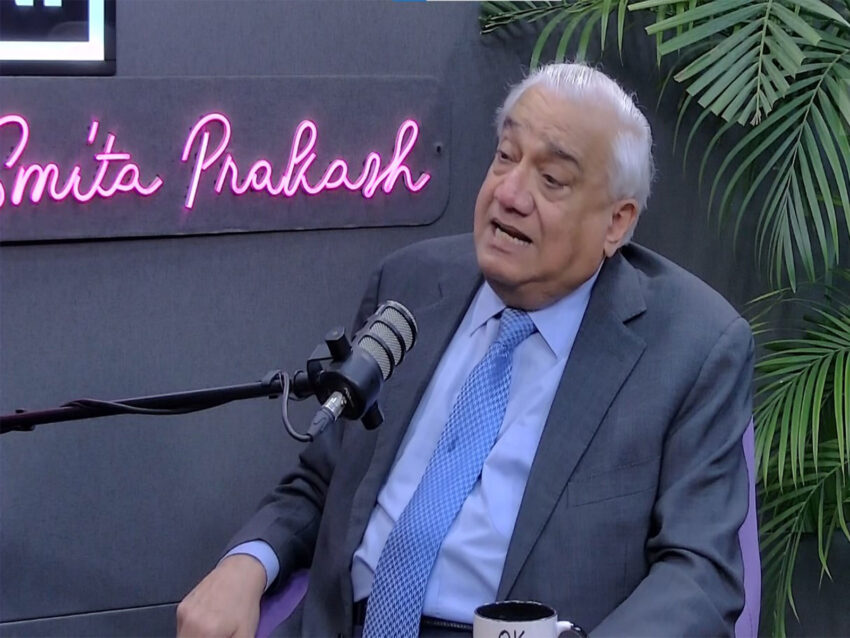
New Delhi [India], December 7 (ANI): Days after Russian President Vladimir Putin’s state visit, former Ambassador of India to Saudi Arabia, Oman and the UAE, Talmiz Ahmad, on Sunday said the West must understand that India retains the right to shape and structure its ties with other countries.
He also advocated for the use of “strategic autonomy” for India amid social media criticism by Americans for hosting Putin, who is heavily criticised by the Republicans and Democrats alike for waging a war against Ukraine.
In an interview with ANI, Ahmad, former Ambassador of India to Saudi Arabia, said that Putin’s visit to India remains significant but comes at a time of “deep divide”. Although he added that there has been a divide between West and East since the Cold War, the West has resorted to “demonising” Russia while suggesting that other countries take definite sides.
“The visit is significant, obviously. We have very substantial ties that go back several decades. These have been constantly reaffirmed. But the visit now took place at a time of deep division. There’s a divide between the West and the East reminiscent of the Cold War. And the West is mobilising all its resources, political, military, diplomatic, to demonise Russia somehow and to suggest that either you are with us or against us,” Ahmad said.
The former Diplomat said that countries like India have asserted that they shouldn’t be forced to make such choices and should be allowed to decide on their partnership with different countries.
“Countries like India have been constantly saying that don’t force us to make choices like this. We don’t want a new Cold War. We want to retain the right to decide our own kind of relationship with different people. We are not hostile to the West, but we retain the right to shape and structure our ties with other countries,” Ahmad said.
Talmiz Ahmad prefers using “strategic autonomy” rather than Jaishankar’s “plurilateralism, minilateralism” to argue that India is an independent state that takes decisions in the national interest without being influenced by other countries. He said that the majority of the international community practices and advocates strategic autonomy.
He said that the term ‘non-aligned’ also had a similar meaning, but its use remained relevant before the end of the Cold War.
“Strategic autonomy says precisely what I wish to imply. And that is, I am an independent state. I want to make my own decisions. Other countries’ decisions will not influence me. I will make decisions in my national interest. That’s what I’m asserting,” Ahmad said.
“Large sections of the European Union are engaged with Russia. Many of them are buying Russian energy. The Americans are interacting with the Russians and the Chinese. Putin has reminded us that the Americans are purchasing nuclear fuel from Russia. Different countries are purchasing rare earths all the time. How dare they presume to tell India or any other country what we should do or what we should not do,” he added.
Ahmad further asserted that the days of US hegemony were over and blamed the Americans for creating a scenario of a possible new Cold War.
“It is the Americans who have created this scenario of a possible new Cold War, where either you are with us or against us. The background is very clear. After the Cold War ended, you had only one: a unipolar world order, with the United States as the hegemon. But much has happened since then. The United States has lost credibility due to its misadventure in Afghanistan, Iraq, and Libya. They are no longer that credible power that they used to be when they were asserting hegemony,” he said.
The former diplomat spoke about the emergence of countries he called “middle powers,” adamant about advancing their views in a multipolar world order.
“In the meantime, other players have entered the global scenario. You have got China, which is challenging the Americans in various areas, particularly in the economy, technology, and logistics. And you have various other countries roughly referred to as middle powers, which are important in their region and are asserting a role for themselves in that regard, in their region,” Ahmad said.
“This is why we call it a multipolar world order, where a large number of countries, usually middle powers, are seeking to assert their point of view and their role in world affairs. And the days of hegemony are done. Now, this scenario is not a new Cold War. It is basically the rise of a multipolar order. Within the multipolar order, countries assert strategic autonomy,” he added. (ANI)