

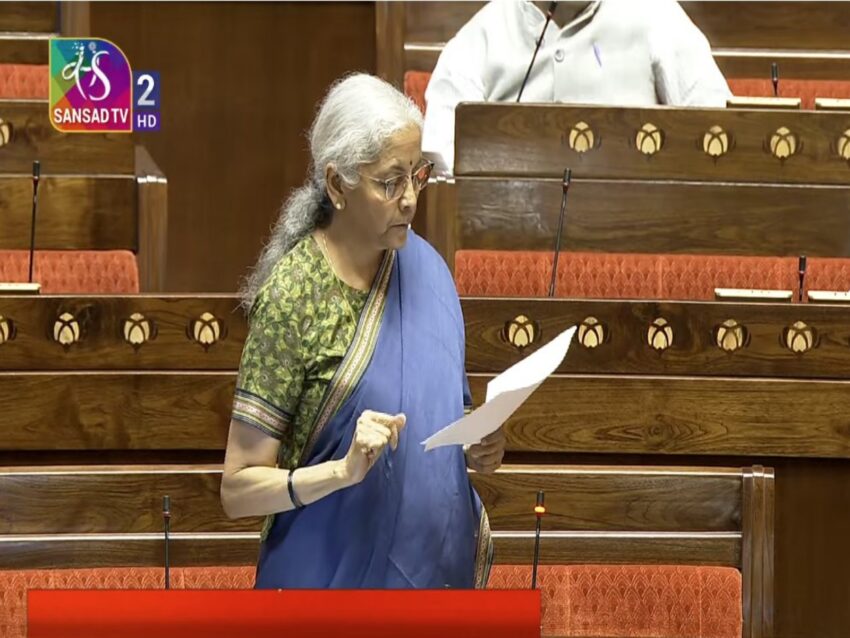
New Delhi [India], March 28 (ANI): Finance Minister Nirmala Sitharaman on Friday cited the energy shortages, fuel price hike and severe austerity measures in Pakistan and some other countries of the world in the wake of West Asia crisis and said the situation across the world is not good but the BJP-led government is managing challenges in a way that citizens don’t face any difficulty.
Replying to the debate in Rajya Sabha on the Finance Bill 2026 and the Appropriation (No 2) Bill, Sitharaman said that Prime Minister Narendra Modi gave directions that there should not be any burden on the citizens of India and the government is acting accordingly.
“Globally, International Crude Oil prices, have surged from USD 70 per barrel to USD 122 per barrel. Within just one month, that’s kind of an increase. Driven by this West Asia conflict, particularly because of the disruptions in Strait of Hormuz. Brent Crude has not dropped below USD 100 since March 13. So consequently, petrol and diesel prices for consumers have gone up all over the world. By 30 to 50% in Southeast Asian nations. 30% in North America. 20% in Europe, 50% in African countries. It’s the increase. And since the last four years, after the Russia-Ukraine conflict, there’s been severe stress in terms of the oil, fertilizers, and therefore, we are carefully managing,” she said.
The Minister pointed to the curbs and price hikes in Pakistan due to fuel supply challenge.
“What is happening in Pakistan? 200% hike on high octane fuel, 20% hike on petrol and diesel happened overnight. Petrol now is sold at 321 PKR a litre. Smart lockdowns announced in Sindh province, so that their fuel can be conserved. Restricting movement, gatherings and public events. Schools are shut for two weeks. Government offices have moved to four day working week. Private offices told to shift 50% staff to work from home. We’re not doing any of it,” she said.
“Still some leaders are spreading rumours that there will be lockdown. This rumour mongering should not happen. It’s being done to spread fear. Markets and shopping centres are ordered to be closed by 9.30 PM in Pakistan. These are all the media reports. All universities shut down and shifted to online learning in Bangladesh as there’s no electricity. Five hour rotational power cuts are happening. Implemented for domestic consumers in the city of Dhaka. Fuel station across Dhaka closed due to shortage of octane and diesel. So, the situation across the world is not good,” she added.
Sithraman said India is maintaining price stability in contrast to its neighbours.
“We’re managing in a way that our citizens don’t face any difficulty. There’s a contrast in price I want to say. In India, nothing has changed. Whereas in Pakistan, plus 20% to plus 200% price depending on petrol, diesel, high octane etc. Bangladesh has rationed stations closed, supply cut 10 to 15%. Excise duty action, we have cut Rs. 10 per litre. Neither Pakistan nor Bangladesh have responded. So, India among these neighbourhood countries is maintaining a level of stability. We’re following PM Narendra Modiji’s guidance on the same.”
She also spoke of the government announcing cut in excise duty.
“Prime Minister Narendra Modiji’s direction to us is ‘There should not be any burden on the citizens of India.’ We’re working accordingly. Our Government has issued a notification cutting petrol excise duty from Rs. 13 to Rs. 3 per litre. A reduction of Rs. 10. Diesel duty was removed entirely, dropping from Rs. 10 to 0. No waiting period, no phased rule out. It’s with immediate effect from today. The results are petrol and diesel retail prices in India remain completely unchanged. They have not increased. On the contrary, the government is taking the burden, making sure the oil marketing companies will ensure buying more and doing supply and keeping the supply uninterrupted. We are making sure that people of India don’t suffer,” she said.
Answering points raised by members, Sitharaman said that between 2014-15 to 2026-27, the overall major Cess Collections, excluding Crude oil and GST Compensation, is estimated to be Rs. 23.34 lakh crore. “The major cesses include – Agriculture & Infrastructure Development Cess, Health & Education Cess, Road and Infra Cess. Against it, the utilization is estimated to be Rs. 24.28 lakh crore. That is 104% utilization of the Cesses collected,” she said.
The Minister said nine revisions of the GDP series have happened since Independence.
“The first base year of 1948-49 was released in 1956 under Prime Minister Nehru’s Congress Government, followed by 1960-61, which was released in 1967 and the 1970-71 base year was released in 1978 under the Janata Party Government under Shri Morarji Desai. Rajiv Gandhi’s Congress Government released the 1980-81 base year series in 1988, and Shri Atal Bihari Vajpayee under the NDA Government released the new series in 1999 with base year 1993-94. Dr Manmohan Singh carried out two revisions, releasing new series in 2006 and in 2010. The current outgoing 2011-12 series was released in 2015 under Hon’ble Prime Minister Narendra Modiji and now the 2022-23 series has already been released. Every previous revision was not done to taunt the earlier governments. It happens under every government,” she said.
“In this new series, several new and improved data sources are being used to bring in granularity, accuracy and reliability of the estimates. More than 300 data sources and about 1,400 variables will be used in this GDP series. It captures informal sector information also because it now uses the Annual Survey of Unincorporated Sector Enterprises (ASUSE). Also, now we have the advantage of the GST data which shows where companies are operating and their output is assigned to the right states accurately. So, the data has now become a lot more comprehensive, a lot more vibrant and a lot more true to the time in which the data is being extracted. The PFMS real-time data actually reduces errors, avoids delays and makes GDP estimates more accurate. We are also using the e-Vahan, rail and air transport services data and fuel-related data so that we are able to estimate better value for the goods and services,” she added.
Taking potshots at opposition members, she said it is ironic that Sanjay Yadav, a member of the RJD, talks about diminishing public sector employment opportunities, when his own party is infamous for the “land-for-jobs” recruitment scam in railways.
“Far from it, our Government has always championed merit-based, timely and transparent recruitment. It is noteworthy that the Ministry of Railways had already published the Annual Recruitment Calendar for Group-C posts 2025-26 well in advance, ensuring certainty in the recruitment process for the entire year. Under the leadership of Prime Minister Narendra Modi, 18 Rozgar Melas have been successfully conducted, in a completely transparent manner, since October 2022, resulting in the issuance of over 11 lakh appointment letters,” she said.
The Finance Bill and the Appropriation Bill was passed by Rajya Sabha. The bills were earlier passed by Lok Sabha. (ANI)