

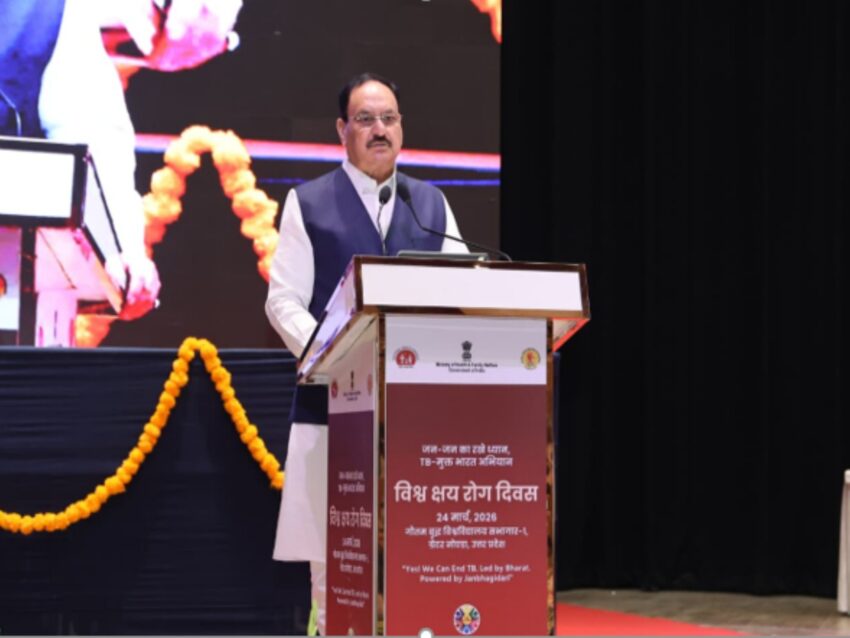
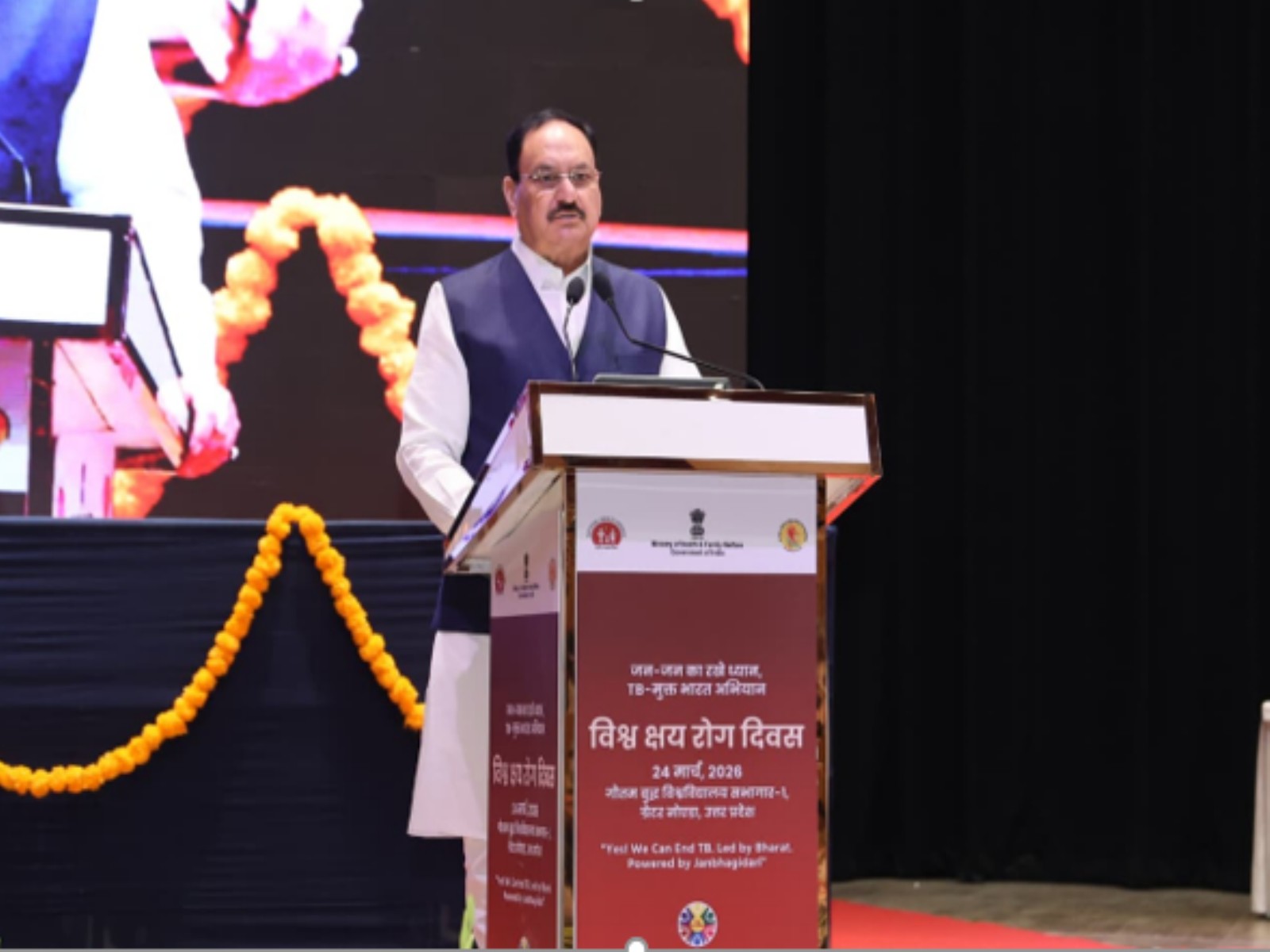
New Delhi [India], March 24 (ANI): Union Minister for Health and Family Welfare Jagat Prakash Nadda, commemorated World TB Day 2026 at a national-level event held in Greater Noida, reaffirming India’s unwavering commitment to eliminating tuberculosis (TB), ahead of the global Sustainable Development Goals target.
The occasion underscored India’s sustained, multi-pronged efforts to combat TB through strengthened public health systems, enhanced community participation, and adoption of innovative, technology-driven interventions, a release said.
Observed annually on 24th March, World TB Day serves as a global call to action to accelerate efforts to end tuberculosis, one of the world’s deadliest infectious diseases. The theme for this year, “Yes! We Can End TB!”, reflects renewed optimism, collective resolve, and intensified action at all levels to achieve a TB-free world, while reinforcing India’s leadership in driving a comprehensive and mission-mode approach towards TB elimination, the release said.
In his remarks, Nadda described World TB Day 2026 as both a moment of reflection and a renewed call to action in India’s journey towards a TB-Mukt Bharat.
He highlighted that over the past decade, India’s TB response has evolved into a transformational, people-centric movement, driven by innovation, equity, and strong political commitment.
Recalling the vision of the Prime Minister Narendra Modi, Nadda emphasized the role of Jan Bhagidari, noting that TB elimination has transitioned from a Whole-of-government approach to a whole-of-society movement, where communities are active partners. This shift, he stated, has significantly accelerated progress and strengthened ownership at all levels.
Highlighting key achievements, the Minister noted that India has achieved a 21% reduction in TB incidence and a 25% decline in TB mortality over the past decade–both outpacing global averages. Treatment coverage has reached 92%, while undetected cases have sharply declined from over 10 lakhs annually to less than one lakh, reflecting intensified case-finding efforts.
Emphasizing evidence-based policymaking, Nadda noted that nearly 50% of TB patients do not present typical symptoms, prompting a shift towards symptom-agnostic screening.
Under the intensified TB Mukt Bharat Abhiyaan initially in 347 districts and later scaled nationwide, advanced tools such as portable X-rays, AI-enabled diagnostics, and molecular testing have been deployed. He also informed that since the commencement of the campaign in December 2024, over 20 crore vulnerable individuals have been screened, leading to the detection of 32.65 lakh TB patients across the country.
Underscoring a critical milestone, the Minister noted that this included nearly 10.9 lakh asymptomatic patients who exhibited no classical symptoms at the time of testing.
He described this as one of the most consequential advances in India’s TB elimination strategy, as it reflects the programme’s success in identifying the “invisible” pool of infection that would otherwise have remained undetected and contributed to continued transmission in the community.
Announcing the next phase, Union Health Minister launched the focused and intensified 100-day TB Mukt Bharat campaign, marking a decisive, mission-mode push to accelerate progress towards TB elimination. The campaign will cover 1.58 lakh villages and urban wards, each guided by granular, locally tailored micro-plans, ensuring precision in implementation and measurable outcomes. With a sharp focus on vulnerable populations, including the urban poor, tribal communities, and migrant groups, the initiative aims to bridge last-mile gaps, enhance early detection, and ensure equitable access to TB services, significantly strengthening India’s on-ground response.
Highlighting treatment advancements, Nadda noted that the BPaLM regimen for drug-resistant TB has reduced treatment duration from 20 months to six months, significantly improving adherence and outcomes.
On the digital front, the Union Minister launched the TB Mukt Bharat App, featuring “Khushi”, an AI-enabled, multilingual chatbot designed for accessibility even on entry-level smartphones. The platform provides real-time guidance on symptoms, entitlements, and nearest diagnostic facilities, thereby bridging the critical gap between symptom onset and timely care-seeking.
Highlighting increased investments, Nadda stated that Government funding for TB elimination has grown ten-fold from ₹640 crore in 2015-16 to ₹6,356 crore in 2025-26, driving advancements in diagnostics, treatment, research, and social support. He also acknowledged the leadership of the Indian Council of Medical Research (ICMR), which has emerged as a global leader in TB research, with innovations such as the WHO-endorsed TrueNat molecular diagnostic platform transforming TB detection both in India and globally.
Underscoring the importance of convergence, the Minister also noted that this shift from a government programme to a national movement has changed the trajectory of India’s fight against TB, with over 24-line ministries, over 30,000 elected representatives and over 7.16 lakh Ni-kshay Mitras from various walks of life supporting TB elimination efforts.
Addressing stigma, Nadda emphasized that TB elimination requires both medical and social action, reiterating that TB is preventable and curable, and early treatment reduces transmission while community support remains critical. (ANI)