

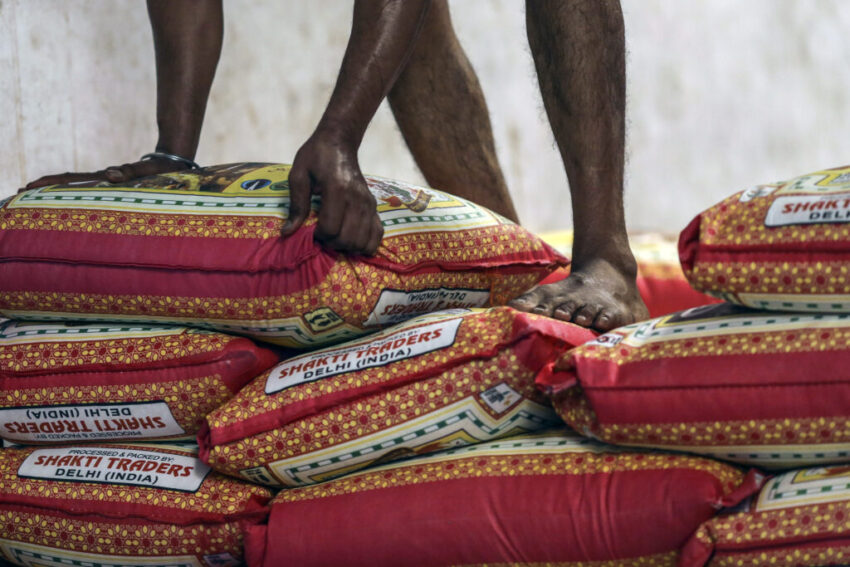
December 9, 2025 – (Bloomberg) –President Donald Trump signaled he could impose fresh tariffs on agricultural products, including Canadian fertilizer and Indian rice, the latest sign that protracted negotiations with two US trading partners could drag on.

Trump spoke Monday (December 8, 2025) at a White House event to announce billions in new aid for US farmers, some of whom said cheaper imports were making it difficult for their products to compete in the marketplace.
The president said he would “take care” of alleged dumping of Indian rice into the US. Some farmers have blamed imports for falling rice prices, saying countries such as India, Vietnam and Thailand are undercutting their crops.
“They shouldn’t be dumping,” Trump said. “I mean, I heard that, I heard that from others. You can’t do that.”
ADVERTISEMENT

India is the world’s largest rice exporter – expected to sell about 25 million tons this season – with much of it heading to nations in Asia and Africa. Global rice prices have been under pressure this year as production stays near a record and major buyer Indonesia seeks to limit purchases.
The US sells more rice abroad than it brings in, while the nation’s purchases so far this year are led by imports from Thailand, followed by India, according to US Department of Agriculture data.
India’s Ministry of Commerce and Industry didn’t immediately respond to a request for comment. The Indian Rice Exporters Federation said in a statement that exports to the US remain demand-led, with major American producers not growing a similar crop to Indian basmati.
“While the US is an important destination, India’s rice exports are well-diversified across global markets,” it added. India exported 274,213 tons of basmati rice and 61,341 tons of non-basmati varieties to the US in the fiscal year ended March 31, the group said.
Trump similarly suggested he could target fertilizer imported from Canada to boost domestic production.
“A lot of it does come in from Canada, and so we’ll end up putting very severe tariffs on that, if we have to, because that’s the way you want to bolster here,” Trump said. “And we can do it here. We can all do that here.”
The US president is facing mounting pressure to address high consumer prices and persistent inflation, which has created voter dissatisfaction that poses a political risk for Republicans heading into next year’s midterm elections. That includes gripes from farmers, a reliable pro-Trump constituency that has nonetheless struggled in part due to market factors including the president’s tariff regime.
Tariffs on fertilizers largely sourced from abroad could renew concerns from American farmers, who have grappled with rising input costs in recent years. Canada is the US’s biggest supplier of potash.
Shipments from the country have so far been minimally affected thanks to a tariff carveout for goods included in the North American trade agreement. But the addition of any fees would be on top of the hurdles that farmers have already faced with phosphate, another key crop input that is largely imported.
Both fertilizers were added to the US’s list of critical minerals in November, a move that farmers hoped would protect global trade flows and support domestic output.
Both Canada and India have sought trade agreements to stabilize their trading relationships with the US, though negotiators have struggled to strike deals. Trump slapped 50% tariffs on Indian goods in August to penalize it for its trade barriers and purchases of Russian oil. A team of US officials is set to visit India this week to continue talks, though a breakthrough agreement to lower the tariffs is not expected.
Trump has previously threatened to increase tariffs on Canadian products by 10% in response to an advertisement by the province of Ontario that is critical of his trade agenda, which would have increased the country’s tariff rate on goods not covered by the USMCA trade deal to 45%. In recent days, Trump has also suggested letting that trilateral deal lapse.