

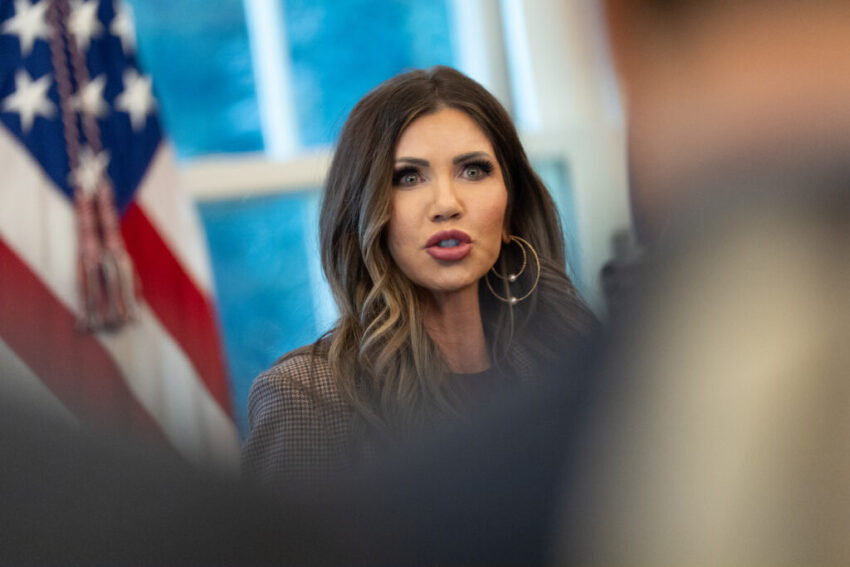

President Donald Trump on Thursday (December 18, 2025) ordered the suspension of the U.S. green-card lottery program that authorities said was used to gain entrance to the United States by the gunman in the recent shootings at Brown University and at the home of a Massachusetts Institute of Technology professor, Homeland Security Secretary Kristi L. Noem said.
Two students were killed and nine others injured at Brown University on Dec. 13 when a man opened fire inside an engineering building. Two days later, Nuno Loureiro, 47, a professor of nuclear science and engineering, and of physics, was found shot dead at his home in Brookline, Massachusetts, about 40 miles from Brown. The same gunman was responsible for the two incidents, authorities said.
The Diversity Immigrant Visa program, known as DV1, allows up to 50,000 people a year from countries with a low immigration rate to the U.S. to apply to come to the United States. The shooter, 48-year-old Claudio Manuel Neves Valente, entered the U.S. in 2017 through that program, according to law enforcement authorities.
“This heinous individual should never have been allowed in our country,” Noem said in a social media post that announced the decision.
ADVERTISEMENT

At Trump’s direction, Noem said she ordered U.S. Citizenship and Immigration Services to immediately “pause” the program.
The Department of Homeland Security did not immediately respond to questions about why Noem believed Valente should not have been admitted. His entry to the U.S. under that program occurred during Trump’s first term.
Trump unsuccessfully urged Congress to terminate the visa lottery in 2017 after another recipient, Sayfullo Saipov of Uzbekistan, carried out an Islamic State-inspired attack in Lower Manhattan that killed eight people and injured 18 others. Saipov was convicted and sentenced to life in prison.
Authorities said they did not know what had motivated the gunman in the recent shootings at Brown University and Brookline. But Valente and Loureiro had attended the same academic program in Portugal, Leah Foley, the U.S. attorney for the District of Massachusetts told reporters.
Valente was living in Miami before he came to Boston last month, authorities said.
The Trump administration has also sought to crack down on immigration following an attack in Washington, D.C., last month, in which an Afghan immigrant opened fire on two National Guard members, killing one and wounding the other.
The man charged with shooting the two Guard members, Rahmanullah Lakanwal, arrived in the U.S. through Operation Allies Welcome, a Biden-era program that helped resettle Afghan nationals after the U.S. military withdrawal from Afghanistan in 2021. He was granted asylum earlier this year.
Noem and other senior Trump officials have claimed that Lakanwal was never vetted before being allowed into the U.S., but people with direct knowledge of the case told The Washington Post last month that he underwent thorough vetting by counterterrorism authorities before entering the country.
The shooting brought immediate scrutiny to Operation Allies Welcome and other immigration programs, and Trump subsequently announced plans for a full review of those admitted.
The administration paused immigration applications from 19 countries it deemed high risk, halted asylum cases processed by U.S. Citizenship and Immigration Services and suspended all immigration-related requests from Afghan nationals, before further expanding its travel ban this week.
The expansion of the travel ban, which has increased the number of countries whose citizens face a full or partial travel ban on entry to the U.S. from 19 to 39, takes effect on Jan. 1.
The expansion will ban citizens from five additional countries, including South Sudan and Syria, and it partially restricts the entry of people from 15 more countries, including Nigeria. Citizens of Laos and Sierra Leone, who previously faced a partial ban on U.S. entry, now face a complete ban.