

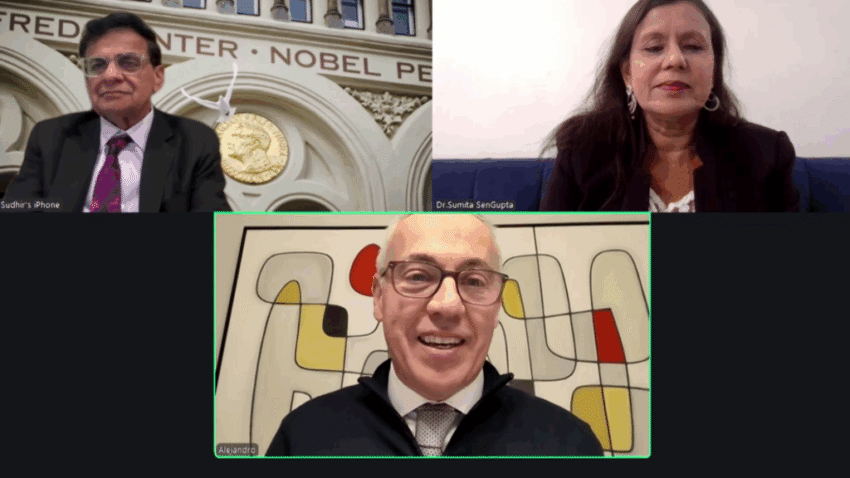
Dr. Alejandro Gonzalez Della Valle, a New York City-based surgeon is an expert in reconstructive surgery of the hip and the knee, including hip and knee replacements as well as joint reserving procedures (arthroscopy). He was interviewed recently on ITV Gold, a part of Parikh Worldwide Media.

He has surgically treated more than 10,000 patients with numerous hip and knee conditions ranging from straightforward procedures to complex revision surgery of hip and knee replacements. He encourages his patients to go back to being active, practicing sports, traveling and enjoying their professional and leisure time after surgery, says the biography of him on the HSS website. In so doing, Dr. Gonzalez Della Valle combines classic concepts of joint replacement surgery with the newest techniques, technologies and materials, and adapts the surgery to meet each patient’s realistic demands.
He has a robust body of research, which includes over 250 peer reviewed publications and book chapters authored by him. In addition, he serves as Chief of the Hip Service and is a member of The Hip Society and The Knee Society.
Stories from his patients, also available on the HSS website, tell of how they were able to get back to normal or even better lives and were active and “back in the game.”
ADVERTISEMENT

During his recent interivew on ITV Gold, he was accompanied by Chairman of the company, also a physician, Padma Shri recipient Dr. Sudhir Parikh who recently underwent surgery at HHS by none other than Dr. Gonzalez Della Valle.
Dr. Sumita Sen Gupta, founder of Arts4All Foundation, talked to Dr. Ganzalez Della Valle and Dr. Sudhir Parikh at the interview which is available on YouTube @https://www.youtube.com/@itvgold/videos
Dr. Parikh welcomed Dr. Gonzalez Della Valle and described the various publications as well as the philanthropic work he was able to accomplish through his media enterprise, especially the younger generation. Dr. Parikh underwent his own surgery at the Hospital for Special Surgery in the hands of Dr. Gonzalez Della Valle, two months ago. He was back on his feet three weeks ago, he said.
“You are a great surgeon,” said Dr. Parikh, noting that on Thanksgiving Day, he wanted to thank Dr. Alajandro Gonzales Della Valle for his talent and humanity.
Dr. SenGupta said the best thing about HSS was to “treat the whole you,” and not just the affected part.
Dr. Gonzalez Della Valle wished everyone a Happy Thanksgiving, and noted that Dr. Parikh’s recovery was because of his own hard work to recover as well as the great team that he had at HHS. “Everybody from the person who greets you to the person who is going to be your nurse, physical therapist,” etc. people who do a “tremendous job” with the operation. Typically, it is 5 to 6 people working on a patient.

Responding to Dr. SenGupta’s query on how things have changed over the many years of practice in the field of knee and hip surgery, Dr. Gonzalez Della Valle said, “So much has changed.”
“I trained in Argentina. Our joint replacement patients used to have to stay 5 to 6 days in the hospital. Now it is generally a one-hour surgery and the patient can go back home the same day or at most the next morning.”
In addition, surgical time is now one hour generally instead of 2 hours. Blood transfusion likelihood was 25 percent and now just 2 percent. Epidural anesthesia is now so well developed. The likelihood of administering blood transfusion has dropped dramatically, he indicated.
Major advancements have been made in relation to pain control, Dr. Gonzalez Della Valle said. Used to be that pain medication was given to a knee replacement patient for two to three months, and now typically, it is for two to three weeks.
Asked by Dr. SenGupta to elaborate on the quality of medications used and the research done behind what is selected to be used, Dr. Gonzalez Della Valle noted that the prosthetic devices implanted are typically made of metal, ceramics and plastic. Years ago, there were serious concerns about the likelihood of that plastic wearing out throughout the life of the patient. Intuitively, the more active a patient was the faster the plastic would wear out, he said. Not so any more. Companies are making the plastics harder and more resilient. Twenty years ago, a young person undergoing hip replacement, would be advised not to walk much or do exercise. “Whereas now, patients are advised to participate in a large number of sports,” Dr. Gonzalez Della Valle said.

On his advice that a patient needs to find the right surgeon, Dr. Gonzalez Della Valle said he was biased because he loved HSS. However, while the technical capabilities the hospital are enormous, “The outcomes that patients feel, are, without any question, substantially driven by human-to-human interaction. And the type of culture that the hospital has—everbody that interacts with you wants you to do great, and he or she will do their best for you to do great. And that’s the type of environment that HSS has.”
That culture, he indicated, drives physicians to practice at the highest levels possible.

Dr. Parikh endorsed what Dr. Alejandro Della Valle said, noting that he had been following HSS over the last 25 years, especially when a former Indian Prime Minister had a knee A replacement there. “So, I know that hospital, and also, from my personal experience.”
Currently, Dr. Parikh is the President of the Global Association of Physicians of Indian Origin, and he said he was going to invite Dr. Gonzalez Della Valle to give the Keynote speech at the next global meeting of GAPIO. “Whatever I say is not enough, I thank you very much,” Dr. Parikh said.
Dr. Gonzalez Della Valle thanked Dr. Parikh for his “wonderful words”, adding, “On the other hand, if a patient comes with a very positive attitude, it is very important to the success of the operation,” and he complimented Dr. Parikh for being such a patient.