


PHOTO: Menaka Tripathi
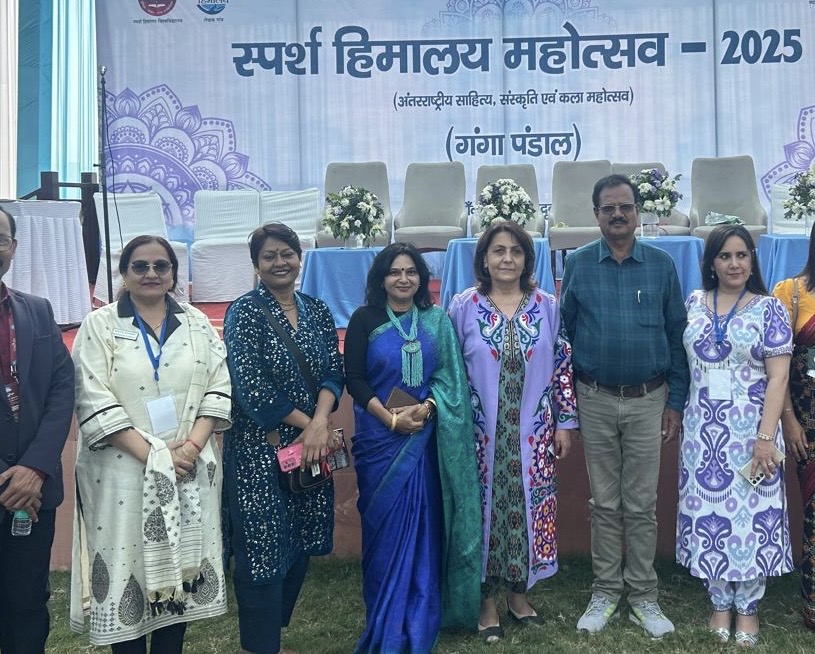
Attended by delegates from more than 60 countries, the 3 day Sparsh Himalaya Festival 2025, organized by Sparsh Himalaya Foundation, was held last month at the Lekhak Gaon in Dehradun, India.
Aiming to promote India as a soft power internationally through celebrating art and cultural heritage, the festival encouraged people to connect with nature and engage in preserving Himalayan culture and environment while building a strong Uttarakhand on the pillars of education, innovation, cleanliness, self employment, Ayurveda and Yoga.
Inaugurating it, the former Union Education Minister and former Chief Minister of Uttarakhand, Dr. Ramesh Pokhriyal ‘Nishank’, said that the event also marked the 25th anniversary of the formation of the state of Uttarakhand. The festival was a definite step towards realizing former Prime Minister Atal Bihari Vajpayee’s dream of a Writer’s Village to develop creativity, culture and education, he said.
Special Guests – Special invitees included former President of Mauritius Prithvirajsing Roopun, Head of Juna Akhada and spiritual leader Paramhans Acharya Avdheshanand Giri Maharaj, well-known environmentalist Dr.Anil Joshi, Patanjali University Vice-Chancellor and Patanjali Ayurveda Managing Director Acharya Balkrishna, Chairman Dr. Anil Sahasrabudhe of National Assessment and Accreditation Council, Member of Parliament Somveer from Bali, Indonesia. Former President Roopun and his wife were honored for actively working to spread Hindi in Mauritius.
ADVERTISEMENT

Among special guests from abroad were Charles Thomson from Australia, Atila Kothalawala from Sri Lanka, Javed Kholov from Tajikistan, Kapil Kumar from Belgium, Dr. Rishikesh Mishra from Japan, and Dr. Savita Tiwari from Mauritius.

PHOTO: sparshhimalaya.org
The Program – The festival included discussions, deliberations, and the launch of numerous books by renowned writers, facilitating exchange of literary ideas and giving writers an opportunity to present their works on a public platform.
There were special sessions on spreading Hindi language and literature abroad and discussions on young writers and creativity in the digital age. Traditional music, dance, drama, cultural performances, and discussions on nature, spirituality, and human values were part of the program.
Promoting Hindi Abroad – A discussion session on The Role of Language, Literature, and Diaspora Consciousness in India’s Cultural Renaissance was the special feature of the festival. Moderated by Dr. Sushil Upadhyay who shared his experience of facing challenges of teaching Hindi abroad, the session was chaired by founder of the Global Hindi Family Anil Joshi, with promoter of Indian culture in Australia Charles Thomson as the chief guest.

PHOTO: Menaka Tripathi
Speakers highlighted the importance of promoting Hindi and cultural traditions by the Indian Diaspora abroad to safeguard the future of Hindi language. Baburao Desai, Dr. Jayantkar Sharma, and Dr. Madhu Khanna shared thoughts on the roots of Indian languages and literature mirroring life.
Dr. Atela from Sri Lanka spoke about spreading of Hindi in South Asia. Saltanat Rahmatullah from Tajikistan spoke about the cultural similarities between Russian and Hindi languages. Javed Kholov from Central Asia discussed the cultural role of the Indian Diaspora.
A special virtual session delved deeply on challenges in teaching Hindi abroad. Attended by more than 100 representatives from different countries, it was moderated by Dr. Vivek Mani Tripathi from China and coordinated by Dr. Shipra Shilpi Saxena from Germany. The session was chaired by Prof. Pushpita Awasthi from the Netherlands, with Prof. Mridul Kirti from Singapore as chief guest.
During the session, Dr. Simmi Kumari from Oman spoke about the spread of Indian culture and Hindi. Other speakers included Dr. Meera Singh, Kavita Vachaknavi, Annada Patni and Neelam Jain from the US, Rama Sharma and Dr. Rishikesh Mishra from Japan, Dr. Bhavana Kunwar from Australia, Shalini Verma from Qatar, Dr. Mansi Sharma from Doha, Dr. Savita Tiwari from Mauritius and Suresh Chandra Shukla from Norway.
A report on their findings and experiences, ideas, and solutions to the challenges faced by scholars from various countries will be published after the festival.
There were other sessions on fiction and non-fiction Hindi literature, honoring expatriate Indian writers and teachers. Cultural program included drama, music, and dance performances, along with Himalaya cuisine.