

I’d been waiting to get my hands on “Good Things” for months. When it finally arrived, I decided I’d set the book down on its spine and make the first thing its pages opened up to. It was a sunny, early fall day, so I was hoping to put together a crunchy salad with a bright dressing – the book contains loads of those – or maybe a creamy dip for crusty bread and vegetables. But that day, the book opened to Page 337 and its recipe for Slow-Cooked Salmon.

I have cooked salmon so many times, fast and slow, hot and low, that I was at first a tad disappointed. Then, I started reading. Author Samin Nosrat wrote about working as a cook in Italy in 2003. Lonely and adrift, she decided to start a food blog called Ciao Samin. Years went by, she returned to California, and she kept cooking and blogging.
“Out of curiosity, I’d occasionally browse the list of search terms that regularly brought readers to my little-known corner of the internet,” Nosrat wrote. “At some point, I noticed a strange pattern. Some of the most common phrases were ‘How to Cook Samin,’ ‘Samin Recipe,’ and my favorite, ‘Wild Samin.’ I couldn’t make any sense of it. Why were there worldwide queries for my recipes and thoughts on how to cook, when I was just another twentysomething line cook? How did people hear about me? And why on earth did all those people think I was so wild?”
Nosrat eventually realized that people weren’t actually seeking her culinary expertise. They were misspelling salmon. “There was nothing to do but laugh and tell my friends about it,” she wrote.
ADVERTISEMENT

It wasn’t until she published “Salt, Fat, Acid, Heat” that she decided to finally give her adoring public the salmon recipe they were looking for. That salmon, set on a bed of herbs or fig leaves and cooked low and slow, is how she has long preferred the pink-fleshed fish. For “Good Things,” she struggled to come up with something new. The trouble is, as she wrote, “I only ever want to eat salmon that’s cooked gently until its flesh is tender but still translucent. I want to feel the distinct pleasure of letting flakes of the rich, buttery fish melt on my tongue.”
While doing research for another project, Nosrat stumbled upon the ancient Greek poet and gastronomist Archestratus’s recipe for tuna: “But here is the very best way for you to deal with this fish. You need fig leaves and oregano (not very much), no cheese, no nonsense. Just wrap it up nicely in fig leaves fastened with string, then hide it under hot ashes and keep a watch on the time: Don’t overcook it.”
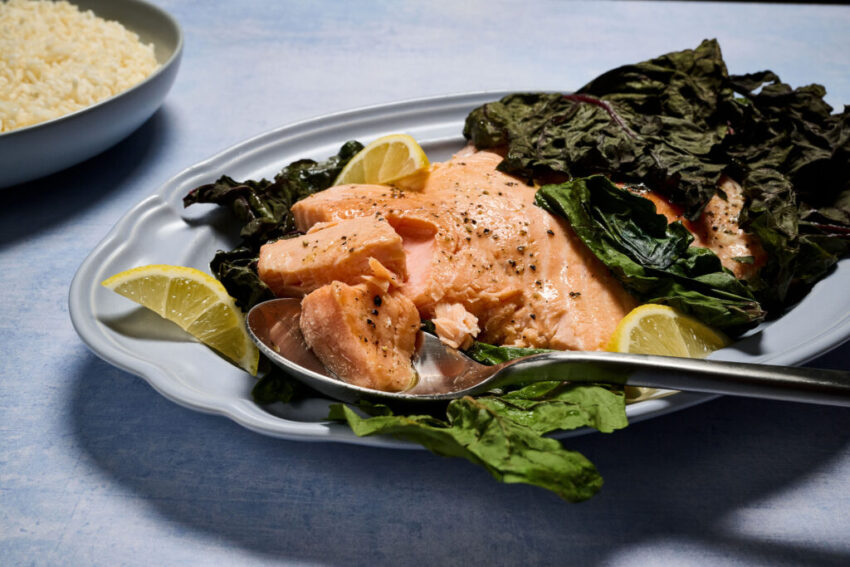
It was a sign. Yes, Archestratus was writing about tuna, not salmon, but otherwise here was a recipe that held true for some 2,300 years. Nosrat decided against trying to improve it for her new book. Instead, she suggests easy-to-find leaves with which to wrap the fish; we’re using Swiss chard here, though if you have access to a fig or banana tree, those large leaves work well, too. She also offers a variety of ways to serve the perfectly tender, marvelously buttery hunks of fish that result: “Garnish with green sauce, garlic and herb [labneh], Meyer lemon relish, house dressing, or a shower of fresh herbs.”
Since she wrote “Good Things,” Nosrat told me, she has enjoyed serving the salmon “warm or at room temperature, with boiled potatoes, jammy eggs, Little Gem leaves, house dressing and a big bowl of aioli and any other Niçoise salad fixings I can find, depending on the season.”
That sounds fantastic to me. Whatever you do, Nosrat advises us to look for high-quality fish. She refers to the Monterey Bay Aquarium’s Seafood Watch guide, and prefers to buy wild Alaskan Chinook (a.k.a. king) salmon. Sockeye is another good choice. (Bonus: This method works on other fish, too.)
Then, take your time in cooking it. If you’ve never made salmon this way, you’re in for a treat. The gentle heat transforms the fish into something so lush that accompaniments almost don’t matter. Thanks to “Good Things,” I may never again think about wild salmon without thinking about Wild Samin.
– – –
Slow-Cooked Salmon

Baking salmon low and slow results in fantastically tender fish that’s good hot, at room temperature or cold. In this recipe, adapted from Samin Nosrat’s “Good Things,” you’ll wrap salmon in Swiss chard leaves, and bake it at 225 degrees until it flakes but is still somewhat translucent – proof that gentle cooking maintains the fish’s optimal texture. Serve the salmon simply as is, with rice or a salad on the side. Or dress it up with a vinaigrette or other sauce.
Active time: 10 minutes. Total time: 1 hour
Servings: 4-6
Storage: Refrigerate for up to 2 days.
INGREDIENTS
One (1-pound) fresh skinless salmon fillet, preferably Chinook/king, center-cut, pin bones removed, patted dry
1/4 teaspoon fine salt
1/4 teaspoon freshly ground black pepper
4 to 6 Swiss chard leaves, stems removed
3 tablespoons extra-virgin olive oil
Lemon wedges, for serving (optional)
DIRECTIONS|
Position a rack in the middle of the oven and preheat to 225 degrees.
Season the salmon on both sides with the salt and pepper. Arrange the chard leaves on a large sheet pan so they overlap. Place the salmon in the center of the leaves, and pour the oil over the fish, using your hands to coat it all over.
Very loosely wrap the chard leaves around the salmon, folding and creasing them so they stay in place. The leaves don’t need to fully cover the fish. (You may have more leaves than you need, depending on how large they are. This is fine.)
Transfer to the oven, and cook for 40 to 45 minutes, or until the fish begins to flake in the thickest part of the fillet when poked with a fork. Because this method is so gentle, the fish may appear translucent even though it’s cooked.
To serve, unwrap the salmon. Transfer to a serving platter, with or without the leaves, and gently tear the fish into large, rustic pieces. Serve family-style, with lemon wedges, if desired.
Substitutions
Swiss chard >> fresh fig leaves, fresh or frozen banana leaves, or bunches of tender herbs, such as parsley or cilantro.
Salmon >> cod, halibut or Arctic char.
Nutritional Facts per serving (about 1/2 cup cooked salmon), based on 6 | Calories: 200; Fat: 16 g; Saturated Fat: 2 g; Carbohydrates: 0 g; Sodium: 133 mg; Cholesterol: 45 mg; Protein: 15 g; Fiber: 0 g; Sugar: 0 g
This analysis is an estimate based on available ingredients and this preparation. It should not substitute for a dietitian’s or nutritionist’s advice.
Adapted from “Good Things” by Samin Nosrat (Random House, 2025).