


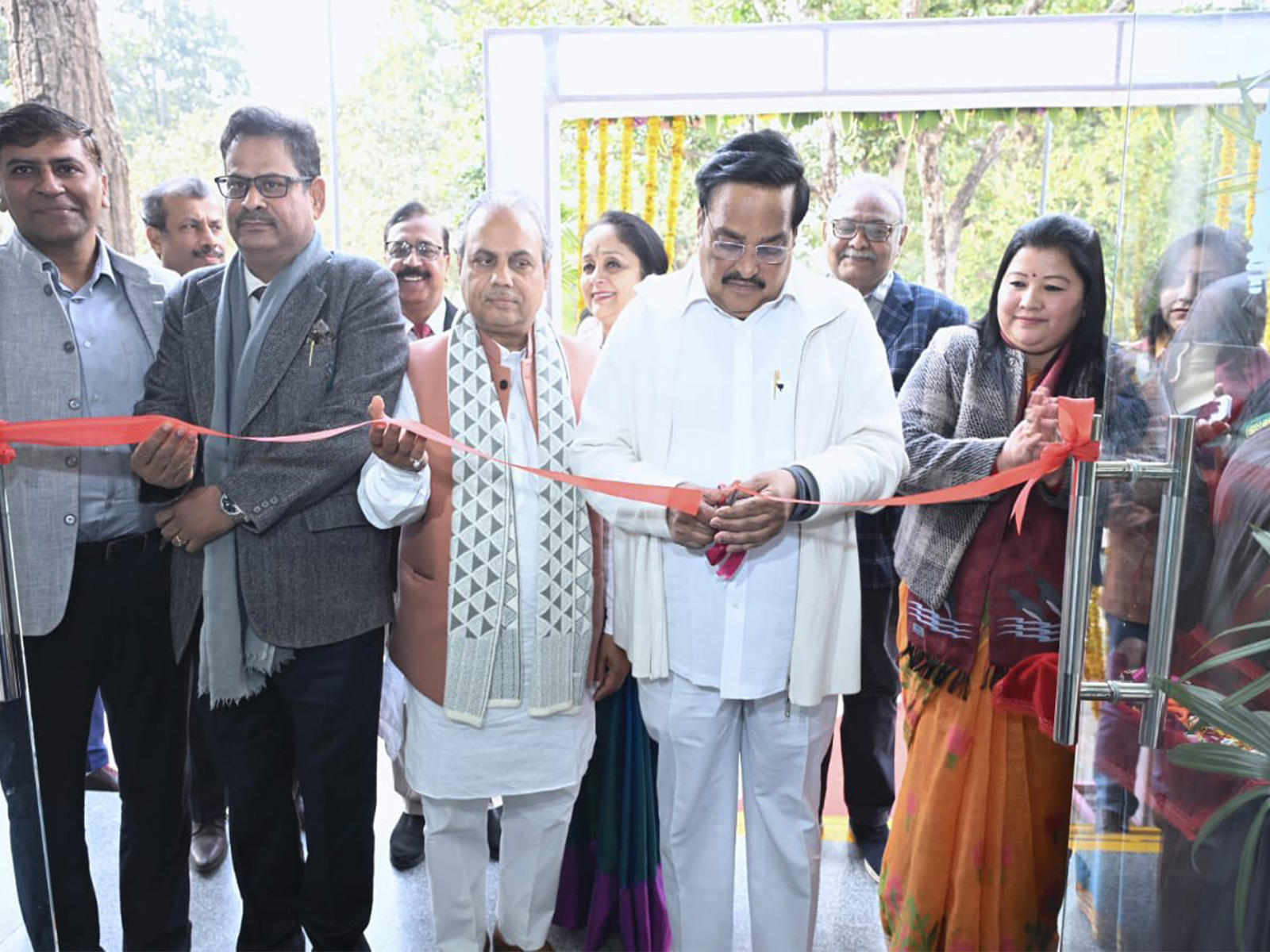
New Delhi [India], January 14 (ANI): Union Minister for Jal Shakti, C. R. Paatil, reaffirmed the Government of India’s commitment to protecting rivers not merely as channels of water, but as life-supporting ecosystems. Emphasising that the true indicator of river health lies in the thriving of aquatic biodiversity, the Minister inaugurated several significant and far-reaching initiatives under the Namami Gange Mission at the Wildlife Institute of India (WII), Dehradun. A special programme was organised on the occasion, during which Paatil launched new and advanced projects focused on river rejuvenation and aquatic life conservation.
According to an official release from the Ministry of Jal Shakti, the event was graced by Dr. Vinay Kumar Ruhella, Vice Chairman, State Disaster Management Authority, Uttarakhand; Dr. Gobind Sagar Bhardwaj, Director, Wildlife Institute of India; and Rajeev Kumar Mital, Director General, National Mission for Clean Ganga, along with senior officials, researchers, conservation experts and students.
Namami Gange program has partnered with Wildlife Institute of India to develop a dedicated centre for study, research and policy support for aquatic biodiversity conservation. The centre was inaugurated and dedicated to the nation by Minister Jal Shakti, C.R. Paatil. The ‘Aqua Life Conservation Monitoring Centre for Ganga and Other Rivers’ has been established as an organised and advanced institutional framework to monitor and conserve aquatic life in the Ganga and other rivers.
Through modern technology, scientific research and data-driven decision-making, the Centre will provide a strong foundation for monitoring, conservation and long-term protection of aquatic species. In the future, it will play a guiding role in policy formulation, research and conservation strategies. The centre has got an ecotoxicology, aquatic ecology and a spatial ecology lab for taking samples from water and species and identifying hotspots. The centre also has got a microplastic lab for the identification of microplastics in the ecosystem.
During the programme, the Dolphin Rescue Ambulance of TSAFI was inaugurated, further strengthening ongoing efforts for dolphin conservation. This ambulance will provide a rapid, sensitive and scientifically equipped life-saving response for Ganga dolphins in distress. The Minister stated that the Ganga dolphin is a sensitive indicator of river health, and this initiative reflects the government’s seriousness and responsiveness towards the protection of aquatic life. The van is a major effort of NMCG in dolphin conservation and rescue, and would go a long way in conserving India’s national aquatic animal, as per the release.
In the same sequence, C.R. Paatil interacted with researchers and MSc. Students of World Life Institute of India. Under the aegis of Namami Gange, WII has launched a two-year Master’s program in Freshwater Ecology and Conservation, training students to understand and protect India’s rivers, wetlands, and freshwater ecosystems through science, fieldwork, and policy studies, equipping future conservationists for river restoration, biodiversity, and sustainable water management. The minister complimented the students for taking up this specialised course and being dedicated to the cause of river conservation and rejuvenation.
The Union Minister carried out a plantation drive in WII and dedicated it to the ‘Ek Ped Maa Ke Naam’ campaign led by the PM. The plantation of trees is an integral component of the Namami Gange program and plays a crucial role in conserving the overall river ecosystem.
The programme also witnessed the formal launch of the Indian Skimmer Conservation Project by Bombay Natural History Society (BNHS). Through this initiative, ongoing efforts to conserve rare bird species along the riverine stretches of the Ganga have been given a structured and organised form. The project underlines that river conservation is not limited to water or aquatic species alone, but is steadily evolving towards the balanced protection of the entire river ecosystem. These species are not only indicators of river health, but also symbols of the richness of our water resources. He further emphasised that by giving equal importance to uninterrupted flow, cleanliness and biodiversity conservation, the Mission has adopted a multi-dimensional, scientific and integrated approach.
In addition, the success of the first phase of TSAFI’s Turtle Conservation Project was highlighted. The Minister remarked that turtles act as silent sentinels of river systems, and their presence indicates river cleanliness and ecological balance. The project has demonstrated that endangered species can be effectively revived through scientific reintroduction, continuous monitoring and active community participation. Under the re-wilding and population recovery component, the project achieved several national milestones. Fifteen captive-reared sub-adults of Narrow-headed Softshell Turtles (Chitra indica) were released into the middle Yamuna. Out of that, 10 turtles were tagged with radio-transmitters and monitored.
Additionally, 20 captive-bred, Red-crowned Roofed Turtles (Batagur kachuga) were tagged with acoustic transmitters and reintroduced into the Upper Ganga near Haiderpur Wetland Complex–marking the first monitored reintroduction of the species in its historic range after three decades.
Paatil also reviewed the overall outcome of the project sanctioned by NMCG to WII for biodiversity conservation in the river Ganga and expressed his satisfaction over the outcomes of the program. He also mentioned that India is now moving forward with full commitment not only towards cleaning its rivers, but also towards conserving their biodiversity, aquatic life and cultural heritage. Sustained efforts are being made to ensure that future generations inherit a healthy, balanced and life-supporting river system.
According to the release, the Minister interacted with Ganga Praharis and mentioned that with the active participation of Ganga Praharis and the younger generation, it has become evident that the future is in safe hands. Their energy, dedication and active involvement have led to remarkable progress in river conservation and cleanliness. The increasing population of over 6,000 dolphins in the Ganga stands as a strong testament to this success, indicating that our rivers are becoming cleaner and more life-sustaining. This achievement is not the result of government efforts alone, but also of Jan Bhagidari and the active participation of local communities.
The event also witnessed the launch of two publications from WII. The Minister launched a publication on the population status and conservation action plan for the critically endangered Gharial. The report presents the distribution of the Gharial in the Ganga basin. A publication on Millets for Life was released, which brings out the linking of biodiversity conservation with food and nutrition security. (ANI)