

World University Leaders Forum convenes international experts to examine the future of AI in universities

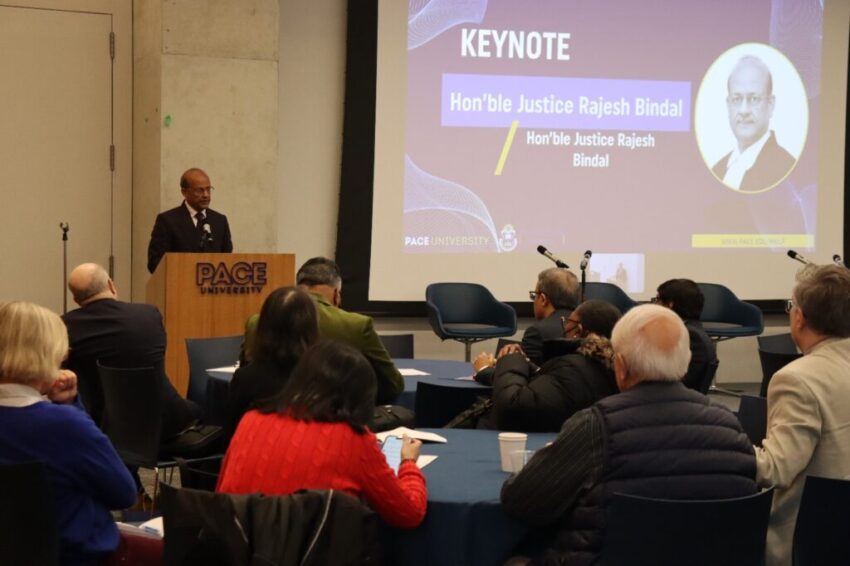
NEW YORK N.Y., March 24, 2026 –– Global leaders in higher education, policy, and technology gathered at Pace University’s New York City campus on Monday, March 23, 2026, for Intelligent Futures: The Role of Artificial Intelligence in Shaping Universities and Higher Education, a one-day international conference exploring how AI is transforming the future of universities worldwide. The event was also attended by Binaya Srikanta Pradhan, Consul General of India in New York.
The event, organized by the World University Leaders Forum (WULF) in partnership with O.P. Jindal Global University, brought together university presidents, faculty, and policymakers to explore AI’s impact on teaching, research, governance, and the student experience.
A central theme throughout the day was the growing need for ethical frameworks and responsible oversight as institutions adopt AI at scale, a press release from Pace University said.
ADVERTISEMENT

“Artificial intelligence has come to stay, and we cannot ignore it.” said Rajesh Bindal, Judge of the Supreme Court of India. “The challenge before universities is to ensure it is used responsibly, with clear policies and thoughtful governance.”
The conference featured keynote remarks, panel discussions, and the launch of the AI Governance Report 2026 from O.P. Jindal Global University, highlighting emerging global approaches to responsible AI adoption in higher education.
Interdisciplinary perspectives were explored during AI and the Humanities in Higher Education discussion, where panelists examined how AI is influencing fields such as philosophy, law, and social sciences. The discussion featured C. Raj Kumar, Vice Chancellor, O.P. Jindal Global University, Mohan Kumar, Dean, Strategic and International Initiatives, Office of the Vice Chancellor & Director General, O.P. Jindal Global University, and Tresmaine Grimes, Dean of Pace’s Dyson College of Arts and Science. The discussion was moderated by Pace University President Marvin Krislov.
“AI is fundamentally reshaping how knowledge is created, shared, and governed,” said Vice Chancellor Kumar. “Universities must lead with a global vision, developing frameworks that balance innovation with accountability while safeguarding academic integrity and public trust.”
The impact of AI on classrooms and student engagement was the focus of AI and the Transformation of Teaching and Learning, where panelists explored how intelligent technologies are redefining curriculum design, assessment, and accessibility.
The discussion featured Norman Eng, EdD, Professor of Education at Brooklyn College, Padmanabha Ramanujam, Dean of Office of Academic Governance at O.P. Jindal Global University, and Michael Wagner, professor and head of digital media department at Drexel University, and was moderated by David Sachs, professor of information systems at Pace’s Seidenberg School of Computer Science and Information Systems and co-chair of Pace University’s AI Committee.
Institutional responsibility took center stage during Governance, Ethics, and the Future of the AI-Enabled University, a panel examining data governance, regulatory considerations, and leadership accountability. The discussion featured Ashwin Fernandes, vice president at QS Quacquarelli Symonds; Ericka Watson, principal and CEO of Data Strategy Advisors, LLC; and Jim Russell, CIO and vice president for digital strategy and planning at Manhattanville University, and was moderated by Li-Chiou Chen, PhD, interim dean of Pace’s Seidenberg School of Computer Science and Information Systems.
“You can’t manage what you can’t see,” said Watson. “Institutions need clear visibility into what AI tools are being used, how they are being used, and by whom. Before you can govern AI, you need to understand your risk, what tools are in use and whether the right frameworks are in place to manage them.”
Throughout the day, speakers addressed issues including academic integrity, data governance, accessibility, and workforce transformation, highlighting both the opportunities and challenges of integrating AI into higher education.