


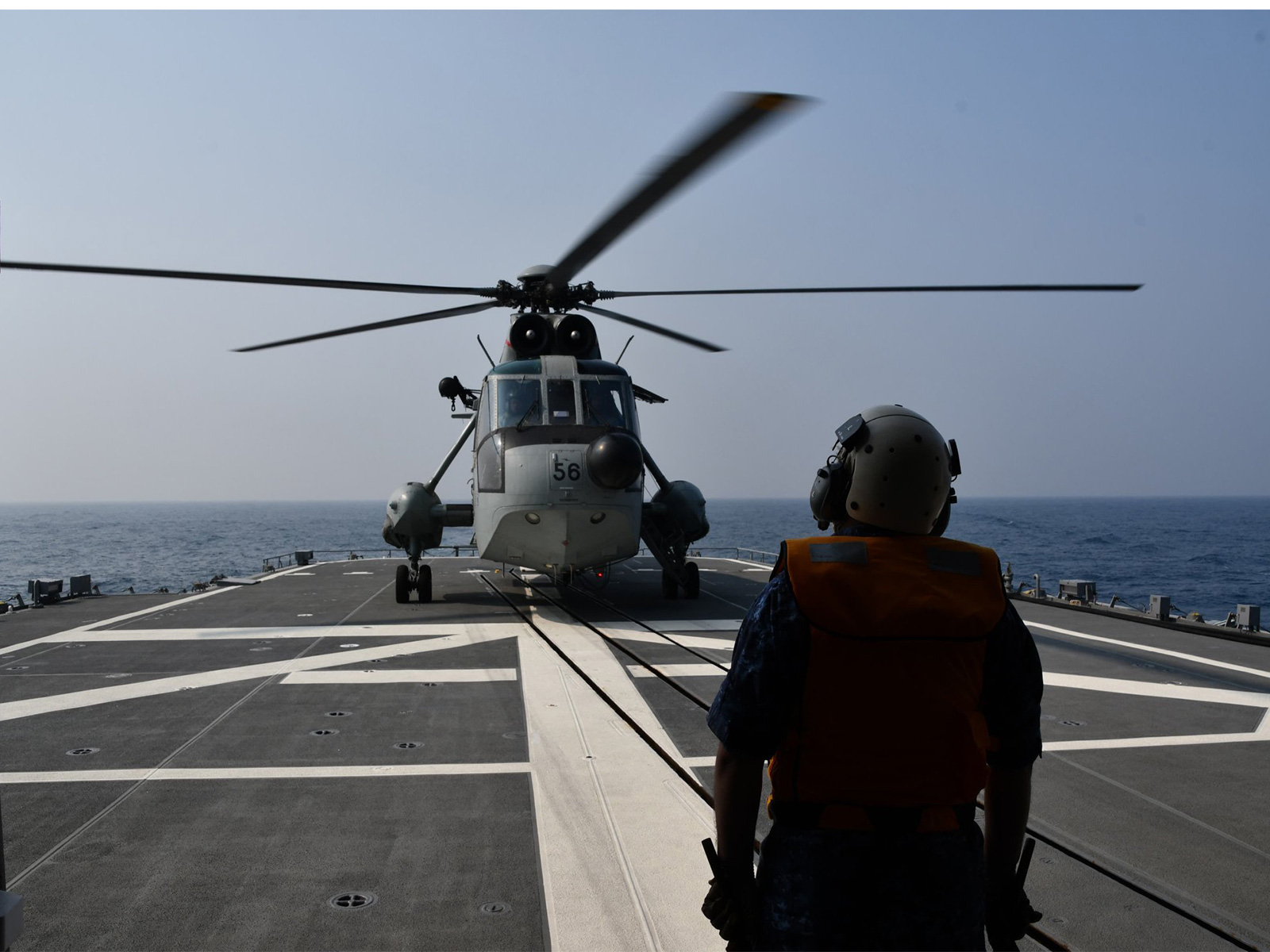
Jammu (Jammu and Kashmir) [India], February 15 (ANI): The Indian Navy acted swiftly in an operation on Saturday to save a critically-ill Japanese national’s life who was on board a ship at Visakhaptnam.
In a post on X, PRO & Spokesperson, MoD, wrote, “Responding swiftly as a #FirstResponder and trusted GlobalSecurityPartner, #IndianNavy launched a Sea King helicopter on #14Feb to evacuate a critically ill Japanese sailor from a #JMSDF ship 200 km from #Visakhapatnam. The patient was safely airlifted to @IN_Dega and shifted to Naval Hospital Kalyani for medical aid. The #MEDEVAC operation reflects strong international Maritime cooperation between India and Japan.”
India and Japan share a ‘Special Strategic and Global Partnership’.
Friendship between the two countries has a long history rooted in spiritual affinity and strong cultural and civilizational ties.
The Shichifukujin or the seven lucky Gods of Japan have their roots in Hindu traditions. An early documented direct contact with Japan was with the Todaiji Temple in Nara, where the consecration or eye-opening of the towering statue of Lord Buddha was performed by an Indian monk Bodhisena in 752 AD.
In contemporary times, prominent Indians associated with Japan were Swami Vivekananda, Nobel laureate Rabindranath Tagore, entrepreneur JRD Tata, freedom fighter Netaji Subhash Chandra Bose, Rash Behari Bose and Justice Radha Binod Pal.
The sole dissenting voice of Justice Radha Binod Pal at the War Crimes Tribunal struck a deep chord among the Japanese public, that continues to reverberate to this day.
Prime Minister Jawaharlal Nehru donated an Indian elephant to the Ueno Zoo in Tokyo in 1949 which was greatly appreciated by the Japanese people. The Japan-India Association set up in 1903 is the oldest international friendship body in Japan.
After World War-II, India did not attend the San Francisco Conference but decided to conclude a separate Peace Treaty with Japan on 28 April 1952, marking the beginning of diplomatic relations.
Since then, the relations have matured over the years to cover a wide range of areas of cooperation including political, defense and security, economic, science and technology, education, cultural and people to people exchange.
There is growing strategic convergence between the two countries. There is synergy between India’s Act-East Policy, Indo-Pacific vision based on the principle of SAGAR, and Indo-Pacific Oceans Initiative (IPOI) on one hand, and Japan’s Free and Open Indo-Pacific Vision on the other.
Japan has agreed to lead cooperation on the Connectivity pillar of IPOI. Japan has also joined India led initiatives such as International Solar Alliance (ISA), Coalition for Disaster Resilient Infrastructure (CDRI) and Leadership Group for Industry Transition (LeadIT). India and Japan are also 1cooperating under Quad framework and India-Japan-Australia Supply Chain Resilience Initiative (SCRI). (ANI)