

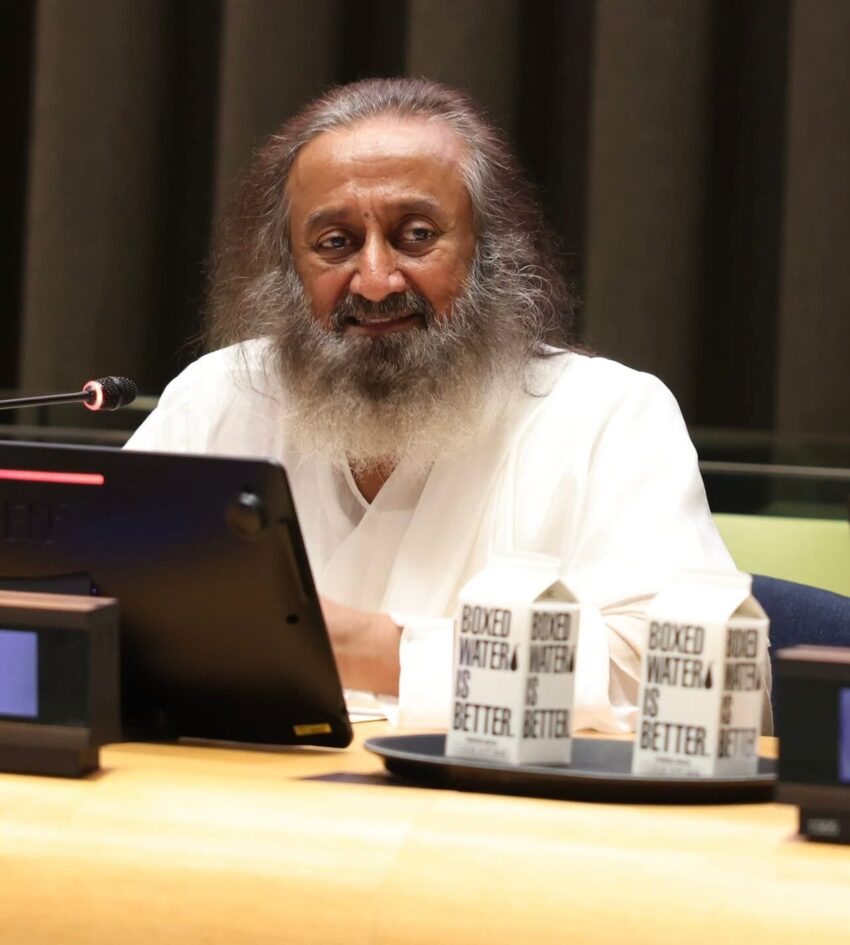

United Nations – That Meditation is important to calm the individual mind and bring inner peace which would heal and repair a world fractured by war and strife, bringing lasting world peace, was the unanimous view of scientists, spiritual leaders, scholars and diplomats at the second International Day of Meditation celebrated December 21, 2025 at the United Nations Headquarters in New York.
Organized jointly by the Permanent Missions of India, Andorra, Mexico, Nepal and Sri Lanka, the special event titled Meditation For Global Peace and Harmony, featured talks, presentations and a special session of practicing meditation led by spiritual leader, teacher and keynote speaker Sri Sri Ravi Shankar.

Speaking about meditation’s calming and healing power, Ravishankar said meditation was helping soldiers fighting a war in Ukraine reduce their stress and depression.

He said the Yoga of meditation was taught on the battlefield by Krishna to an Arjuna who was depressed by the upcoming war. He said, “Actually, meditation was taught in the war field when Lord Krishna taught Arjuna Yoga and Meditation.” Life today is no less than a battlefield, making it important for us to meditate in spite of impediments, he said.
ADVERTISEMENT

There are many stages of meditation and many techniques, Ravi Shankar said. The goal of the many techniques for meditating is to achieve unified tranquility and oneness that binds us today, he said. Breathing in and out and concentrating on it was one of the techniques of meditation, he said. It is necessary to temporarily put aside desires and anger over what has happened while meditating, he said.
“…you have to say, let me keep my desires aside. You say, I’m going to look into them later,” Ravi Shankar explained. That moment of keeping all aside is the path to meditation, he said, and then led the gathering into a short meditation session.

India’s permanent representative to the U.N., P. Harish, spoke about the U.N. General Assembly unanimously adopting the resolution last December to mark December 21 as the World Meditation Day. Harish said the UN resolution affirms India’s gift to humanity and its civilization and ethos of peace and harmony.
The U.N. resolution acknowledges that meditation transcends cultural, religious and geographical boundaries, offering a universal template of transformation, Harish said.
“Transformation within brings transformation in the external world. Indeed, inner peace brings external peace in the world outside,” Harish said.
Meditation’s roots go back more than 5000 years in ancient India, to the concept of jnana or knowledge, which is a state of pure consciousness, where the mind’s relentless, chattering subsides, giving way to clarity and calmness, he said.
Recounting the benefits of meditation, Harish said it recalibrates our mental and emotional systems and cultivates clarity, emotional intelligence and interconnectedness. The benefits of meditation have been validated by scientific research which has proved that meditation reduces stress, improves physical and mental well being, decreases depression and anxiety and heals emotional trauma, Harish said.
Nepal ’s representative, Lok Bahadur Thapa, said his country has had long affinity with the practice of meditation with the geographical landscape of his country being conducive to finding peace through meditation.

Representative of Andorra said, as a European country, Andorra understands and promotes meditation as a practical and accessible tool for human development.
Meditation is rooted into the history of Sri Lanka through Budhha’s teachings, said the representative from Sri Lanka. Meditation has benefits for mental health and physical health and its global promotion can lead to peace and harmony and health, he said.
Inner peace can lead to outer peace in the universe, contributing to world harmony which can be achieved through meditation, stated the representative of Mexico.
Yogmata Keiko Aikawa, awarded the title of Mahamandaleshwar by India, spoke about her travels to India, Tibet and China on her path to achieve Nirvana, the ultimate state of enlightenment, perfect peace and happiness, which can be achieved by anyone, she said. “Meditation guides us to true self, a state of peace and light, and experience beyond time,” she said.
Sister BK Gayatri, spiritual educator, writer and speaker, and the representative to the UN of the Brahma Kumaris Organization, spoke about belief in meditation bringing diverse people with different beliefs together for the celebration of the whole of humanity.
L.P. Bhanusharma, co-founder of Jeevan Vigyan Foundation in Nepal, spoke about providing practical education in Yoga and Meditation. Speaking about an energy field waiting to be awakened by meditation and pranayama, he said the importance of meditation is recognized by modern neuroscience.
Bhanusharma also said meditation should be practiced by leaders in the interest of world peace. “Peacebuilding, like any great habit, must be practiced daily to become second nature,” he said. “Why expect leaders to suddenly embody peace at the negotiating table without daily discipline in meditation, wellness, and returning towards shared human roots…,” he said.
Dr. Lasantha Chandana Goonetilleke, Prof of Math at Rutgers University made a presentation on Indriya Bhavana Sutta about cultivating and achieving equanimity through meditation.
Dr. John Hagelin, Physicist & International President of the Global Union of Scientists for Peace, and president emeritus of Maharishi International University, made a short presentation on evidence based solutions to crime through meditation. “There are really powerful, scientifically confirmed evidence-based approaches to relieving acute stress, practices that are meditation-based, that can remove stress and its negative effects on the brain and human behavior,” he said.
Robert Schneider, professor of Integrative Medicine and Director of the Institute for Natural Medicine and Prevention made slide presentation on the benefits of meditation.
The World Meditation Day was also celebrated at the U.N. by the Permanent Mission of Nepal, and by many organizations across the U.S. and around the world.