

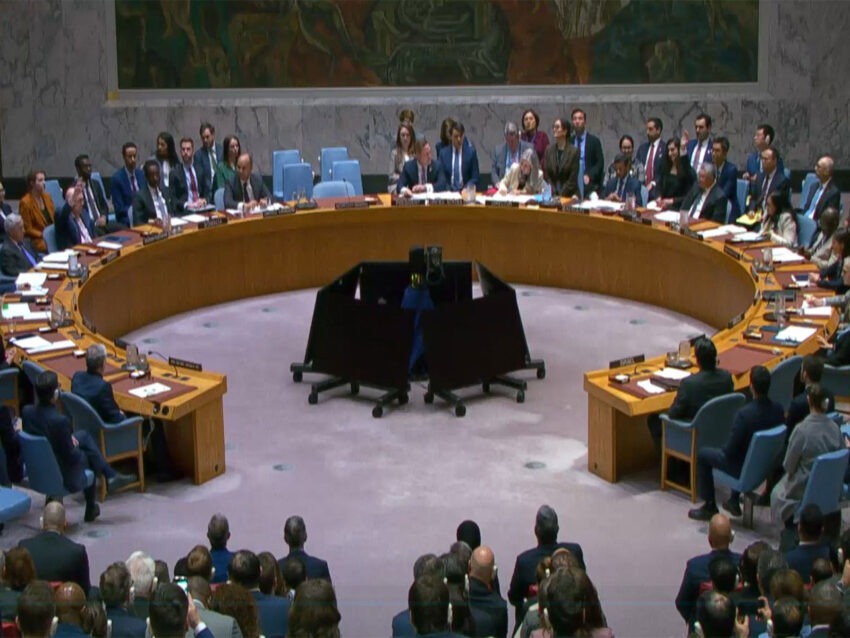

United Nations – India co-sponsored on March 11, 2026, the Security Council resolution condemning Iran’s “egregious attacks” against its regional neighbors.
Resolution 2817 (2026), co-sponsored by about 140 member states out of a total of 193 member states, was adopted after a unanimous vote by the 15-member Council with a clear vote of 13 in favor and no vote against. China and the Russian Federation were 2 members who abstained from voting or using their veto power.
The resolution condemns “in the strongest terms” Iran’s attacks against residential and civilian areas of Bahrain, Kuwait, Oman, Qatar, Saudi Arabia, the United Arab Emirates and Jordan. It also demands Iran to stop its actions, threats and provocations in the regions maritime trade.
Following that, India’s Ministry of External Affairs (MEA) issued a statement March 12, 2026, that India has co-sponsored the resolution led by the Gulf Cooperation Countries (GCC) in the interest of the safety of its Diaspora in the GCC countries. MEA spokesperson, Randhir Jaiswal, said, “The resolution reflects several of our positions, as you know, that we have a large Diaspora in the GCC countries and their well-being and welfare is of utmost importance.” “The Gulf is also very important for our energy security needs,” he said.
ADVERTISEMENT

Drafted by Bahrain, the resolution, seems to bring together nations which have historical disagreements with each other. That, and the number of member states co-sponsoring the resolution, both reflected global collective conscience, said Bahrain’s representative, Jamal Fares Alrowqaiei, pointing out that the Gulf region was important for economic stability, trade, and global security.
The representatives of the United Kingdom, Greece, Panama, Latvia and Colombia voted in favor of the resolution, along with the United States who is the Security Council President for the month of March.
France, Denmark, Liberia, the Democratic Republic of Congo and Somalia also voted for the resolution. France’s representative, Jérôme Bonnafont, voiced concerns about Iran’s nuclear threats and its support of regional proxies. Denmark’s representative, Christina Markus Lassen, pointed out the large support for the resolution in the interest of civilians. Liberia and the Democratic Republic of the Congo said the resolution was needed to stop the war and solve the situation with diplomacy, dialogue, de-escalation and respect for international law.
Although China abstained from voting for the resolution, its representative strongly suggested that both the United States and Israel launched military strikes without Council authorization and must cease their actions immediately.
Russia which also abstained from voting, presented a second draft, maintaining that the passed resolution was biased and one-sided. Russian representative, Vassily Nebenzia, said the passed resolution did not take in account the actions of Israel and the US who had also killed men, women and children in Iran.
The Security Council then voted a second time on the draft presented by the Russia. Pakistan, although it had voted in favor of the resolution, supported the second draft presented by Russia. China, Pakistan, Russia and Somalia voted in favor of Russia’s draft. The US and Latvia voted against it.
Russia’s draft did not pass as Bahrain, Colombia, Democratic Republic of the Congo, Denmark, France, Greece, Liberia, Panama and United Kingdom abstained from voting on it.
Members who abstained from voting on the second draft of Russia found it not taking in account the realities of the region.
Bahrain’s representative noted that the text of the second draft was too general. The representative of the United Kingdom, Dame Barbara Woodward, criticized Russia for hypocrisy in presenting itself as a guardian of international peace and security. France’s representative, Bonnafont, also pointed out that the second draft did not describe Iran’s responsibility in unjustified attacks against its regional neighbors who posed no threat.
The representative of the United States, Michael Waltz, accused the Russian Federation of wasting time in the second vote, knowing fully that its text would not be accepted. Latvia’s delegate described the text as deeply “cynical” text, coming from the Russian Federation which has for years been using force against civilians and civilian infrastructure in a sovereign country, just as Iran is doing now.
China’s representative expressed regret about the second draft not succeeding. Russia accused member states of short term political interests in not voting for their draft. However, it expressed a desire to contribute to the response to events in the region.
The representatives of Israel and Iran, both present at the Security Council vote, accused each other and the US. Iran’s representative accused the US of starting the war, and blamed it for obstructing efforts to end the war. Israel’s representative pointed out the grave danger of Iran’s nuclear program not being peaceful as it claimed.