

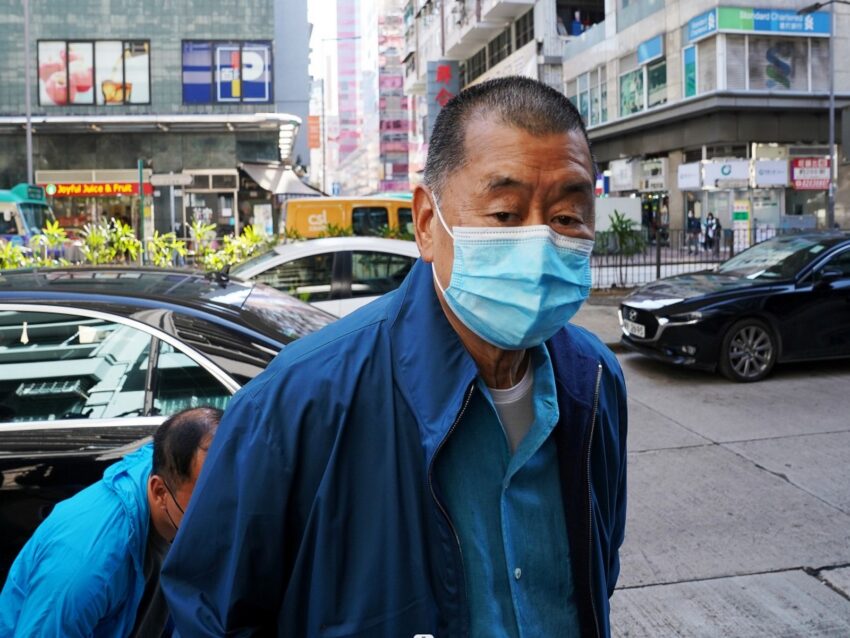
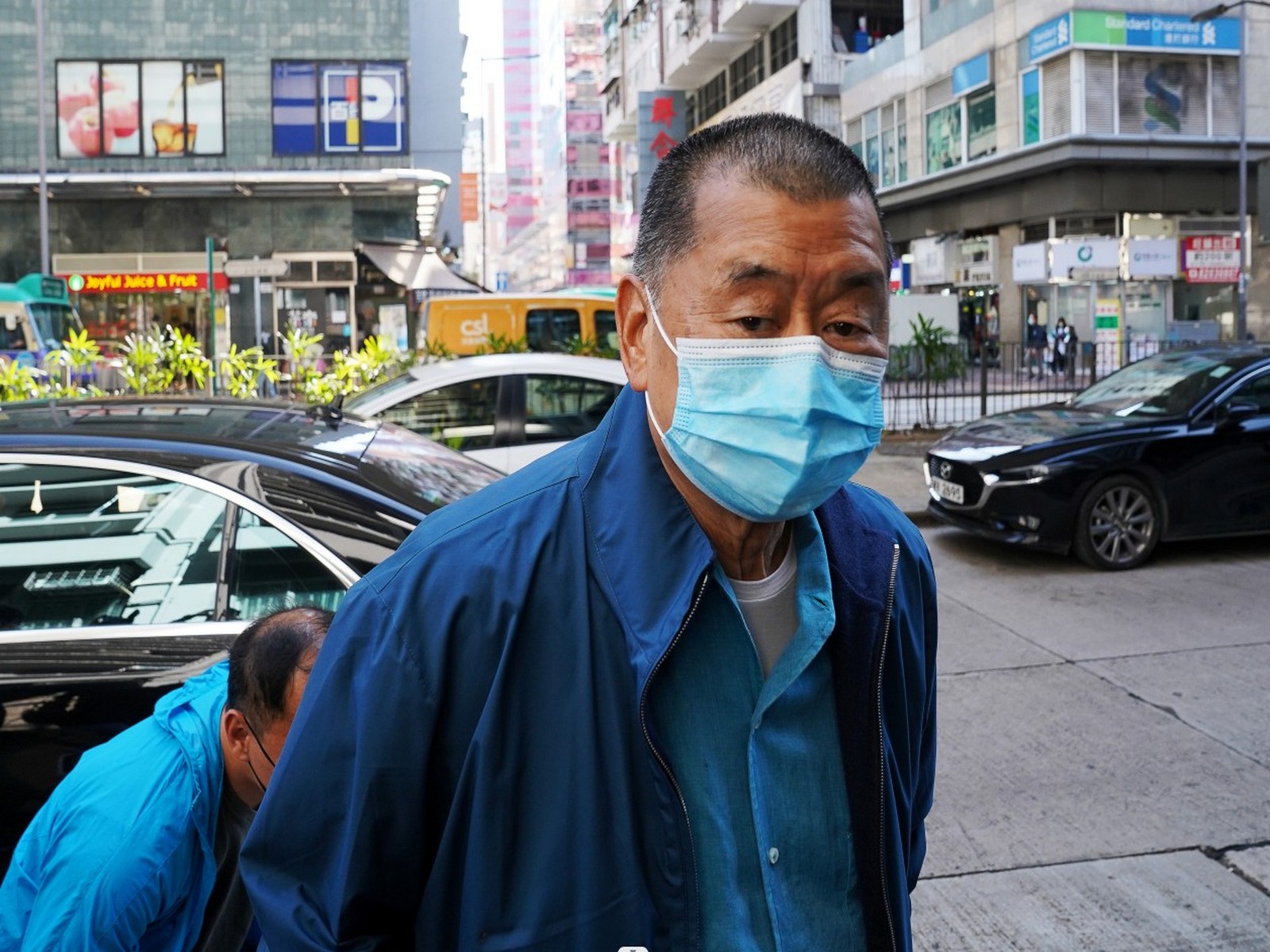
Hong Kong, December 16 (ANI): Hong Kong’s court on December 15 delivered a guilty verdict against the media mogul Jimmy Lai, editor of the former Apple Daily newspaper. The verdict came five years after Lai was detained and charged with sedition and two cases of collusion with foreign forces.
Lai is one of the highest-profile people netted under Hong Kong’s draconian national security legislation. The National Security Law was enacted on 30 June 2020 at Beijing’s behest, and the Hong Kong authorities have vigorously and enthusiastically wielded it as they serve their Chinese Communist Party (CCP) masters.
The judges concluded that Lai intended “to seek the downfall” of the CCP at the cost of the interests of people in Hong Kong and mainland China. “This was the ultimate aim of the conspiracies and secessionist publications,” they declared.
As evidence, they noted that Lai had travelled to the USA on two occasions, when Donald Trump was in his first presidency, and met with US officials such as then Vice President Mike Pence and Secretary of State Mike Pompeo. Another “crime” was that Lai “affiliated himself with Western values.”
After the verdict was delivered, Chief Superintendent Steve Li of the police’s National Security Department gloated that Lai’s conviction represented “justice served”.
He declared that Lai “exploited his media enterprise” and used his wealth and “extensive foreign political connections” to collude with foreign powers. However, others take a very different view.
Amnesty International described it as a “death knell” for press freedom in Hong Kong.
Lai turned 78 whilst in jail earlier this month, and his court case took two full years. The guilty verdict was summarised in an 855-page document, with Lai accused of using his tabloid newspaper to lobby foreign powers to intervene during Hong Kong’s turbulent protests in 2019.
The court claimed Lai stoked hatred against Chinese and Hong Kong authorities through 161 op-eds that he published in Apple Daily, and that he harboured “resentment and hatred”.
The court has not sentenced Lai yet, but life imprisonment is on the cards. Most expected this guilty verdict, as the Hong Kong government appoints its own judges for national security trials, in much the same way that the jurisprudence system in China is subservient to the CCP.
Describing the document issued by the court, Kevin Yam, a pro-democracy activist and disbarred Hong Kong lawyer, commented, “It’s just a case of putting more dead wood on a pyre with which to burn Jimmy Lai.”
He noted that the document confirms that campaigning for one’s political views is a crime, and that having an editorial stance that runs counter to the government of the day is also a crime.
Many Hong Kongers believe this court case is designed to further muzzle the populace and to force the media to self-censor. To quote a Chinese idiom, they believe it is a case of killing the chicken to scare the monkey. In other words, by setting a harsh example of someone like Jimmy Lai, others will be intimidated and forced into line.
After a year of civil unrest and protest, Beijing directly inserted its national security legislation into Hong Kong’s Basic Law in 2020. The passing of that law has suffocated free expression in Hong Kong, with everyone too afraid to speak out against the government or China. A hotline where people can dob in neighbours and colleagues also forces citizens to be circumspect in what they say.
This is entirely the purpose of the National Security Law, which criminalises subversion, secession, terrorist acts (which include disrupting transport or infrastructure) and colluding with foreign forces. In November last year, 45 pro- democracy campaigners were jailed for subversion, many of them icons of the protest movement that had vainly sought universal suffrage in Hong Kong, something once promised by China.
As of September 2025, a total of 341 individuals had been arrested for activities the police claimed posed a threat to national security since the National Security Law was enacted in mid-2020.
In July 2023, the government issued outstanding arrest warrants for eight self-exiled democracy activists. The police cited Articles 37 and 38 of the National Security Law, which state that the legislation applies to everyone in the world and covers offences committed outside the territory. The government also offered a bounty of HK$1 million for each of the wanted.
Breaking the government’s supposed taboo on commenting on court cases, Chief Executive John Lee said the eight would be “pursued for life”, and he denounced them as “rats in the street.”
To date, the law has been used to arrest and convict people for such “crimes” as wearing T-shirts with the slogan “Liberate Hong Kong, revolution of our times”; for posting social media messages criticising the government; for turning their backs when the Chinese national anthem is played; and for attempting to remember the Tiananmen Square massacre.
Furthermore, showing how thin-skinned the authorities have become, the police arrested several people after they petitioned for an independent investigation into the causes of a tragic apartment block fire on 26 November that killed at least 160 residents, and where others still remain missing. They were arrested for sedition after activities such as handing out flyers demanding a thorough investigation.
Many in Hong Kong’s population were incensed that the government initially blamed bamboo scaffolding for the fire that engulfed seven apartment blocks in Tai Po. Instead, the main culprit was the netting that failed to meet fire-retardant standards.
Shockingly, the Hong Kong government swiftly framed the disaster as a national security incident. This was in direct response to a briefing given to Xia Baolong, Director of the Hong Kong and Macao Work Office of the CCP’s Central Committee, on 1 December.
As Eric Y.H. Lai, a Senior Fellow at Georgetown Centre for Asian Law, wrote in a report for The Jamestown Foundation think-tank in the USA, “From that point on, the Hong Kong government increasingly adopted stability-maintenance rhetoric and tools more commonly associated with mainland governance.
In doing so, Hong Kong’s authorities transformed a domestic disaster response operation into an exercise in
regime security, relying on information control, weakened accountability mechanisms, and the monopolisation of community relief through state-aligned groups.”
Lai contended, “The governance model emerging from the Wang Fuk Court fire reflects a deeper integration of Hong Kong’s local administration into the CCP’s national security apparatus.”
The mainland promoted a particular narrative instead of fingering the sub-par scaffolding and materials from China, contravention of fire regulations, possible negligence by various government departments, and evidence that pro-government actors were involved in suspicious contractor selection. It is widely believed that corruption, bid rigging and collusion are now rampant in Hong Kong, just as they are in China.
Hong Kong’s Office for Safeguarding National Security (OSNS) – controlled by Beijing – issued a statement accusing “anti-China, Hong Kong-destabilising forces” of spreading false information and attacking the government’s rescue efforts after the fire.
They accused unnamed parties of sowing discord, making “malicious attacks” and “slanderous remarks”. Anyone familiar with diatribes from Beijing will recognise such phrases.
Simultaneously, the OSNS praised the government for “promptly clarifying the facts”. Lai remarked, “OSNS’s involvement framed the fire not as a governance failure, but as a battleground for national security, elevating the stakes and enabling more aggressive intervention in public discourse.”
Shortly after, the OSNS summoned foreign journalists and warned them against interfering in Hong Kong’s internal affairs. “By restricting public access to information and pressuring intermediaries who facilitate the flow of local data to foreign media, authorities sought to limit external scrutiny and preempt demands for accountability,” Lai assessed.
To date, no Hong Kong government officials have been subject to investigation. Chief Executive Lee announced the creation of an independent committee to look into the fire, but it has negligible authority. This is a typical government ploy, invoking investigative bodies with limited legal force. Such weakened oversight places the government beyond reproach. The same applies to the so-called Independent Police Complaint Council, which is not independent and has little power to check law enforcement agencies.
The tragic fire was perceived as a threat to the government, for the populace rapidly mobilised at the grassroots level. This is dangerous to any authoritarian regime like the CCP. The leaders, fearing another movement like the pro-democracy protests, therefore acted swiftly to suppress any dissent or collective action.
Government control and political loyalty are now the order of the day in Hong Kong, just as they are in China. Lai remarked further in The Jamestown Foundation report, “As scrutiny began shifting toward institutional accountability, authorities moved to constrain the flow of information with criminalisation and censorship.”
This is precisely the face-saving and truth-hiding behaviour that occurs in China when anything goes wrong. It also marked a sharp fall in the accuracy and truthfulness in Hong Kong’s media landscape.
In May, the annual Reporters Without Borders (RSF) Press Freedom Index noted that Hong Kong had dropped into the “red zone” alongside China. The city continued to plummet down the index, reaching 140th place, which was five spots lower than last year.
Hong Kong keeps Sri Lanka and Kazakhstan for company there, but it has not yet reached the dire straits of China, which languishes in 178th place for press freedom. Only North Korea and Eritrea rank lower than China.
Aleksandra Bielakowska, RSF’s Asia-Pacific Bureau Advocacy Manager, commented in May, “At RSF, we have never seen such a sharp and rapid deterioration in the press freedom record of any country or territory.
Today, Hong Kong increasingly resembles neighbouring China, the world’s largest prison for journalists.”
She added, “Imprisonment, harassment, doxing, administrative pressure, surveillance and lack of financial sustainability all define a grim daily reality for the valiant few journalists who decided to stay in the territory. This often leads Hongkongers towards another path: reporting from exile.”
Hong Kong’s government asserts that press freedom remains unperturbed. It “strongly condemned the unfounded and biased remarks” by RSF. Incidentally, the RSF ranked Hong Kong as having the 18th freest press back in 2002. Considering it now ranks 140th, this represents a stunning downfall and reflects the chilling effects of CCP policy.
The devastating fire – the deadliest in Hong Kong since 1948 – came two weeks before the territory’s second “patriots only” Legislative Council election was scheduled. Many felt the election should have been postponed, but it went ahead on 7 December regardless. Ninety members were elected to the Legislative Council, of which only 20 were popularly elected.
The result is a homogenous council that does not permit differences of opinion nor indulge in healthy debate and discourse; it is essentially a rubber-stamp parliament, as in China. The government invested a lot of effort in getting a higher voter turnout, likely to massage the credibility of the election. Nonetheless, only 31.9% of eligible people turned out to vote. This was only slightly higher than the record low of 30.2% achieved last time in 2021.
Lai, in his editorial for The Jamestown Foundation, pointed out an oxymoron. The 2020 National Security Law was supposed to make Hong Kong safer, as the territory journeyed “from stability to prosperity”. Instead, he concluded that information transparency and statutory accountability have become subordinate to political security. Even advocating for a lawful enquiry can now be construed as a security offence.
This typifies the paranoia of communist and authoritarian regimes, where the slightest hint of criticism is treated as an existential threat. Hong Kong, once a bastion of press freedom and an avid observer of commemorations for victims of the 1989 Tiananmen Square massacre, is a completely different place. All books covering sensitive topics such as Tiananmen Square have been removed from library bookshelves. (ANI)