

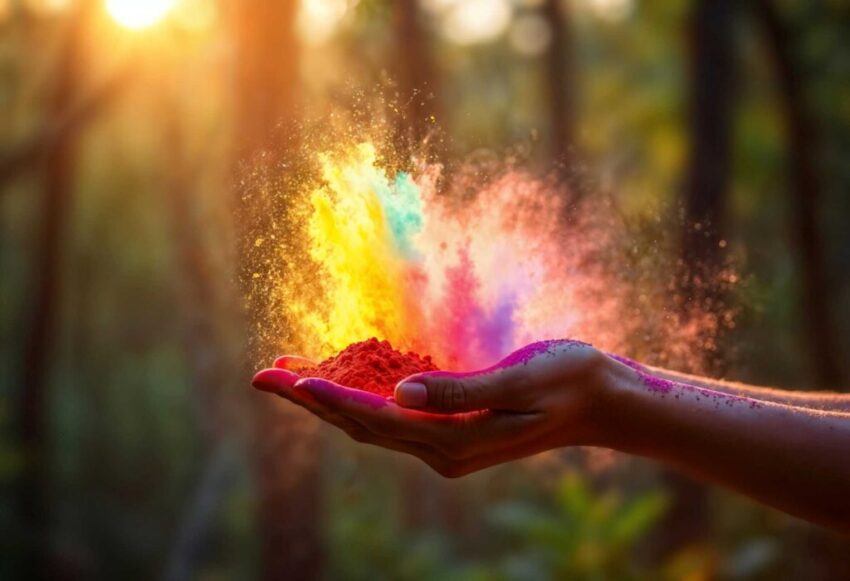

India is often described as a land of festivals, but HOLI occupies a space that is uniquely vibrant, emotional and deeply symbolic. Celebrated on the last full moon day of the Hindu month of Phalguna (usually falling in March), HOLI marks the arrival of spring and the symbolic victory of light over darkness. While it is widely known as the “Festival of Colours,” its deeper spiritual message carries universal relevance , perhaps now more than ever. Across India and in many parts of the world , from New York to London to Sydney, communities gather to celebrate HOLI with laughter, music and the playful application of colours. Streets transform into canvases of pink, yellow, green and blue. Differences of age, background, language and status momentarily dissolve as people greet one another with warmth and joy. For a few hours, life feels lighter. But Holi was never meant to be only a social carnival. Traditionally, the festival begins with Holika Dahan, a ceremonial bonfire held on the eve of HOLI also called Chhoti Holi (small holi). Rooted in ancient mythology, the ritual symbolizes the triumph of devotion and righteousness over arrogance and evil. The story reminds us that pride, ego and misuse of power ultimately lead to downfall, while faith and integrity prevail. On this night, families gather around the fire, offering prayers and symbolic items into the flames. From a spiritual perspective, this fire represents far more than a historical event. It is an invitation to burn away our inner negativity of anger, jealousy, resentment, greed and ego. Just as dry twigs and leaves are reduced to ashes, so too can our accumulated emotional burdens be released through reflection and conscious awareness. Holi, at its core, begins with this inner cleansing. The next day bursts forth in colour. Traditionally, white garments are worn so that every hue stands out vividly. Friends and strangers alike apply gulaal (red coloured powder) to each other’s faces, symbolizing equality and shared humanity. In that moment, distinctions blur. One cannot easily tell who belongs to which social class, profession or background. That’s how colour becomes the great equalizer. This aspect of Holi carries profound meaning in a world increasingly divided by ideology, identity and conflict. So, when colour covers the face, it silently suggests that beyond our external labels lies a shared human essence. The red of love, the yellow of optimism, the green of renewal, these colours are metaphors for the virtues that reside within each person. Yet, as with many traditions, the deeper significance of Holi has gradually faded in some contexts. In urban settings especially, the festival can sometimes become an excuse for excess wasteful use of water, synthetic dyes that harm the environment, or unruly behaviour masked as celebration. When celebration loses mindfulness, its essence diminishes.
For those brothers and sisters living outside India, including the vibrant South Asian diaspora in the United States , HOLI presents a special opportunity. It is not merely a nostalgic cultural event but a bridge between generations. Children born abroad may not speak their ancestral language fluently, but through HOLI they experience a living tradition that communicates joy, unity and resilience. In multicultural cities like New York, HOLI celebrations also invite participation beyond the Indian community. Neighbours, colleagues and friends from diverse backgrounds join in, curious and open. In doing so, the festival becomes a symbol of cultural sharing rather than separation. From a spiritual standpoint, HOLI gently asks each of us a question: What needs to be burnt within me? And which colours do I wish to express in my life? If anger has become habitual, can I replace it with patience? If comparison and competition dominate my thoughts, can I cultivate contentment? If relationships have grown strained, can forgiveness become the first colour I apply this year? In an age defined by digital noise, political polarization and relentless productivity, HOLI reminds us to pause. It reminds us that joy is not purchased, it is created. Harmony is not negotiated only in boardrooms and parliaments; it begins in human hearts. Environmental awareness also calls for a more responsible celebration. Natural, eco-friendly colours, mindful use of water and respectful conduct ensure that the festival aligns with the very spirit it seeks to promote i.e harmony with both humanity and nature.
Ultimately, Holi’s enduring relevance lies in its simplicity. It celebrates the victory of good over evil, the transition from winter to spring, the power of community and the possibility of inner transformation. For readers of Desi Talk/ New India Times and the broader global community, HOLI can be more than a day of festivity. It can be a conscious reset. A chance to let go of accumulated grievances. A reminder that beneath our professional roles, cultural identities and personal narratives, we share a common human longing , to live in peace and to experience authentic joy. As colours fill the air this season, may they not wash away in a day. May they linger as attitudes of kindness, gestures of reconciliation and choices rooted in awareness. When the fire of Holika burns, may it consume our negativity. And when we step into the celebration, may we carry forward not only colour on our clothes, but light in our consciousness.That would be the true triumph of Holi , a festival that colours not just the skin, but the soul.