

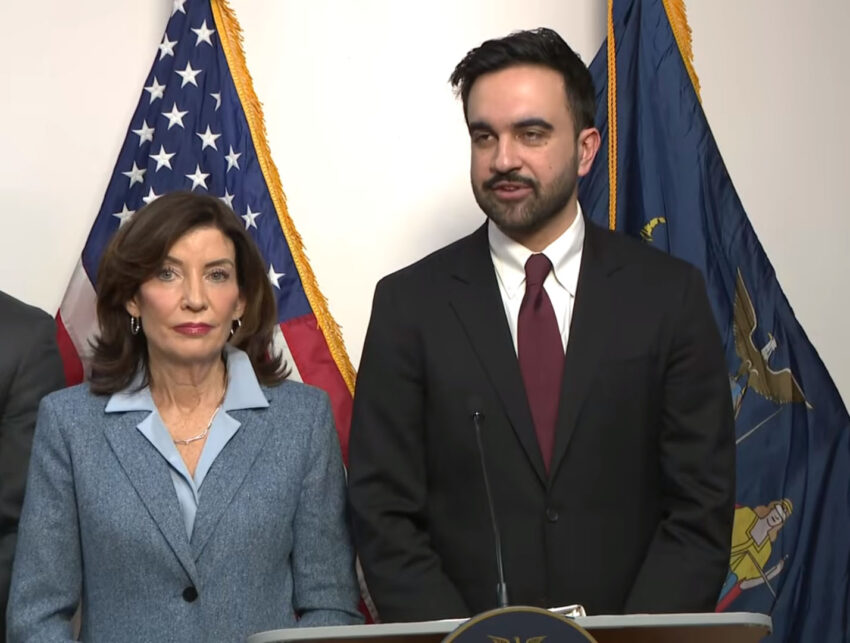
NEW YORK – Gov. Kathy Hochul and New York City Mayor Zohran Mamdani on Tuesday, January 6, 2026, announced a sweeping new plan to provide free child care for 2-year-olds in New York City, a major step toward universal child care that state and city leaders say will ease costs for families and strengthen the economy.
Under the plan, New York State will fully fund the launch of “2-Care,” a universal child care program for 2-year-olds proposed by Mamdani during his mayoral campaign. The program is expected to serve about 2,000 children this fall, with capacity expanding annually until all 2-year-olds in the city are eligible within four years.
Hochul said the state will commit funding for multiple years, an unusual move aimed at ensuring the program’s long-term stability as the city builds capacity and hires workers.
“The era of empty promises ends with the two of us right here, right now,” Hochul said at an event at the Flatbush YMCA in Brooklyn. “Every child will have the same opportunity to get the same head start, and no working parent will have to sacrifice their paycheck or their career.”
ADVERTISEMENT

The announcement comes as child care costs in New York City routinely exceed $25,000 a year, rivaling college tuition and forcing many parents to cut back on work, delay having children or leave the state altogether.
Hochul said the state’s total child care investment will reach $4.5 billion this year, including $1.7 billion in new recurring spending. That includes expanded child care subsidies, new community-based daycare pilots for children from birth to age 3, and funding to increase reimbursement rates and stabilize the child care workforce.
Mamdani, now in his first days in office, called the announcement a defining moment for working families.
“Today, we take one step toward realizing a city where every New Yorker can afford to keep calling it their home,” Mamdani said. “This is what it looks like when government chooses collaboration over dysfunction and delivers real results.”
The mayor said the city will also invest $100 million to fix long-standing problems in the existing 3-K program, including uneven seat availability that has forced some families to travel across boroughs for placements. The new 2-Care program will build on existing city contracts with both center-based and home-based child care providers.
Officials said children with disabilities and children living in shelters will be included in the expansion.
Beyond New York City, Hochul announced $470 million to support universal prekindergarten statewide, with the goal of guaranteeing access for all 4-year-olds by 2028. She also unveiled a pilot program to expand full-day, year-round child care for infants and toddlers in selected counties outside the city.
“We have to look out for everybody,” Hochul said. “There’s more to New York State than just New York City.”
The governor framed the initiative as both a family-support policy and an economic necessity, arguing that affordable child care allows parents to remain in the workforce and supports businesses across the state.
Advocates and providers welcomed the announcement. Sharon Levy, a senior vice president at the YMCA of Greater New York, said universal child care would help families stay in the city long-term.
“My job doesn’t end in June and restart in September,” Levy said. “Year-round, affordable care is what families actually need.”
Parents also spoke about the challenges of navigating high costs and limited availability. Soyona Dawes, whose child attends 3-K at the Flatbush YMCA, said many families are forced into “impossible tradeoffs” between careers and child care.
During a question-and-answer session, Hochul said the program would not be affected by the federal government’s recent move to withhold billions of dollars in child care and social service funding from New York. She said the state is preparing legal action to restore the funds.
“This will not affect these commitments here today,” Hochul said.
Mamdani said the first year of the 2-Care program will cost about $75 million, with costs rising as enrollment expands. State officials declined to project long-term costs beyond the next two budget cycles but said they are committed to making the program universal.
“No one is asking for life in New York City to be easy,” Mamdani said. “They just want it to be a little less hard.”