

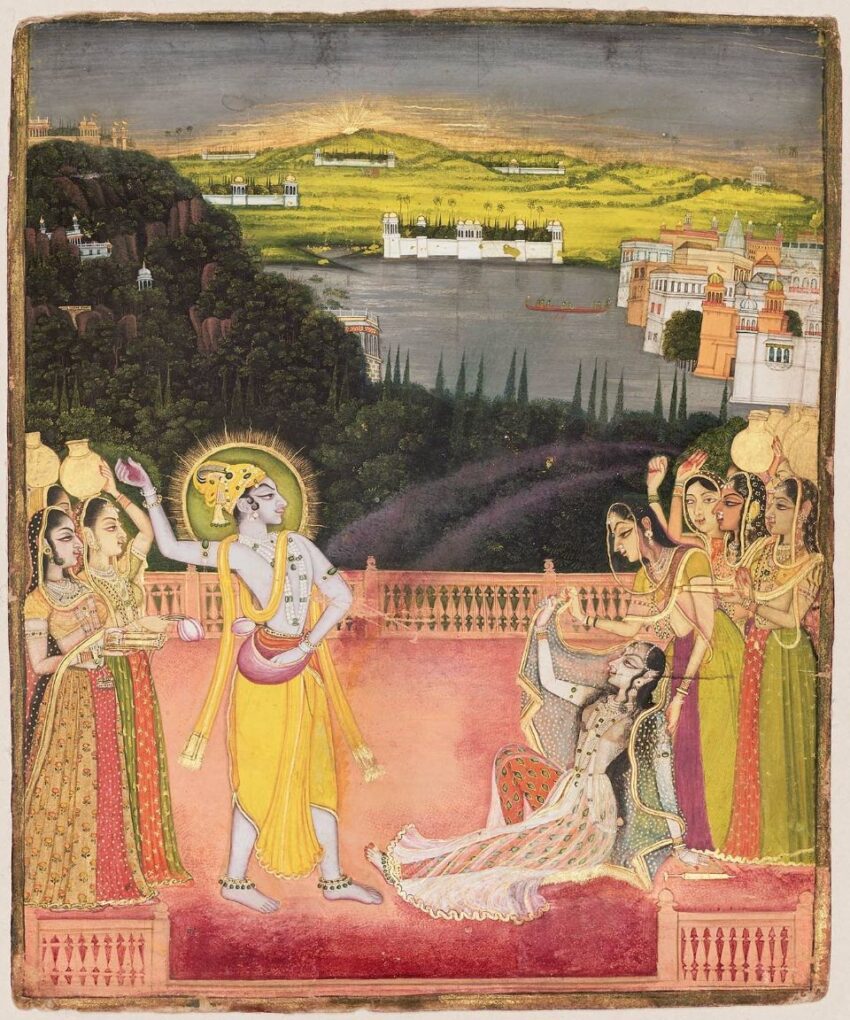
Holi is known as a spring festival, ending winter and ushering in new years in its wake for many regions in India. It is also a festival with religious significance of the burning of Holika and saving of Prahlad by Vishnu in his Nrusinh avatar. However, Holi is best known as a festival of colors representing the love of Radha and Krishna.

PHOTOS: Wikipedia
Modern Holi celebrations have evolved into a conglomeration of old rituals and new traditions and cultural festivities in diverse regions of India.
But, Holi is one of the oldest Hindu festivals, with mentions in several ancient scriptures, ranging from Puranas to early Sutras and classical Sanskrit literature. The festival, which celebrates the triumph of good over evil and the arrival of spring, is described in all with its core rituals, Holika Dahan and the divine love story of Radha and Krishna.
References to Holi are found by researchers in the Atharva Veda Parishishta, the Puranas, an Upapurana, Sutras, and classic literature. All of them mention three main legends associated with the festival of Holi.
ADVERTISEMENT

- Prahlad and Holika – Prahlad, a devotee of Vishnu was saved by him from a fire that burned his evil aunt Holika.
- Radha-Krishna – Their playful love with Krishna coloring Radha and the gopis, starting the tradition of playing with colors.
- Shiva and Kamadeva – Shiva disturbed from deep meditation burned Kamadeva, the god of love, to ashes with his third eye and later revived him.
In Hindu sacred literature, the Vedas contain hymns, philosophy and rituals that form the foundation of Hindu belief and practice. Puranas, as commentaries on the Vedas, feature mythology and legends and contain stories of deities, folk tales and philosophy, according to Encyclopedia Britannica. Sutras which were written much later are like concise summaries of the core teachings.
Atharvaveda (Parishishta): Holi is mentioned in the addendums of Atharvaveda. The reference is to Holaka (होलक) or Holi as it later came to be known, being observed on the full-moon night of the Phalguna month, signifying the burning of evil and the arrival of spring.
The Atharvaveda Parishishta mentions Holaka (18.12.1), indicating it was a recognized, potentially royal, festival in ancient times, involving the burning of wood or cow dung, often referred to as the “evening of bonfires”. The festival is also linked to the fertility of the earth and the celebration of love, often associated with Kama, the god of desire.
Narada Purana: Narada Purana is one of the ancient scriptures that describes the demon king Hiranyakashipu asking his sister Holika to sit in the fire with his son Prahlad in her lap because Prahlad worshipped Vishnu. Holika burned in the fire although she had a boon of immunity from fire while it did not harm Prahlad. The text details the story of Holika Dahan symbolizing the triumph of faith and virtue over evil.
The event seems to establish the practice of lighting a bonfire on the full moon day of Holi.
Bhavishya Purana: It describes the origins of Holi, linking the festival to the destruction of the ogress Dhundha, who troubled people during King Raghu’s reign. In it, the sacred bonfire ritual is described as a method of purification, transformation, and a celebration of the triumph of virtue over vice.
Researchers mention Bhavishya Purana and other texts to have validated the ancient roots of the Holi festival in the Prahlad-Holika story, with specific mention of the annihilation of Dhundha.
Vishnu Purana: While the Vishnu Purana primarily focuses on the Prahlad-Narasimha narrative, the festival also connects with the divine love of Radha and Krishna in other scriptures.
As described here, Holi commemorates Vishnu saving his devotee Prahlad from the fire, celebrating the victory of good over evil.
Bhagvat Purana: The 7th Chapter contains the legend of Prahlad, Hiranyakashipu, and Holika, which forms the theological basis for Holika Dahan and the triumph of good over evil. It details how the devotee Prahlada was saved from a fire by Lord Vishnu while the demoness Holika burned.
Scholars have found reference to Radha in a specific verse describing a special gopi of Krishna. The text relates Krishna’s playful color-throwing with the gopis, providing the basis for the colorful, playful aspect of the festival, often associated with the Radha-Krishna legend of playing with colors with Radha and the gopis in Vrindavan.
Garg Samhita: Garga Samhita is recognized as the first literary work to provide the earliest detailed romantic description of Radha and Krishna playing Holi in the Braj region. The text describes the divine couple Radha and Krishna, along with the gopis, playfully applying colors and flower pollen, marking it as a foundational text for the Holi tradition.
Canto 4, Madhurya-khanda, Chapter 12, describes Radha abandoning her jealous anger to celebrate the festival with her friends. It portrays the scene with red powders, yellow garments, singing, and laughter with descriptions in the text of Krishna wearing yellow garments, a crown like the rising sun, and engaging in the festivities with joyful intoxication.
The Garga Samhita serves as a primary source for the devotional (bhakti) tradition of Holi, focusing on the intimate, loving play between Radha, Krishna, and the gopis.
Kathaka-Grhya-Sutras: It contains some of the earliest textual references to rituals resembling Holi, highlighting its ancient roots as a spring festival, sometimes called “Holika” or “Holikotsava”.
Along with the Jamini’s Purvamimamsa Sutras, the Kathaka-Grhya-Sutras are cited as providing foundational descriptions of the Holi festival’s practices, pre-dating the Puranic stories of Prahlad and Holika.
Both the texts describe the festival as a rite of passage for welcoming spring, associated with the burning of evil spirits, or an ogress. Also mentioned are a set of rites performed by married women for the wellbeing of their families and to welcome the full moon Raka.

PHOTO: Courtesy wikipedia.
Jaimini’s Purva Mimamsa Sutras: Jaimini’s Purva Mimamsa Sutras, an ancient foundational text on Hindu rituals and philosophy, is cited as one of the early scriptures that mentions the festival of Holi, originally known as ‘Holika’.
Alongside the Kathaka-Grhya-Sutras, the Purva Mimamsa Sutras are noted as holding some of the earliest textual references to the celebration of Holi, indicating its existence several centuries before the common era.
The festival as mentioned in both texts was often associated with specific, ordained rites. References are found highlighting the festival as a time for offering, a rite performed for the prosperity, well-being, and happiness of families.
Ratnavali, a drama by King Harshvardhan: The 7th-century Sanskrit drama Ratnavali written by King Harsha contains one of the earliest, most detailed literary descriptions of the Holi festival.
The play in four acts describes the festival of colors as holikotsav. In a dialogue, the King and his court humorist (Vidushaka) describe the festive gaiety in the city of Kaushambi. The text mentions people covering each other in red powder (abeer), scattering red powder, and spraying colored water.
Ratnavali is often cited by historians alongside works like the Dashakumaracharita by Dandin as a primary source for the early, detailed depiction of the festival of colors.
Malvikagnimitram of Kalidasa: The renowned Sanskrit poet and playwright Kalidasa (4th-5th centuries CE) makes references in his works to spring festivals that are precursors of the modern Holi festival.
Kalidasa’s drama Malavikagnimitram and poem Kumarasambhava are part of the early historical evidence indicating that the “festival of colors” existed and was celebrated during the Gupta period. These texts describe spring festivals, sometimes referred to as Madanotsav, a festival dedicated to the god of love or as Holikotsav which involved the spraying of colored water and powders.
Kam Sutra by Vatsayana: The Kamasutra by Vatsyayana, composed around the 3rd or 4th century CE, mentions an ancient version of the Holi festival described as a spring festival associated with pleasure and romance, and honoring Kama, the deity of love.
The festival is depicted as a time for social gathering, romantic love, and the symbolic use of colors or powders. The celebration is sometimes referred to as Holaka, associated with the Vasantotsava (spring festival), proving that historically, the festival was heavily centered around honoring Kama, the god of love and desire.