

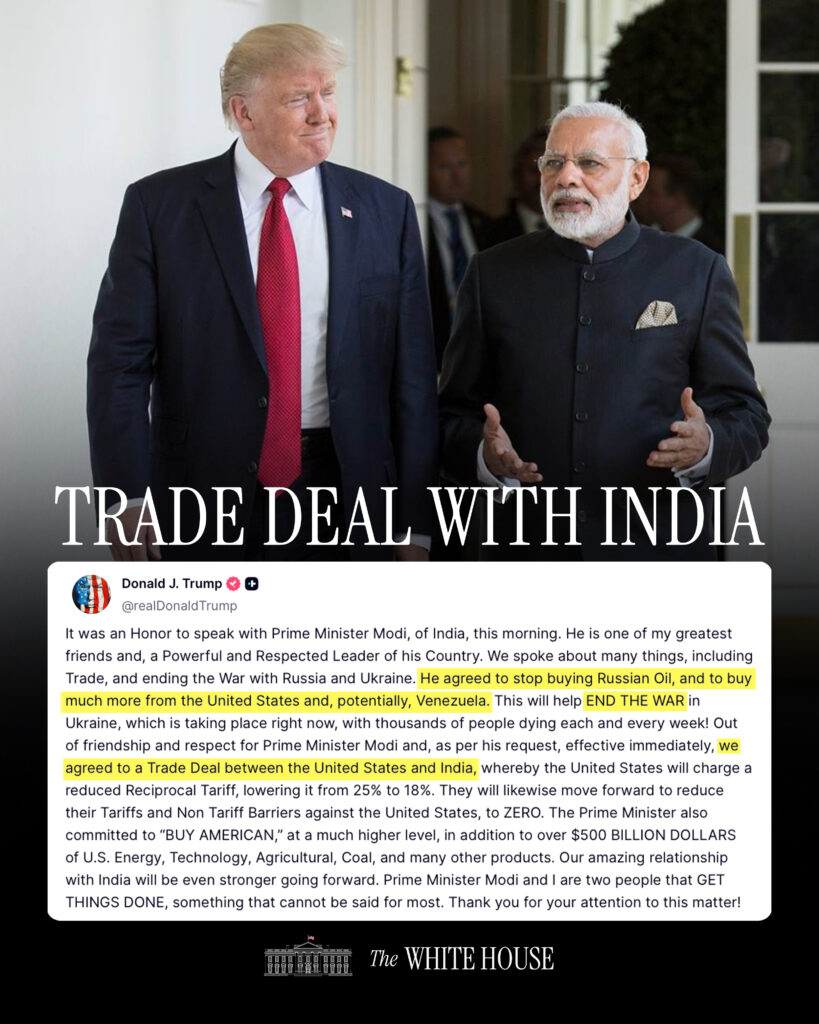
 Indian American community leaders, organizations and think tanks applauded the announcement February 2, 2026, of an imminent trade deal between Washington and New Delhi that brings down tariffs on Indian goods and could herald a return to normal bilateral relations after months of tension.

A lot of the credit for the emerging trade deal lies with Ambassador Sergio Gor’s arrival in Delhi, say some observers.

“Engagement at the highest levels is currently happening,” Ambassador Gor said posting pictures of India’s External Affairs Minister S. Jaishankar, who arrived in Washington Feb. 2, with Secretary of State Marco Rubio and himself.
“The United States is ready to elevate this relationship even further. Limitless Potential!” Ambassador Gor enthused.
ADVERTISEMENT

Background
Prime Minister Modi in an X post February 2, announced that US tariffs on Indian products had been reduced to 18 percent by Washington, in a breakthrough after months of negotiations between the two nations.
“Wonderful to speak with my dear friend President Trump today. Delighted that Made in India products will now have a reduced tariff of 18%,” Modi posted X.com/narendramodi.
President Trump in his post on Truth Social said a trade deal had been struck with India and tariffs were being reduced to 18 percent from 25 percent.
In a rapidly developing story of high import to both United States and India, leaders of the two countries appeared to have averted a major trade confrontation with global implications.
President Trump’s post on Truth Social following a call with Modi, said, “Out of friendship and respect for Prime Minister Modi and, as per his request, effective immediately, we agreed to a Trade Deal between the United States and India, whereby the United States will charge a reduced Reciprocal Tariff, lowering it from 25% to 18%.”
The President went on to add that Modi had also committed to buying more than $500 billion dollars products in U.S. energy, technology, agricultural and other sectors.
A White House official told Reuters, “We are also dropping the 25% tariff given India’s agreement to stop buying Russian oil.”
On Saturday, January 31, Trump had broached the idea of a potential deal for India to buy Venezuelan oil after the US seized control of that country.
In August 2025, the Trump administration had doubled duties on imports from India to 50% in a bid to stop New Delhi from purchasing Russian oil, and in January, the President had threatened another rate rise.
New Delhi has over the last year been reducing its purchases of Russian oil, particularly after Moscow’s invasion of Ukraine and subsequent sanctions on such purchases by different countries.
“Recently India has begun to slow its purchases from Russia, the Reuters report said, noting, “In January, they were around 1.2 million barrels per day, and are projected to decline to about 1 million bpd in February and 800,000 bpd in March.”
Reactions
“This agreement is a great relief for India and good news for the United States. The reduction of tariffs to 18 percent is most welcome relief to India and its economy. And at the same time, US can see its exports with India increase,” said Padma Shri recipient Dr. Sudhir Parikh, chairman of Parikh Worldwide Media/ITV Gold. “Hopefully the Ts will be crossed and the Is will be dotted soon between these two great democracies with the arrival of India’s External Affairs Minister Jaishankar,” he added.
“It’s a big breakthrough. It happened because the two leaders spoke. But also, a lot of credit must go to newly appointed Ambassador Sergio Gor to India. He has the ear of the President, and this agreement comes within a month of his reaching India,” said M.R. Rangaswami, founder of IndiaSpora, an advocacy organization based in California. “We are very excited that everything seems to be back to normal and we can move forward.”
The US India Strategic Partnership Forum (USISPF) welcomed the agreement, saying, “The reduction of India’s reciprocal tariff from 25% to 18% marks an important and positive first step. While the agreement’s specifics are pending, today’s announcement signals strong political will on both sides to move toward a comprehensive U.S.–India Bilateral Trade Agreement (BTA) that addresses tariffs, market access, non-tariff barriers, and other trade-related issues across a wide range of sectors.”
Describing it as a “constructive” momentum the USISPF expressed optimism about the future, and committed to helping expand bilateral trade to the $500 billion target.
Wendy Cutler, senior vice president of the Asia Society Policy Institute, called the announcement of the trade deal, as still “light on details.”
“The announcement is certainly a relief to our Indian partners, who have faced some of the highest tariff rates of any partner,” said Cutler who is the former Acting Deputy U.S. Trade Representative. “It will help clear the pathway for the U.S. and India to work cooperatively on other pressing matters concerning critical minerals, technology cooperation, and supply chain resiliency.”
Reducing the U.S. reciprocal tariff for India to 18%, gives Indian exporters “a slight edge in the U.S. market over its ASEAN competitors who have secured 19-20% tariffs,” Cutler pointed out.
(Updated and revised Feb. 6, 2026 version of previous report)