

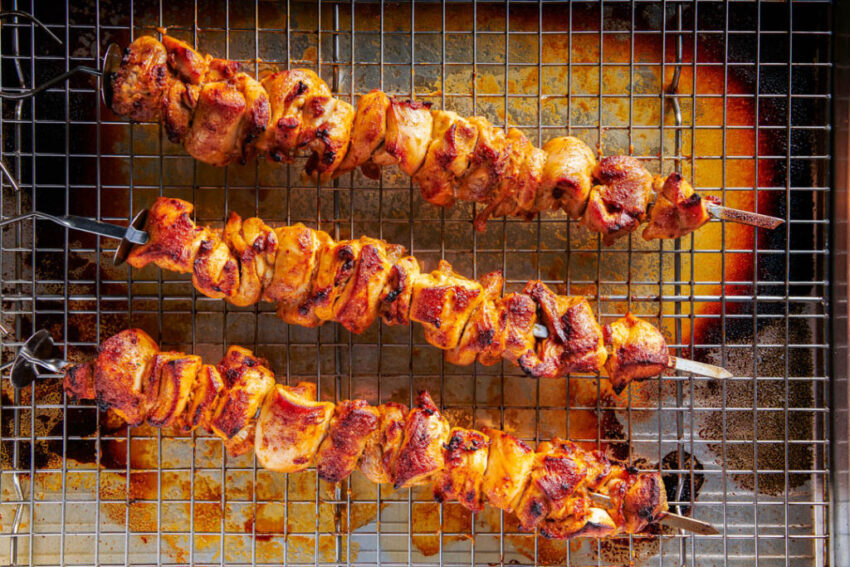

Cooking chicken can flummox even the more confident home cooks among us. What’s the best way to keep it from drying out? What internal temperature should I aim for? How do I avoid spreading bacteria all over the kitchen?
Practice is more than half the battle, but picking the right recipe to boost your confidence is just as important. These Chicken Tikka Kebabs from Madhur Jaffrey are a great example, bringing together accessibility, affordability and hard-to-mess-up results. And they’re incredibly tasty, too.
I first came across this recipe as part of a personal quest to re-create the chicken kebabs at Food Factory, a hole-in-the-wall eatery in Arlington, Virginia, that my husband grew up going to. (The restaurant “seemed to want to fend off patrons, not just by its prosaic name, but with its back-alley location behind Fairfax Drive in Ballston,” former Washington Post food critic Phyllis Richman recalled to Arlington Magazine in 2015.”) He took me there a few times after I moved to the area, and as I feasted on juicy, charred chunks of meat scooped up with torn pieces of pillowy naan and doused with a spicy green chutney, I quickly understood his enthusiasm. Then, the restaurant was no more.
Determined to bring a little Food Factory spirit home, I started perusing the cookbook shelf at the library and came across Jaffrey’s “From Curries to Kebabs.” (Her chickpea curry from the same book also became a family favorite.) While Indian in origin, as opposed to Food Factory’s largely Pakistani or Afghan fare (even Richman couldn’t get a straight answer), the recipe looked not only promising, but also doable for a novice cook like I was at the time.
ADVERTISEMENT

Sure enough, as is always the case with Jaffrey’s recipes, the kebabs were a triumph. So much time has now passed since our last Food Factory meal that I can’t tell you today how much they replicated the dish, but I remember being won over with the very first bite. For whatever reason, the recipe dropped out of my rotation until relatively recently, when I dusted it back off for my son. I’d almost forgotten how delectable the kebabs were – tender, juicy and just the right amount of spicy.
Now, with many more years under my belt as a food writer and recipe developer, I’ve started to think beyond the nostalgia to consider why this kebab recipe works so well – and why it will for you, too, even if you find yourself less than confident about cooking chicken. Here are the keys to success:
– – –
Use chicken thighs. Jaffrey’s original recipe calls for boneless, skinless breasts, which work well, but I have started routinely making it with thighs, which are often less expensive. Dark meat is generally more forgiving because it can be cooked to as high as 195 degrees and still come out juicy. Consider using thighs, especially if you’re nervous about dry meat, because they give you added margin for error.
– – –
Cut the meat into small pieces. Readers routinely ask us about how to make sure chicken is cooked to a safe internal temperature. That can be tricky on a whole bird, the parts of which can cook at different rates, or even larger pieces such as cutlets. The bite-size pieces of kebabs are much harder to undercook, but you can always double-check. An instant-read thermometer should read at least 165 degrees in the center of the meat. (Just avoid contact with the skewer if you’re using metal, as it can throw off the reading.)
– – –
Be smart about marinating. Marinating is less powerful than you might think, with seasonings barely penetrating the surface, regardless of how long the meat sits. America’s Test Kitchen notes that marinades are most effective over a greater surface area (you get more of that around all the sides of each individual piece of kebab meat) and with a higher concentration of salt. Jaffrey’s recipe ticks both boxes. And while her recipe as written suggests 6 to 8 hours to marinate, I found that 20 minutes with just the salt and lemon juice followed by 30 minutes with the cream and spices gave me just as good results.
– – –
Cook under the broiler. As counterintuitive as it might seem, broiling is an ideal cooking method “for tender meats, poultry and fish, because it’s a dry, high-temperature, short-time method,” chemistry professor and food science writer Robert Wolke explained in a 2001 story in The Post. In this recipe, the intense heat quickly and efficiently cooks the small pieces of meat, with no need to worry about the exterior overcooking before the interior is done.
Once you’ve mastered these kebabs, feel free to switch up the spices as you see fit. You can move on to similar recipes or progress to more advanced dishes that build on this foundation. Jerk Chicken and Pineapple Skewers; Herby Coconut Chicken Skewers Platter; Simple Butter Chicken; Grilled Chicken With Tomato-Peanut Chutney; and Cilantro Tandoori-Spiced Grilled Chicken Thighs would all be excellent next steps.
– – –
Chicken Tikka Kebabs

These restaurant-quality broiled chicken tikka kebabs are supremely tender and simple to make. You can let the meat marinate for up to 8 hours, though even a short rest will infuse it with flavor. The kebabs are delectable with a simple starch, such as rice or naan, but serving them with a raita (yogurt sauce) or cilantro chutney (see related recipes) will take them over the top.
Cookbook author Madhur Jaffrey originally called for boneless, skinless chicken breasts. We found thighs worked just as well, if not better. We prefer using long, flat metal skewers here, but wooden ones are okay, too. (Just cover any large exposed areas of the wooden skewers with foil.) The recipe scales up easily to feed more people.
Make ahead: The chicken needs to marinate on the counter for 20 minutes, then in the refrigerator for at least 30 minutes and up to 8 hours. You will need three to five (8-to-10-inch) wooden or metal skewers. If using wooden skewers, soak them in water for 20 minutes.
Storage: Refrigerate for up to 4 days.
Active time: 40 mins; Total time: 1 hour 30 mins, including marinating time
INGREDIENTS
1 1/2 pounds boneless, skinless chicken thighs or breasts, cut into 1-inch pieces
3 tablespoons fresh lemon juice (from 1 to 2 lemons)
1 1/4 teaspoons fine salt
1/3 cup heavy cream
2 garlic cloves, pressed or finely grated
1 tablespoon finely grated fresh ginger
1 teaspoon ground cumin
1 teaspoon sweet paprika
1/2 teaspoon cayenne pepper
1/2 teaspoon garam masala, store-bought or homemade (see related recipes)
nonstick cooking spray
naan or rice, for serving
Cilantro or other green chutney, for serving (see related recipes)
STEPS
In a large bowl, combine the chicken, lemon juice and salt, rubbing the seasonings well into the meat. Prick the chicken pieces lightly with the tip of a knife and rub the seasonings in again. Let rest at room temperature for 20 minutes.
Add the cream, garlic, ginger, cumin, paprika, cayenne and garam masala to the bowl. Mix well, cover and refrigerate for at least 30 minutes and up to 8 hours. (A few hours longer won’t hurt, either, if that works better for your schedule.)
When ready to cook, position a rack to 5 to 6 inches from the broiling element, and preheat the broiler to HIGH. Set a wire rack inside a large sheet pan and lightly coat with nonstick cooking spray (see Notes).
Remove the chicken from the marinade and thread the pieces onto the skewers, leaving about 1 inch of space at the end and setting the skewers on the wire rack as you work. Broil until the chicken is lightly browned and cooked through (an instant-read thermometer inserted in the center of the meat away from the metal skewer should read at least 165 degrees), flipping once, about 6 minutes per side. Serve hot, on or off the skewers, with naan or rice and chutney on the side.
Substitutions: Want a little smoky flavor? >> Replace some or all of the sweet paprika with smoked paprika. Don’t like heat? >> Reduce or omit the cayenne pepper. Dairy-free? >> Use nondairy cream or coconut milk instead of the heavy cream, though the coconut will lend a slightly different flavor.
Notes: If you don’t have a wire rack to set inside a sheet pan, you can balance the skewers on a broiler-safe pan or baking dish large enough to catch all the juices.
Nutrition | Per serving: 279 calories, 1g carbohydrates, 147mg cholesterol, 19g fat, 0g fiber, 29g protein, 7g saturated fat, 479mg sodium, 1g sugar
Adapted from “From Curries to Kebabs: Recipes From the Indian Spice Trail” by Madhur Jaffrey (Echo Point Books & Media, 2017).