

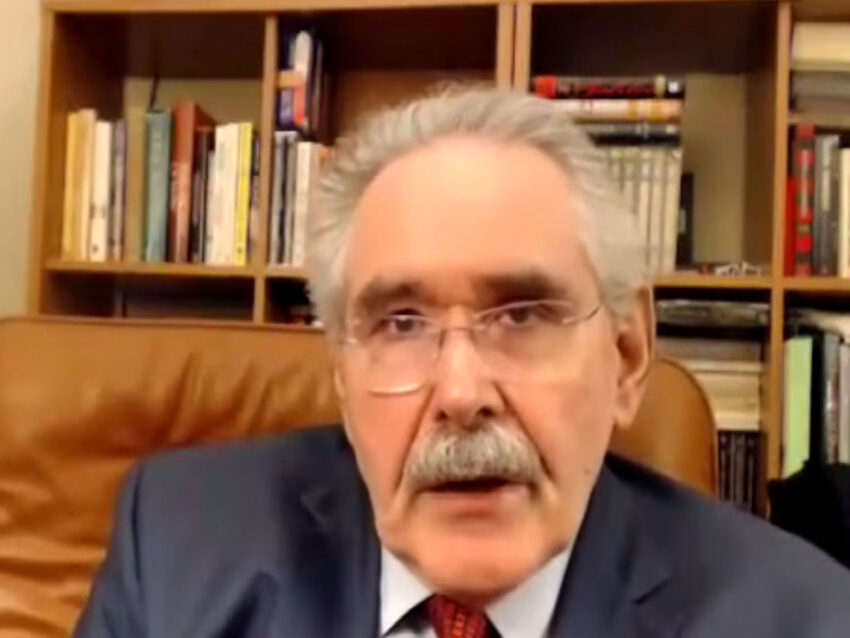
New Delhi [India], January 18 (ANI): Veteran Canadian journalist Terry Milewski has underlined the need for a comprehensive India-Canada Free Trade Agreement (FTA) and a stronger push for people-to-people ties, as he spoke about the future direction of bilateral relations amid evolving global geopolitics.
In an interview with ANI, Milewski said the key outcome of a possible visit by Canadian Prime Minister Mark Carney to India should be “a comprehensive free trade agreement where India and Canada set an example of what it should be,” adding, “It should be trade without tariffs.”
Emphasising that the FTA must go beyond limited trade openings, Milewski said, “We need a comprehensive free trade agreement where India and Canada set an example of what it should be. It should be trade without tariffs. Why should there be any tariffs at all?”
Linking trade policy to broader political and economic realities, he said, “It’s not about what’s right and wrong. It’s what they will go ahead and do,” adding that the global environment is being reshaped by expanding strategic competition and uncertainty.
Milewski also cautioned against viewing the current improvement in ties as a full resolution of disputes. “The vaunted rapprochement between India and Canada, in my submission, doesn’t really exist. It’s an illusion that both governments find convenient,” he said.
He added that the dispute that triggered the downturn in ties remains unresolved, saying, “They have not decided to settle dispute which began the precipitous decline in relations which happened when Trudeau accused the Modi government of murder.”
The diplomatic chill between the two nations began in 2023 when India expressed concerns over Canada’s perceived leniency towards Khalistani separatist elements and former Canadian Prime Minister Justin Trudeau alleged that Indian agents were involved in the killing of NIA-designated terrorist Hardeep Singh Nijjar outside a gurdwara the same year.
Commenting on how both sides are managing the relationship, Milewski said, “Both governments have decided to let it be,” adding, “They’re just going to have to go with the undecided, unsettled, dispute in the background.”
Referring to possible diplomatic engagement, Milewski said, “It’s reported pretty widely that in the next couple of months, Carney may come to India,” and added that if such a visit takes place, he would like to see India build a memorial to Air India 182 victims.
“For one thing, I think that it shouldn’t happen at all unless and until the Indian government itself raises the money and builds a memorial to the victims of Air India 182,” he said, adding, “We have four memorials in Canada.”
Highlighting the importance of deeper engagement at the societal level, Milewski said, “People-to-people exchanges between India and Canada are enormously fruitful. It’s wonderful for Canada,” but added that ties have become “mired in a completely wrong dynamic of crime.”
“I’d like to see a vast improvement in the quality and style of people-to-people exchanges, an intermingling of two wonderful people, the Canadians and the Indians,” he said.
Milewski also spoke about the shifting international environment and Canada’s evolving foreign policy outlook, saying, “We’ve had our heads snapped two or three times already in this interview by the things that have happened since Trump arrived on the scene.”
On the emerging global scenario, he said, “The overturning of the old world order and its by the new world order,” adding, “I don’t think it’s going to get better soon. It’s going to get worse.”
The remarks come as Canadian Prime Minister Mark Carney has stated that Ottawa, to diversify its global trade landscape, will be doubling non-US exports by the next decade.
Indian High Commissioner to Canada Dinesh Patnaik has said that Carney is set to visit India in the coming weeks to expand bilateral trade with New Delhi, after over two years of strained diplomatic relations.
Speaking to CBC’s “Power & Politics”, Patnaik on January 13 said Carney’s visit is aimed at diversifying Canada’s trading partners amid high tariffs imposed by the United States on its largest trade partner.
Both India and Canada are facing high tariffs imposed by US President Donald Trump on their exports, including 50 per cent tariffs on India and 35 per cent tariffs on Canada, the report said.
“In a shifting global trade landscape, Canada’s new government is focused on what we can control. We’re going to double our non-US exports over the next decade — to secure new opportunities for Canadian businesses, and create tens of thousands of new careers for Canadian workers,” Carney said in a post on X on Monday.
Patnaik said Carney’s visit is expected after India tables its Union Budget on February 1, describing the renewed engagement as a sign that “trust is back in the system.”
He added that diplomats are working to “catch up” on initiatives delayed due to a “slight gap” in relations.
Patnaik reiterated that the Indian government has denied any involvement, saying, “We have always said it’s preposterous, absurd. It’s something we don’t do,” and that “there is no case against the Government of India.”
The envoy further said Canada’s approach is changing under the current leadership, stating, “There’s a new prime minister who is changing the way Canada behaves,” as quoted by CBC.
In November last year, Carney accepted Prime Minister Narendra Modi’s invitation to visit India in early 2026, according to a statement from the Office of the Prime Minister of Canada.
Following the return of high commissioners in August 2025, the two prime ministers agreed to increase diplomatic staffing to meet growing consular demand and strengthen people-to-people ties. They also agreed to support reciprocal knowledge transfer as part of ongoing engagement between the two countries.
Carney welcomed the progress being made in the law enforcement dialogue between India and Canada.
India and Canada have agreed to begin negotiations on a high-ambition Comprehensive Economic Partnership Agreement (CEPA) following a bilateral meeting between Prime Minister Narendra Modi and Canadian Prime Minister Mark Carney on the sidelines of the G20 Leaders’ Summit in South Africa.
The planned CEPA talks aim to raise bilateral trade to USD 50 billion by 2030. (ANI)