

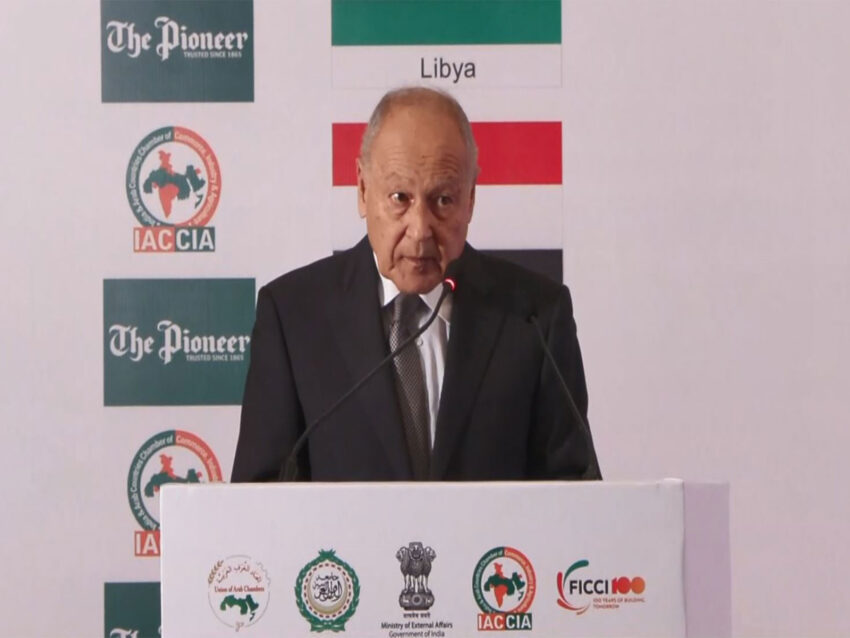
New Delhi [India], January 31 (ANI): Arab League Secretary General Ahmed Aboul Gheit defended Arab states’ decision to support the US-led Board of Peace on Gaza, saying it offered a rare opening for a ceasefire after repeated diplomatic efforts had failed to stop the fighting.
Setting out the Arab League’s broader regional approach during the interaction, Aboul Gheit, speaking on Friday at a public event hosted by the Indian Council of World Affairs and moderated by former diplomat Talmiz Ahmad, said Gulf countries have consistently opposed military escalation and advocated diplomatic solutions.
Providing context for Arab backing of the Gaza initiative, he said, “We have had a president in Washington who admitted that he was a Zionist himself. He supported Israel directly as a Zionist.”
Referring to former President Joe Biden, he added, “Four times there have been calls in the Security Council and draft resolutions presented calling for a ceasefire in Palestine, and the American administration at the time vetoed them all.”
Against this backdrop, most Gulf Arab states signed on to the Board of Peace last week in Davos, despite scepticism over its framework.
Several European countries, including France, the United Kingdom, Norway and Sweden, have declined, citing concerns that the body could undermine the United Nations.
Responding to those reservations, Aboul Gheit defended Arab participation, saying, “When I heard for the first time that the American president himself, in person, was committing himself to lead a council or a board to supervise a settlement, well, welcome!”
He added, “Between someone who was saying, ‘I am the strongest adviser and supporter to Israel, I am a Zionist’ and a president who says, ‘I am for peace and for the ending of the killing and ending the conflict’, if we are logical, we have to try.”
At the same time, he acknowledged unresolved questions surrounding funding, oversight, coordination with the United Nations and the absence of the Palestinian Authority from the executive committee, stating, “How the implementation will proceed remains to be seen.”
Turning from Gaza to wider regional security concerns, Aboul Gheit warned that any military action against Iran would have serious consequences for the region and beyond.
Referring to a potential strike, he said, “If such an event happens, it will be negative for the region and for everyone else,” adding, “It will be a disaster for the peace of the world.”
His remarks came in response to a question on US President Donald Trump’s announcement that a naval armada had been dispatched to the Gulf, raising fears of possible military action against Tehran.
Placing the deployment in historical context, Aboul Gheit noted that the US Fifth Fleet has been based in Bahrain since 1995 and that American forces have maintained a presence in the region since 1945.
“The presence of the American troops in the Gulf, Bahrain, the Red Sea and the Mediterranean is not a new development,” he said, adding that what had changed was “the politics and policies” in Washington.
Questioning recent US statements in this context, the former Egyptian foreign minister said, “I am not taken in by [the] declarations of Americans.”
He added, “Yes, they want to settle from that point of view, thinking that Iran is a nuclear country.”
Broadening the discussion to the Palestinian issue, Aboul Gheit addressed Israel’s opposition to Palestinian statehood, saying occupying powers rarely concede political demands voluntarily.
“An occupying power will never tell you, ‘Yes, sir, you are permitted to do so,'” he said, drawing parallels with colonial rule.
Linking regional tensions to wider global shifts, he also warned of increasing international instability, saying, “I claim that we are in the midst of a Cold War,” while arguing that the American empire was facing decline.
Reflecting on historical precedents, Aboul Gheit said, “There is no way for a new order to emerge without war,” citing the formation of the United Nations after the Second World War.
Asked how the current turbulence might be resolved, he said, “In all honesty, I don’t know. The situation is very fluid.”
Earlier in the day, Aboul Gheit met External Affairs Minister S. Jaishankar in New Delhi.
In a post on X, Jaishankar said the two held a “warm” meeting and exchanged views on “recent developments in the region”.
Touching on bilateral relations during the interaction, Aboul Gheit expressed optimism about India-Arab ties, praising India’s achievements and highlighting the large Indian workforce across Gulf countries.
“The Arabs understand the potential of India,” he said, while noting that momentum in ties had slowed in recent years.
Aboul Gheit is in New Delhi to participate in the second Arab-India foreign ministers’ meeting, taking place today after a ten-year hiatus.
He also inaugurated the Arab-Indian Chamber of Commerce and Industry on Friday. (ANI)