

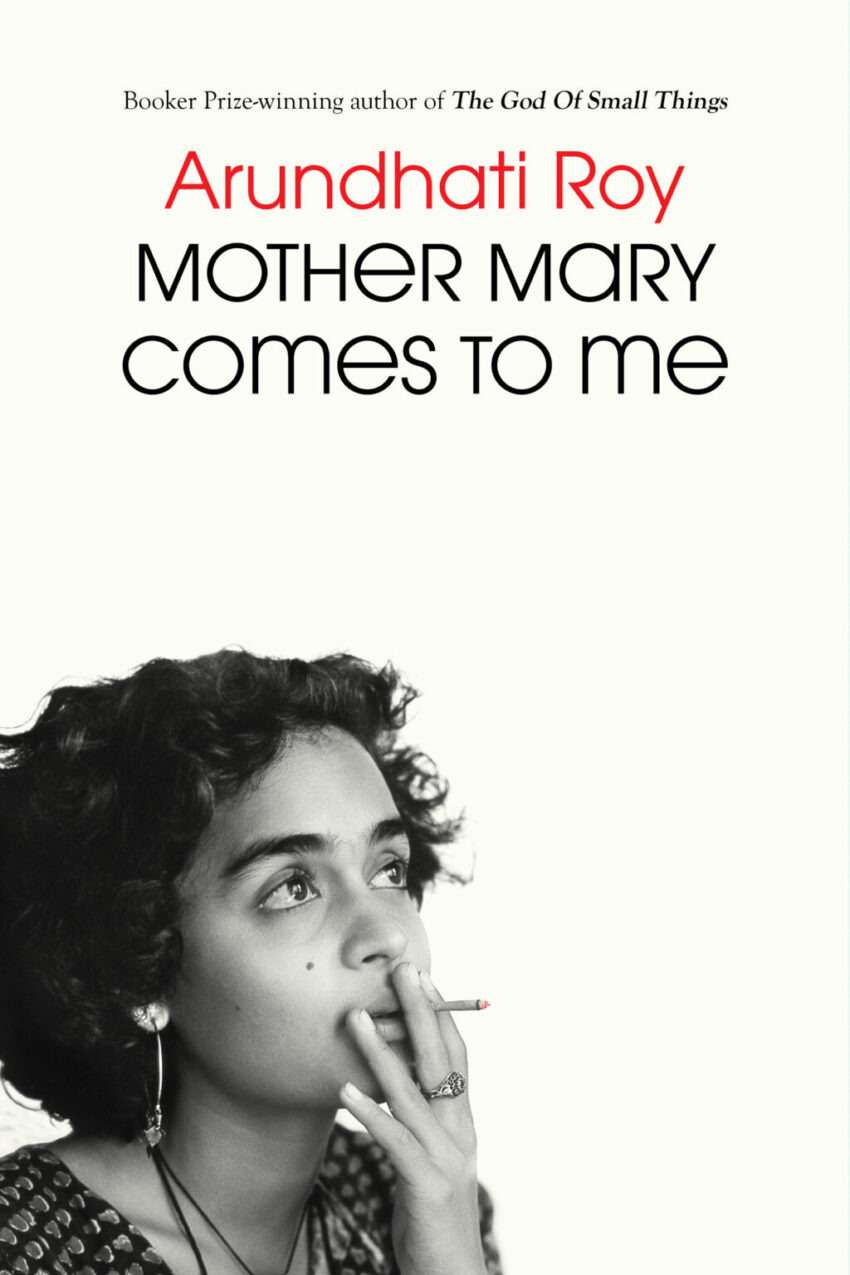

For as long as the Indian novelist, Booker Prize winner and activist Arundhati Roy can remember, her mother was – or pretended to be – dying. A chronic asthmatic with a flair for drama, Mary Roy kept her children in line by warning them that any misbehavior on their part might trigger a fatal attack. “Anything I said those days ended in a storm of insults and anger. And asthma. And blame about being the cause of Mrs. Roy’s impending death,” Arundhati Roy recalls in her new memoir, “Mother Mary Comes to Me.” “As a consequence, I had more or less stopped talking.” She needn’t have done so. Mary never actually died, of course, at least until she did. And when she finally passed, in 2022, the cause was not her daughter’s insolence or obstinance but only her own advanced age.
Even in death, her eccentricities and moods loom large. As Roy puts it mournfully, she remains “taller in my mind than any billboard.” When she was alive, she was on the verge of expiring; now that she is dead, she is more inescapably present than ever before. It is a contradiction worthy of a woman who played so many sharply conflicting parts throughout her eventful life.
In the small Syrian Christian community where Roy spent much of her childhood, she watched her mother “unleash all of herself – her genius, her eccentricity, her radical kindness, her militant courage, her ruthlessness, her generosity, her cruelty, her bullying, her head for business, and her wild, unpredictable temper.” She founded a famed coeducational school and fought for equal rights for Syrian Christian women – yet she blasted her daughter for promiscuity in decidedly sexist terms. She was gentle and patient with her pupils – yet she was sharp and sometimes violent with her own children. On one occasion, she beat Roy’s brother viciously because his report card deemed him an “average student”; on another, she shot Roy’s dog, who had transgressed by mating with a mutt on the street. Even when she was not outright abusive, she could be cold and unfeeling. To avoid the appearance of favoritism, she instructed her children to call her “Mrs. Roy,” just as her students did. “To me,” Roy writes, “she still is more Mrs. Roy than mother.”
But if Mrs. Roy is the reason her daughter became a lifelong “vagrant,” as Roy puts it, she is also the reason her dreamy child would grow up to become the first Indian citizen to win the Booker Prize. Mrs. Roy is the one who introduced her daughter to “Shakespeare, Kipling, and A.A. Milne” and gifted her a typewriter. In a culture in which most women dared aspire to nothing more than a suitable marriage, Mrs. Roy was bent on assuring her rebellious daughter “that if she put her mind to it, she could be anything she wanted to be.”
ADVERTISEMENT

Roy took this lesson to heart – so much so that she moved to Delhi, three days’ travel from her small village, to pursue a degree in architecture at the age of 16 and stopped coming home, even for vacations, two years later. Throughout her chaotic and bohemian youth, she worked odd jobs, took even odder drugs and lived, among other places, in a storeroom in a studio at the architecture school. After several missteps and many bouts of demoralizing poverty, she found her footing as an actress, a screenwriter and, finally, a novelist.
The international success of her 1997 debut, “The God of Small Things,” freed her to turn her attention to politics, and for the past several decades she has devoted herself to writing barn-burning commentary and staging protests against Narendra Modi’s far-right regime. “Mother Mary Comes to Me” often feels like two books sutured together: a tender and ambivalent memoir about the difficult Mrs. Roy and a withering polemic about India’s political ills.
Roy is disdainful of those who suggest there is any tension between these two projects. “I was soon being called a writer-activist, a term I found absurd because it suggested that writing about things that vitally affected people’s lives was not the remit of a writer,” she writes. It is true that writing is generally about people, and it is true that people are political beasts. But perhaps the commenters who label Roy a “writer-activist” are not objecting to her choice of political topics, much less proposing that writers feign detachment or disinterest, so much as noting that her political writing is much cruder and more scolding than her fiction (or, in this case, her straightforward reminiscences as a memoirist). The problem is not that Roy has chosen to write about politics but that she has done so with all the subtlety of a pamphleteer.
The incongruity of her two modes – the one searching and tentative, the other didactic and doctrinaire – becomes especially conspicuous when they appear side by side as they do here. On one page, she notes that she both loved and hated her mother; on the next, she describes a half-finished dam that destroyed a local ecosystem as “a monument to greed and irresponsibility.” For what it’s worth, I think she is right about the dam – but that does not make the observation any less predictable or “Mother Mary Comes to Me” any more cohesive.
Still, this memoir is full of precise imagery and blistering emotional intelligence when it treats human relations. It is no accident that Roy is at her most meticulous and probing when she focuses on the person who taught her that a woman, too, can be a full-fledged human being – both a marvel and a monster, both a teacher and a tyrant. “Perhaps even more than a daughter mourning the passing of her mother,” Roy muses, “I mourn her as a writer who has lost her most enthralling subject.” Mrs. Roy is not only this book’s eponym but its heroine, and by far its most interesting character.
Happily, the example that she set endures. After all, she was a teacher, and her lessons are bound to outlive her. When Roy visited her mother’s school, she often found herself “wishing I were her student and not her daughter.” I think she is underselling herself. At her most captivating and her least homiletic, she is both.