

By Ayushi Agarwal
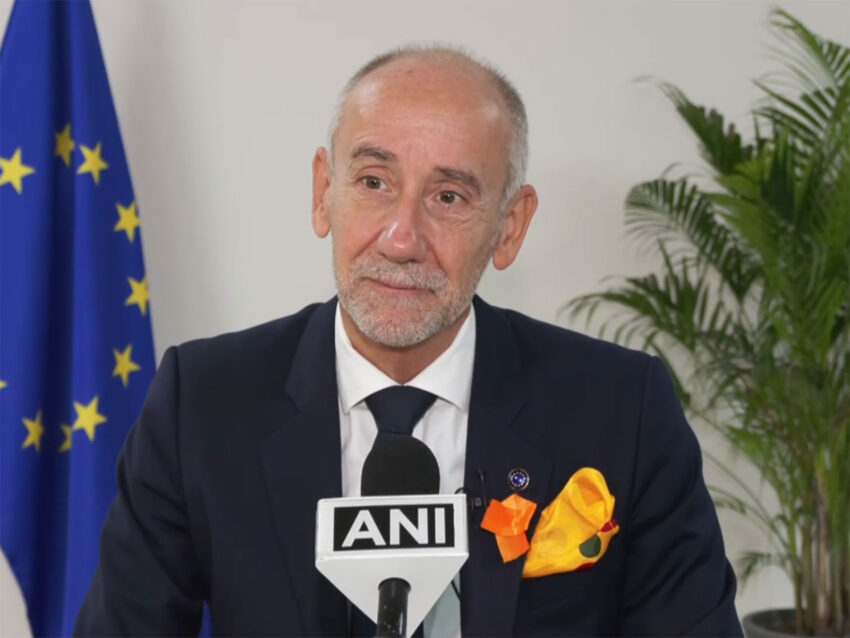
New Delhi [India], November 27 (ANI): Ambassador of the European Union to India Jean-Eric Paquet said on Friday that the landmark India-European Union Free Trade Agreement (FTA) will be formally signed on December 16 during Prime Minister Narendra Modi’s visit to Brussels and is projected to enter into force in the first half of 2027, cutting tariffs to zero on 99 per cent of Indian trade volume entering Europe and slashing Indian import duties on European wine in half immediately.
Speaking with ANI, Paquet noted that negotiations on the pact are complete and the agreement is ready for signature. Once signed, the deal will undergo scrutiny and approval by the European Parliament, a process the ambassador expects to move swiftly following recent engagements by European lawmakers in New Delhi.
“Well, the FTA is negotiated, is ready. So we will see it signed during the visit of the Prime Minister on the 16th in December. There are a number of other areas, of course, of cooperation where we will certainly also take stock of progress during the visit,” Paquet said.
Once the agreement is signed in Brussels, India’s domestic formalities will be largely complete, while the European side will move to parliamentary scrutiny. Paquet explained that the European Parliament has already closely followed the pact through multiple visits to New Delhi and will begin its approval process immediately after the signing.
“So the process is once the FTA is signed, I think on the Indian side this broadly completes the process. On our side, we have one more step to go through, which is the European Parliament scrutinising the agreement to give its assent. They will start working on it immediately after signature,” he said.
Pointing to recent discussions with the Chairman of the European Parliament’s Foreign Affairs Committee in New Delhi, Paquet voiced confidence that the ratification process will move swiftly toward implementation next year.
“He said that they will be extremely ambitious on the timeline, and he was also very optimistic on a positive outcome. So with that, we look at entry into force in the first half of ’27. I hope rather early in the first half of ’27, but the exact timeline will, I think, be clearer once the Parliament has started to work,” the envoy noted.
Highlighting the commercial impact of the pact, Paquet said bilateral trade—which stood at EUR 118 billion in goods in 2025—is poised for major expansion once duties are dismantled.
“Trade is extremely large already between Europe and India. The FTA will certainly allow a very strong acceleration of the growth of that trade. We see with FTAs usually growth doubles at least, as opposed to a situation without an FTA, to partners without one,” he said.
Detailing the tariff reductions, Paquet confirmed that duties will fall sharply as soon as the pact takes effect, benefiting both Indian exporters and European consumers across key sectors such as textiles, food, and high-value goods.
“Tariffs go down steeply for more than 80% of the tariff lines. We already go down to zero at entry into force, and then progressively for the others. And you’re right to say that 99% of the trade volume covered by India to Europe will enjoy these fully liberalised tariffs,” Paquet explained. “The European consumer will benefit from cheaper textiles and food, but also probably more high-value products which India also exports to Europe will all benefit from these lower tariffs.”
Conversely, Indian consumers and supply chains will see immediate price drops on European imports, most visibly on iconic European products.
“Indian people who engage with me in Delhi always mention wine and cheese. And indeed, on wine, the reduction will be 50% at entry into force, so wine tariffs will go from 150% to 75% as the deal enters into force. So it will be visible immediately here in India as well,” Paquet said.
Beyond trade in goods, the ambassador emphasised that the agreement opens significant new avenues in services and professional mobility for companies on both sides.
“With the liberalisation of services, Indian companies will be able to dispatch Indian workers short-term to render IT services, for example, services also related to the goods. And the same for Europeans here in India. For example, on insurance or financing, there will be much easier access to the Indian market. And that in itself supports trade, supports work on supply chains,” he said.
Alongside the FTA, Paquet made a strong push for negotiators to wrap up the parallel Investment Protection Agreement within the remaining two weeks before the December 16 summit, calling it a “very powerful” signal to industry and investors on both sides.
“What we are discussing is connecting India’s economy with Europe’s economy, the biggest internal market in the world with the fastest-growing economy. And that’s very much about supply chains, making them more resilient, de-risking them. So this is not just trading on these supply chains; it’s also investment. So having an Investment Protection Agreement would be very powerful as a signal. So I can only encourage the negotiating teams to make progress. There are two weeks left,” he said.
Reflecting on his tenure in New Delhi so far, the EU envoy praised the momentum across Indian business, research, administration, and defence sectors, calling the level of engagement “quite remarkable.”
“I’m impressed by the momentum of our strategic partnership and agenda. I think all the actors I meet in India, be it in business, in research, of course partners in the administration, are very focused on ensuring, together with their European partners, that we deliver on that agenda, be it on trade, on investments, on research, on technological cooperation. Also, defence industries are very interested. So the level of energy and engagement is quite remarkable and beyond what I had expected,” Paquet said.
When asked whether progress can be expected in the negotiations on the Investment Protection Agreement during PM Modi’s visit, the EU envoy said, “That’s what, I think, we should work towards. It’s difficult for me to say today whether that can be done. My own assessment of the ongoing negotiation is that the remaining items are obviously the last ones and therefore the politically and technically more relevant and possibly more difficult ones. I don’t see any of these items as not being solvable. So I would, as I said earlier on, really encourage the two negotiating teams to get it over the finish line. Announcing it at the occasion of the visit would be a particularly strong outcome and signal.” (ANI)