

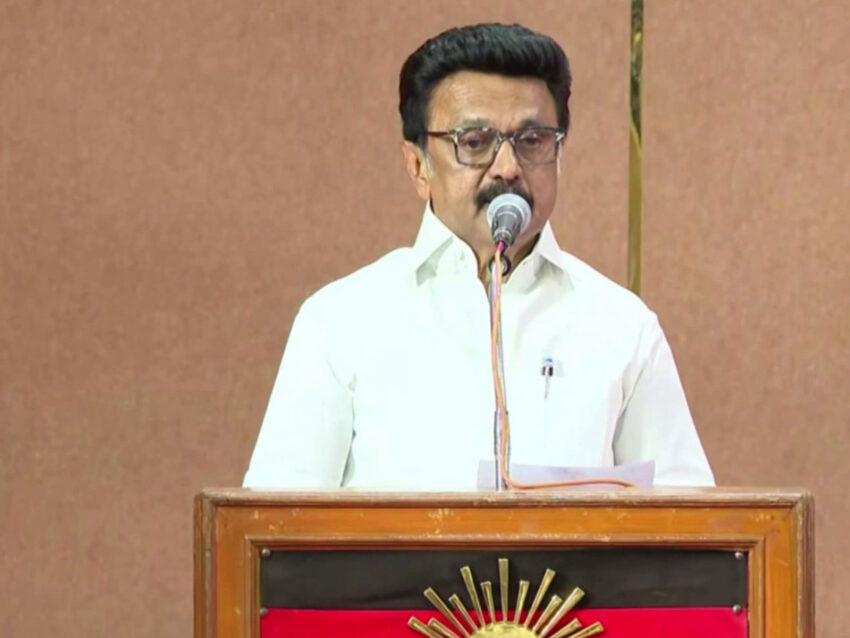
Chennai (Tamil Nadu) [India], November 27 (ANI): Former Tamil Nadu Chief Minister and DMK chief MK Stalin on Friday reiterated the party’s demand for safeguards to protect the state’s share of representation in the Lok Sabha amid the debate over the proposed delimitation exercise, asserting that there would be “no question of any compromise” on Tamil Nadu’s interests.
In a post on X, Stalin wrote, “The DMK was the first in India to raise its voice against the dangers of delimitation! It was only in Chennai that political leaders from across the country came together for the first time to demand fair delimitation.”
Stalin further reiterated two demands concerning the allocation of Lok Sabha seats among states.
The first demand is that Tamil Nadu’s existing 7.18 per cent share of seats in the Lok Sabha should not be reduced, even if the total number of parliamentary constituencies is increased.
The second demand is that the existing proportion of parliamentary representation among states, determined based on the 1971 Census, should remain unchanged for another 25 years.
Reiterating the party’s position, the Stalin said there was no change in its stand and ruled out any compromise on the demands.
“The DMK stands firm on these two demands and will continue to do so. There is no change in our position, and there is no question of any compromise!” he said.
Stalin also criticised political leaders whom he accused of abandoning their principles for positions of power, asserting that media speculation and criticism would not weaken the DMK’s resolve.
“Neither the speculations being circulated in the media nor the wails of backstabbers can shake our resolve. The DMK will never compromise on Tamil Nadu’s interests. Nor will it depart from its principles!” he added.
The delimitation issue has remained a major concern for southern states, including Andhra Pradesh, Telangana, Tamil Nadu, Kerala and Karnataka. These states have expressed apprehension that a population-based redistribution of parliamentary seats could reduce their relative share of representation compared with states that have recorded higher population growth.
Under the existing constitutional framework, the allocation of Lok Sabha seats among states has been retained based on the 1971 Census, with the freeze extended until the publication of the first Census after 2026. The debate has consequently centred on balancing population-based representation with concerns of states that have pursued population stabilisation.
The issue has gained attention ahead of the reconvened Parliament session scheduled to begin on November 30. The Lok Sabha Secretariat has announced that the second part of the Eighth Session of the Eighteenth Lok Sabha will commence on November 30 and is likely to conclude on December 3, subject to the exigencies of government business.
Union Parliamentary Affairs Minister Kiren Rijiju said the government had requested the Lok Sabha Speaker and the Rajya Sabha Chairman to reconvene the Lower House on November 30 and the Upper House on December 2, respectively, to transact essential government business.
Although the government has not specified which Bills will be taken up during the sittings, the announcement has intensified speculation over the possible introduction of the Delimitation Bill and the implementation of women’s reservation.
Parliament last met during the Monsoon Session 2026, which concluded on August 13, with both Houses adjourned sine die. The proposed Delimitation Bill aims to increase the strength of the Lok Sabha to 850 seats. (ANI)