

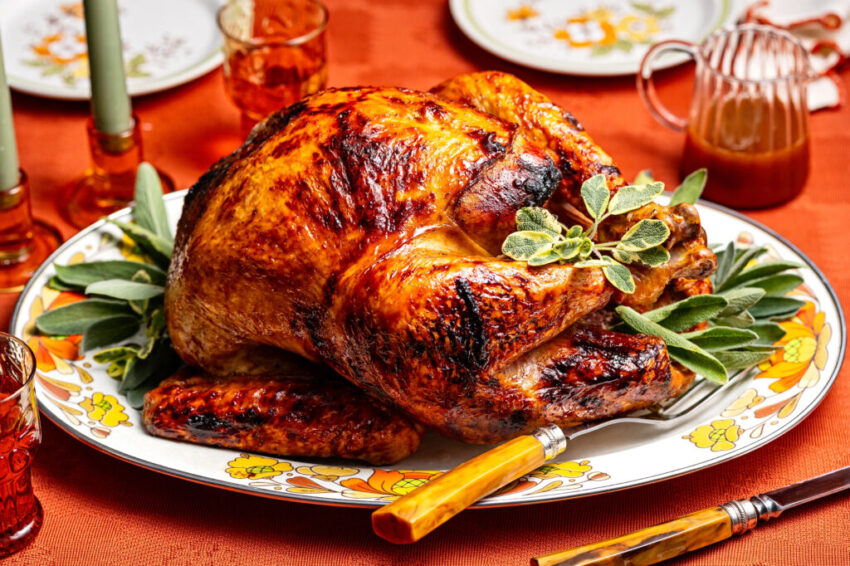
Every Thanksgiving, I look forward to roasting the turkey. It is one of my favorite things to cook and also one of the least fussy. (Yes, really.) Sometimes it’s a bird I’ve specially reserved from my favorite stand at the farmers market. Other times I’ve managed to snag it on sale or order it from my butcher. But no matter its provenance, the result is always a juicy, flavorful turkey, with lacquered, crispy skin. It never fails to impress, and it’s because I follow a few simple tips that all but guarantee success. And because I want everyone to confidently produce a delicious Thanksgiving turkey, I’m sharing these suggestions with you here.

Dry the turkey well before roasting
The most enviable Thanksgiving spreads include a beautifully burnished turkey, with skin so crisp you can almost hear it shattering when you bite down. To achieve that, you need to thoroughly pat dry the meat inside and out – with plenty of paper towels – because any residual moisture will cause the turkey to steam instead of roast. Make sure that you also do the turkey cavity, too, as it always harbors more liquid than you might think. (While you’re at it, make sure you’ve removed the giblets, if they’re included.)
If time (and refrigerator space) are no object, a great way of drying the turkey is by seasoning it all over with salt up to three days before cooking and letting it sit in the fridge uncovered. The dry brine flavors the meat, while the refrigerator air will remove excess moisture from the bird and tighten the skin, which will render it crispier.
Protect the white meat
White meat is leaner than dark meat, and the longer it cooks, the drier it gets. Dark meat, on the other hand, has a more forgiving temperature range and “becomes more tender the longer it cooks, as more connective tissue breaks down,” writes former staff writer Aaron Hutcherson. The differences in timing and response to heat present a conundrum if you’re roasting the turkey whole, which many people do. To keep the breast meat tender and moist, slow down its cooking by tenting it with a double layer of heavy-duty aluminum foil. This will allow for the white and dark meat to finish at roughly the same time. Another way to even out the cook time is by spatchcocking the turkey – removing its backbone and cracking its breastbone for a flattened bird.
ADVERTISEMENT

Don’t baste the turkey
Last year I started a small kitchen controversy by telling readers to stop basting their turkeys. I confessed that I stopped this practice more than 20 years ago, all because of Alton Brown’s science-based explanation. According to Brown, basting is not only ineffective but also inefficient. The basting juices can’t penetrate the turkey skin, plus you are adding more moisture to the skin, which not only will not make the meat moist but also will prevent the skin from crisping up. Additionally, a water-based basting liquid causes significant cooling, and when that energy is drawn out of the turkey, it extends the cook time, thus drying out the meat.
Use a leave-in probe thermometer
Whenever I hear from people that they don’t like turkey because it’s dry, I suspect it’s because they’ve been eating meat that’s been overcooked. But this doesn’t have to happen to you! To ensure turkey success, invest in a leave-in probe thermometer – many come with an alarm that goes off when the desired temperature is reached – to keep track of the temperature without having to constantly open and close the oven, which can slow down the cooking and contribute to a drier bird. I’ve used the inexpensive Polder Deluxe Preset In-Oven Thermometer for years, and have also gifted it to friends and family.
To use it, stick the probe of the thermometer into the thickest part of the thigh away from the bone, and remove the turkey from the oven once the temperature reaches 150 degrees. Let the turkey sit, still with the probe in its thigh, until the carryover cooking pushes the internal temperature to 165 degrees.
And if you think you don’t need a probe thermometer because many turkeys are sold with those plastic pop-out timers, let me give you some useful advice: Ignore them. They are notoriously inaccurate, and by the time they pop out of a turkey, it’s about as juicy as particle board.
Let the turkey rest before carving

While the desire to dig into your Thanksgiving turkey might be great – after all, you’ve been waiting for hours, your kitchen smells amazing, and you and your guests are hungry – you need to let the bird rest, for at least 30 minutes and up to 1 hour (but no more than 2!) before you slice it. The resting time allows for carryover cooking and for the meat to start cooling down a bit. This also lets the internal pressure of the bird decrease, which will help minimize the loss of juices. Don’t tent it with foil, as that will slow down the cooling process. Instead, use that waiting time to transform the turkey drippings into delicious gravy.