

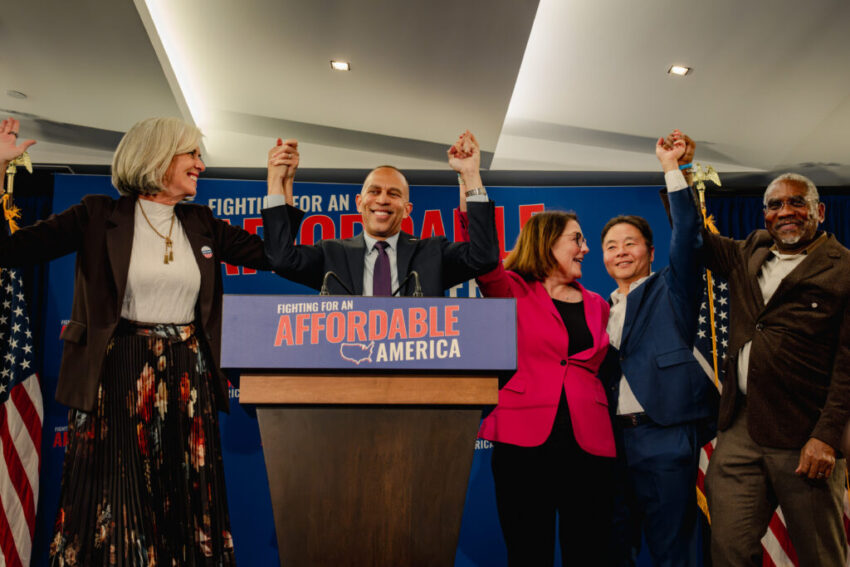

The American voter dealt President Donald Trump a historic rebuke on a scale not seen since 1974, propelling Democrats into control of both houses of Congress with commanding wins in places they hadn’t carried in decades.
Democrats won both the Senate and governor’s races in Texas – their first statewide victories there since 1994. They took a U.S. Senate seat in South Carolina and the Georgia governorship for the first time since 1998. Kansas sent a Democrat to the Senate for the first time since 1932.
Among their early House victories were a Kentucky district that voted for Trump by 15 points and two Florida seats that Republicans redrew to shift right. The head of the House GOP’s campaign arm trailed in his own race with 99 percent of the vote counted. As of 12:01 a.m. Wednesday, Democrats led in every competitive House contest.
The leftward swing extended across demographics and geographies. Compared with 2024, the exit poll conducted for the Associated Press and the major television networks showed double-digit swings toward the Democrats among Latinos, Catholic voters and voters younger than 30.
ADVERTISEMENT

Republicans also suffered from a collapse in turnout, as fewer of their supporters showed up on Election Day than four years ago, according to preliminary turnout data. Sixty percent of voters said they disapproved of Trump, and 81 percent of them voted for Democrats, according to preliminary results from the NORC Civic Health & Elections Project survey, which was sponsored by The Washington Post and other organizations.
Voters named the economy, health care and the war with Iran as their top issues, the survey showed. Just 12 percent said their family was getting ahead, while 29 percent said they were falling behind. Democrats had a 12-point advantage with voters who named the economy and jobs as their top concern, who made up a majority of the electorate. Two years ago, such voters favored Trump by 20 points.
Voters without college degrees, who favored Trump by more than a dozen points in 2024, went for Democrats this year by about 49 percent to 47 percent. Democrats also narrowly won with men, who voted for Trump by 55 percent to 43 percent in 2024.
Democrats will take power on Capitol Hill eager to thwart Trump’s agenda and investigate scandals throughout his administration. Rep. Robert Garcia (California), the ranking Democrat on the House Oversight Committee, previewed investigations into the Trump family, immigration enforcement and the Jeffrey Epstein files.
“The American people have spoken all across the land,” said House Minority Leader Hakeem Jeffries (D-New York). “This is a change election, and we understand as House Democrats that we need to deliver dramatic change. Things are broken.”
In interviews as the results came in, Trump vowed to wield his veto pen to force Democrats to compromise. He distanced himself from the results and cast blame on other Republicans. He also declined to name his preferred successor and left open the possibility of a competitive primary in 2028.
“I don’t like to consider it a defeat for me, I wasn’t on the ballot,” he said on Fox News, after campaigning for two months telling his supporters at least 41 times to “pretend I’m on the ballot.”
“No matter how good the president is, you lose.”
Addressing the Iran war, Trump said, “Historically I think I’ll be judged for doing the right thing. But that gave us an evening that was not that pleasant.”
Throughout the fall campaign, Trump and Democrats agreed on wanting to make the election about him. Republicans in tough races increasingly broke with him on tariffs and the Iran war as voters felt the pinch of higher prices.
In 1974, Americans punished Republicans for the Watergate scandal that led to President Richard M. Nixon’s resignation. That year, Democrats picked up four Senate seats, 45 House seats and four governorships with a 17-point edge in the popular vote. (Republicans gained 54 seats in 1994 from a popular-vote advantage of only about 7 percent. Over the decades, gerrymandering has narrowed the field of competitive House races.)
The president’s party typically loses congressional seats in midterm elections. Unlike many past elections in which presidents have suffered from events over which they had little control – a recession, for example – Trump’s steady drop in polls over the past year and a half followed directly from his own policy decisions, including his tariffs, the decision to launch a war against Iran and his opposition to the release of the Justice Department’s files on Epstein, the late financier and convicted sex offender.
The early results were consistent with pre-election polls showing Democrats favored to win both chambers of Congress. Trump’s approval sank to a record low of 33 percent in October, according to a Washington Post-ABC News-Ipsos poll. For the first time in more than a decade, more voters trusted Democrats to deal with the economy, as about three-quarters of Americans disapproved of Trump’s handling of inflation and the cost of living in the United States. Seventy-two percent said the country was heading in the wrong direction.
That public dissatisfaction overpowered the GOP’s advantage in campaign spending. Trump’s super PACs pumped at least $380 million into midterm races, with another more than $400 million from Elon Musk, the world’s richest man, according to federal disclosures.
The midterms were the most expensive election ever, topping past cycles that included presidential campaigns, according to media tracker AdImpact. Republicans spent $5.45 billion on advertising across TV, radio and digital, and Democrats spent $5.02 billion.
Texas’s Senate race between Republican Ken Paxton and Democrat James Talarico became the most expensive non-presidential race ever, costing more than $500 million, according to AdImpact. Talarico led by about 11 points with 88 percent counted, winning nearly two-thirds of independent voters. In Kansas, nearly 7 in 10 independents supported Democrat Adam Hamilton, who beat incumbent Republican Roger Marshall by about five points.
Democrats also made inroads with Trump voters and people who did not cast ballots in 2024, according to the NORC poll. In four states where Democrats flipped Senate seats – Iowa, Kansas, North Carolina and Texas – about 1 in 10 Trump voters supported the Democrat. Fifteen percent of this year’s voters didn’t participate two years ago, and they supported Democrats by about 20 points.
Democrats picked up a Senate seat in North Carolina, where former governor Roy Cooper beat former Republican National Committee chairman Michael Whatley. The Republican incumbent, Thom Tillis, did not seek reelection after crossing Trump last year.
Sen. Jon Ossoff (D-Georgia) cruised to reelection, and former Atlanta mayor Keisha Lance Bottoms became the nation’s first Black woman to be elected governor. Rep. Chris Pappas (D) easily won a Senate seat in New Hampshire.
“When I first talked about taking back the Senate in 2025, people rolled their eyes. They said it couldn’t be done,” Democratic leader Chuck Schumer of New York said. “There is now a generational remake of the Senate map.”

In Ohio’s gubernatorial contest, Republican Vivek Ramaswamy lost to Democrat Amy Acton after bipartisan backlash to an attack ad featuring her estranged mother. Democrats also flipped the executive mansion in Iowa and led early returns for governor in Nevada and Alaska.
The election mostly ran smoothly despite concerns from Democrats and some election officials that Trump officials might try to use federal power to favor Republicans.
Top election officials in Michigan and New Mexico complained to the Justice Department on Tuesday about what they described as unusual behavior by federal election monitors deployed to polling sites in their states. The Department of Homeland Security did not deploy immigration officers to voting locations.
In Alaska, Trump has demanded the disqualification of the Democratic Senate nominee, Mary Peltola, after the New York Times reported that operatives aligned with her helped recruit an independent candidate with the same name as the incumbent Republican senator, Dan Sullivan.
“I’ve heard from people who think they’ve voted for the wrong guy and have apologized to me,” Sullivan told a Fox News reporter on Tuesday. “The scheme is working.”
In the final weeks of the campaign, Trump’s closing message insisted that the economy was booming – contrary to most Americans’ experience. As in his past campaigns, he attacked Democrats, calling them “communists,” “freaks” and “jihadists.”
“These are the couple of points where I just leave because they’re so good,” he said, citing positive economic statistics when he spoke in Lubbock, Texas, a week before the election. “The rest is just – we’re wasting frickin’ time,” he said – a recurring bit that he reprised at numerous rallies.
He called Democratic Senate nominee Abdul El-Sayed of Michigan, who is Muslim, a “jihadist” and said Black and Jewish Americans would be “crazy” to vote for him; demanded the ouster of Rep. Ilhan Omar (D-Minnesota) and the prosecution of Peltola; used an offensive nickname for Democratic Senate nominee Annie Andrews of South Carolina; mimed an imaginary incident of Talarico vomiting after eating meat; and joked that a $5,000 stimulus he promised citizens if Republicans won would barely cover a hamburger and “maybe a small dessert” at his Mar-a-Lago Club in Florida.
Interruptions from protesters frequently punctuated his rallies. Often, they cited the investigation into Epstein, who had been a friend of Trump’s years ago.
Trump spent election night watching the results with Cabinet officials and advisers in the East Room of the White House. He repeatedly posted critiques of Fox News’ coverage and said on social media that he would “become a Political Pundit” and openly discuss why Republican candidates lost.
As the Democratic wins piled up, the president posted a statement on his Truth Social site: “I wasn’t on the Ballot and if I was, we would have won IN A LANDSLIDE!”