

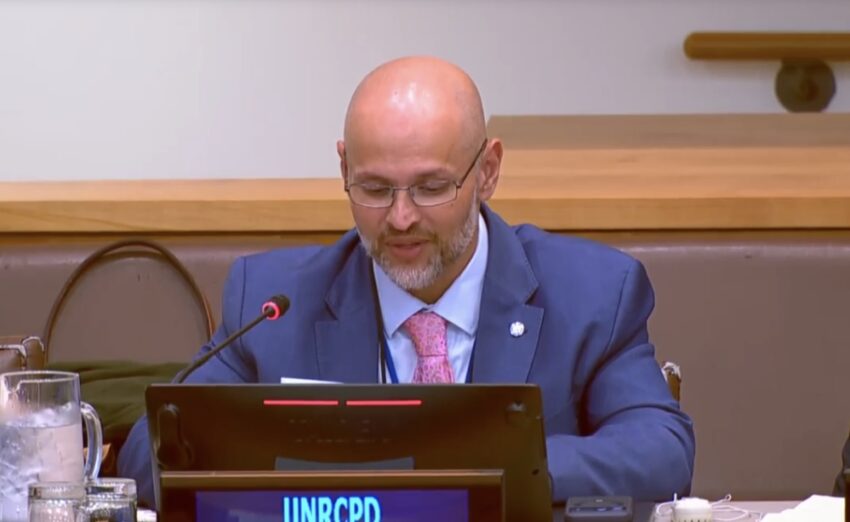
United Nations – Despite a fragile operational environment, the Asia-Pacific member states consistently demonstrate a firm dedication to open dialogue and the reinforcement of established arms control norms, stressed Deepayan Basu Ray, Director of the United Nations Regional Center for Peace and Disarmament in Asia and the Pacific (UNRCPD).

Basu Ray was presenting the comprehensive annual report detailing the organization’s activities and outlining the complex security environment confronting the Asia-Pacific region at the UN General Assembly’s First Committee during its 20th plenary meeting on a thematic discussion on regional disarmament and security.
Established in 1987 under General Assembly Resolution 42/39 D and operationalized in 1989, with its headquarters subsequently relocated from New York to Kathmandu, Nepal, in 2008, the UNRCPD continues to serve its 43 regional member states by bridging critical strategic gaps.
The briefing, submitted alongside related reports under Secretary-General’s document A/81/153, outlined how the Center has successfully connected regional governments, independent experts, and practitioners over the past year.
ADVERTISEMENT

“In a region where sustained disarmament dialogue remains limited, networked communities of practice have expanded opportunities for peer exchange, strengthened regional expertise and created more durable channels for cooperation beyond individual activities,” Basu Ray stated.
Outlining the core operational pillars of the Kathmandu-based Center, Basu Ray added, “In this regard, UNRCPD has continued to develop and deliver on its mandate and support Asia Pacific member states in three principal ways. First, by strengthening regional collaboration, second, by building partnerships, and third, by providing technical assistance on request.”
Basu Ray also highlighted that security challenges across the region remain uniquely complex due to deep-seated geopolitical diversity, persistent regional tensions, escalating military expenditures, and rapid technological breakthroughs in artificial intelligence, autonomous systems, and cyber capabilities. Basu Ray noted that ongoing intra- and inter-state conflicts continue to threaten human lives and jeopardize hard-won economic development both regionally and globally.
Detailing the specific nature of these vulnerabilities, Basu Ray stated, “The illicit proliferation of small arms, ammunition and other conventional weapons fuels, armed violence, organized crime and gender based violence across the region.” Compounding these dynamics are institutional capacity gaps, insufficient data availability, and shrinking avenues for multilateral diplomatic engagement, he said.
The Center made efforts during the past year to meet with some of these challenges, according to Basu Ray. Its efforts materialized through key regional initiatives, including the inaugural Small Arms and Light Weapons Fellowship launched in partnership with India, the China-ASEAN Biosecurity Workshop, the 24th annual Joint Republic of Korea-United Nations Conference, and the fourth iteration of the Disarmament Toolkit Training Program.
He reported the Centre advanced its institutional outreach by establishing collaborative frameworks on military expenditure and artificial intelligence, culminating in the upcoming launch of the Asia Pacific Disarmament Education Network.
Extending formal appreciation to the government and people of Nepal for hosting the UNRCPD, Basu Ray acknowledged Thailand for its annual contributions alongside voluntary financial support provided by China, India, the Republic of Korea, and the European Union.
Looking forward, Basu Ray stated, the UNRCPD intends to maintain its focus on high-priority security concerns for regional states, anchored by mechanisms such as the Arms Trade Treaty, the Voluntary Trust Fund, and dedicated bilateral contributions.