

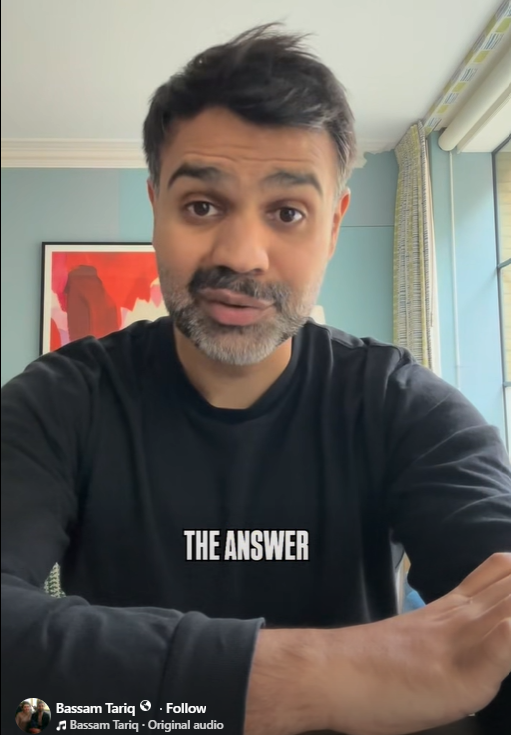

Filmmaking, says writer-director Bassam Tariq, is a long journey, “and you don’t know where or how things will come.”
He would know. His latest film, the thriller “Your Mother Your Mother Your Mother,” was years in the making. After a successful festival run, it’s now in theaters, earning rave reviews and early awards-chatter.
And the movie only exists because Tariq walked away from a Marvel movie.
The film stars two-time Oscar winner Mahershala Ali as Latif, a devout Muslim who also happens to be a hitman trying to solo-parent his three children after the sudden death of his wife. The youngest, a baby, will only take breast milk, and Latif embarks on a journey to feed his child, while dealing with violent ghosts of his past. Set in Houston, audiences meet religious crime bosses, right-wing zealots, porn-peddlers, Mormon missionaries and “reformed” strippers.
ADVERTISEMENT

Tariq started the script years ago and only picked it back up – with the urging of his longtime collaborator and friend Riz Ahmed – after leaving the stalled Marvel reboot of “Blade” in 2022. (Ali was also supposed to star in that film, but he has said the project is now defunct.)
The filmmaker beamed in from a hotel room in Chicago, where he was staying for a community screening of “Your Mother,” to talk about the work of moviemaking, his own creative process and the flash of inspiration that led to the film’s memorable last line.
“Your Mother” is stunning in part because of the contrasting threads it seamlessly weaves. It’s both violent and beautiful. Quiet and explosive. Funny, yet a portrait of grief. It’s also a meditation on faith. The film’s title references a Hadith, in which the prophet Muhammad is asked repeatedly who deserves the best treatment. He responds: “Your mother,” three times, then, finally, “Your father.”
Tariq is Muslim, as is Ali. It’s striking that a film like this – with complex characters who happen to be Muslim, navigating the different ways faith plays out for them – is being released in the current political and social climate of resurgent Islamophobia. The weight of representation for prominent Muslim Americans at such a fraught moment could be immense.
But Tariq’s film comes after a slate of works by other artists who have helped broaden the portrayals of Muslim characters, including those by Ramy Youssef, Mo Amer and Ahmed. He and Ahmed learned, Tariq says, that “we’ve got to be arm-in-arm in this stuff, and we have to build along with people from our community.”
Rather than seeing the artist as a solo auteur, Tariq says “I believe in a collective spirit. I believe that people come together to make great work.”
“Your Mother” is not Islam 101. Audiences are dropped into a mosques, prayers, Ramadan, without exposition. “What’s exciting about audiences, they want to be challenged. They want go into spaces and worlds that they haven’t stepped in before,” Tariq tells me. “I don’t know if a film like this would have been made 10 years ago.”
Tariq says he finds American audiences “are more open and accepting in a way that we haven’t seen before.”
The film was partially inspired by a real life quest Tariq undertook after his wife, who was nursing their newborn, was hospitalized and he needed to search New York City for donated breast milk.
But when I asked if he experienced a particular “a-ha” creative moment – a time when inspiration struck, or he unlocked a particular quandary in his process – he wanted shared the story of that last line of dialogue.
Our conversation is part of my own quest: to uncover the mystery of the human creative impulse, to discover the ways magic comes to us.
When I saw Ali’s Latif deliver this final line – a reply to a question posed by his teenage daughter – I found myself sobbing. Below is an excerpt of my conversation with Tariq, lightly edited for clarity and space. (And a small spoiler alert – we do discuss the actual line.)
Do you feel like you’re part of a tradition of artists making work exploring complex themes through characters who happen to be Muslim? Do you even think of this as a Muslim movie?
Tariq: Honestly, I feel like I’m more in a cinematic tradition of [Martin] Scorsese or [Francis Ford] Coppola when he made “Godfather,” and people were really upset in that [Italian American] community, like, “What did you just do?!” But at the same time, people were, like, “Oh my God, this is so beautiful. And yes, this is true and this is true.” I want to be a part of that discussion because I think this is what cinema allows. This is also what America is. This film can only exist in the context of the United States. These characters can only exist in the U.S. This is a uniquely American film. And there’s so many experiences of what it means to be American. To look at it from this Muslim lens felt really, really exciting to me.
When I go into a theater, I pray that a film will teach me something, because I’m here now for an hour-and-a-half, two hours. I need to learn something. It may not tell me the meaning of life, nor do I want it to – but I want to learn. I want to expand my heart and be more compassionate. And I believe that art is a vehicle for empathy.
When did you experience an “aha” moment in making “Your Mother Your Mother Your Mother?”
Tariq: I was sitting in London in a coffee shop – it was this Christian fellowship coffee shop in East London near Brick Lane. I was doing a commercial at the time, and I had some days off in between. And [as I’m writing], I’m just like, how do I end this moment with the daughter, where she says “Why did you leave me?” What is his response back?
When I wrote the line – “So I could find my way back to you.” – I remembered thinking, “That is so corny.’ But I was like, ‘F— it, I’m gonna be corny. I don’t give a s—.” Because so much of the journey [in the film] is you go to all these places to understand that this is what you needed to do to be where you are now. I remember some people feeling like, that’s some cheesy a– s—, but I was like, I don’t care. That’s how I want to end it. And I think Mahershala delivers it beautifully.
I remember that moment vividly in London, because it was a real tough day. It was a tough shoot. I’d come off a few projects that didn’t go so well. So I didn’t feel the best. And at that time, when you’re still [working] in a PDF or a Word document, it’s like, ‘Who’s going to believe in this?’ I feel the same way right now as I’m writing this new thing, banging my head against the wall trying to figure out a script. I just don’t know if it’s gonna land, but I just have to keep showing up.
Say more about “showing up.”
Tariq: The whole filmmaking process is a journey, and you don’t know where or how things will come, but you have to keep showing up. And it is so hard. It’s like showing up at the gym, and I hate going to gym. But you just gotta show up and then you do what you gotta do, and then leave. You always feel better as you’re leaving than you did before you come in, so I have to always remember that.
But even in that moment of writing that line, you had the impulse to self-edit yourself. You had that immediate reaction of, “This is corny.” What kept you from listening to that voice?
Tariq: I’m realizing that a part of art is to be corny, and it’s okay. I’m learning that it’s okay to have your heart on your sleeve. For so much of my time, my 20s, I tried to play it super cool.
There is a way to do these things where they can be more open and accessible, and you can still have that deep, creative integrity of the work. That’s something that I’m learning, and I think it’s a balance. I’m learning that I can fill it with a lot of corn balls, and it’s okay, because we can then bring it back. But to operate from a place of fear where I fear it being saccharine? That’s not healthy. It’s better to operate from a place of love – and then edit.