

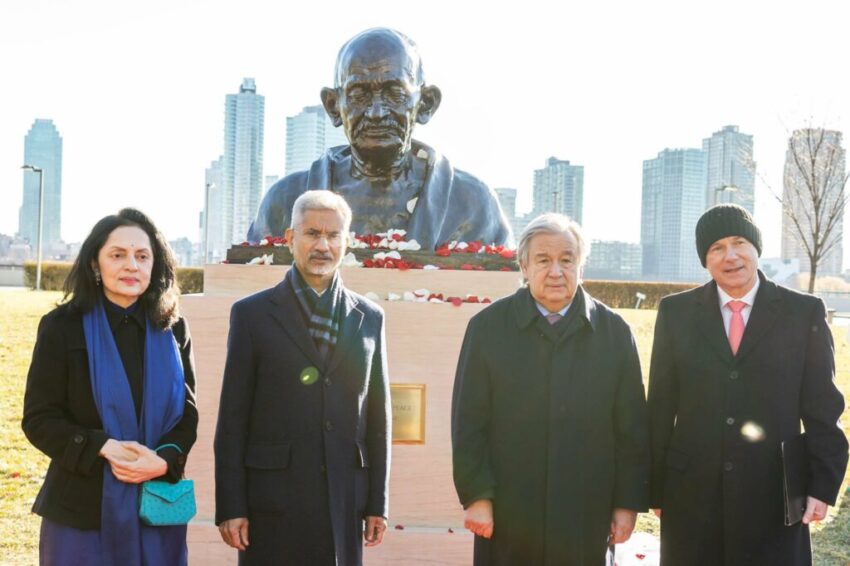
United Nations – October 2, Mahatma Gandhi’s birthday, is celebrated by the United Nations every year as the International Day of Non-Violence, with promoting education, public awareness, and special commemorative events that reaffirm a culture of peace and tolerance.

Key commemoration activities at the UN include official messages from the UN Secretary-General António Guterres and other global leaders emphasizing the power of peaceful protest, dialogue, and diplomacy over armed conflict.
The International Day of Non-Violence is unanimously recognized and celebrated by all 193 UN member states. When the UN General Assembly adopted resolution A/RES/61/271 in 2007 to establish the day, the initiative was co-sponsored by a massive coalition of 142 countries, showcasing universal global backing.
Every year on October 2, the UN celebrates it with special events at its headquarters in New York. The Permanent Mission of India to the UN, and missions of other countries, host special programs featuring discussions on non-violent conflict resolution, and tributes to Gandhi’s legacy. Events often draw attention to iconic symbols of peace situated at UN grounds, such as the Knotted Gun sculpture.
ADVERTISEMENT

UN Secretary-General António Guterres referred to this legacy of peaceful conflict resolution in his last year’s address. He noted that Gandhi’s core lessons carry a “renewed urgency”. He pointed out how rising economic inequalities, poverty, and geopolitical divisions are driving a wedge between societies, and urged member states to prioritize the tools of dialogue and international law over aggression.
The UN uses its global digital platforms, public exhibits, and cultural film screenings to disseminate messages about rejecting physical violence and utilizing active non-cooperation and peaceful persuasion.
While the day is observed universally across the globe, specific member states consistently hold high-profile, organized public commemorations, educational forums, or diplomatic events.
As the birthplace of Mahatma Gandhi, India leads the global observance, celebrating it as a major national holiday (Gandhi Jayanti) featuring state-led prayer services, national sanitation drives, and school events.
In the U.S., major civic programs and peace walks are held in Washington, D.C., Atlanta, and Dallas.
South Africa holds a deep historical connection to Gandhi’s philosophy, as his time living there birthed his concept of Satyagraha (truth-force). The day is used to link his legacy with Nelson Mandela’s anti-apartheid struggle.
European Nations including Spain, Belgium, the Netherlands, and Switzerland, and Southeast & Central Asian countries including Thailand and Kazakhstan Latin American Nations such as Brazil, also commemorate the International Day of Non Violence.
Since the UN explicitly designed the day to build a global “culture of peace, tolerance, and understanding,” it is celebrated with programs at the local schools, peace organizations, and embassies.
Last year marked the 156th birth anniversary of Mahatma Gandhi, and the UN focused its celebration on addressing global polarization and armed conflicts through targeted high-level discussions, symbolic gatherings, and educational campaigns.
The day began with high level commemoration at the UN Headquarters in New York hosted by the Permanent Mission of India to the UN. Celebrations featured specialized seminars and cultural exhibitions exploring how non-violence remains a practical blueprint for contemporary global governance.
Under the theme of “Non-Violence as a means to Peace and Development”, UN panels connected Gandhian principles directly to the UN’s three core pillars of Sustainable development, Human rights and humanitarian issues, and Peace and security.