

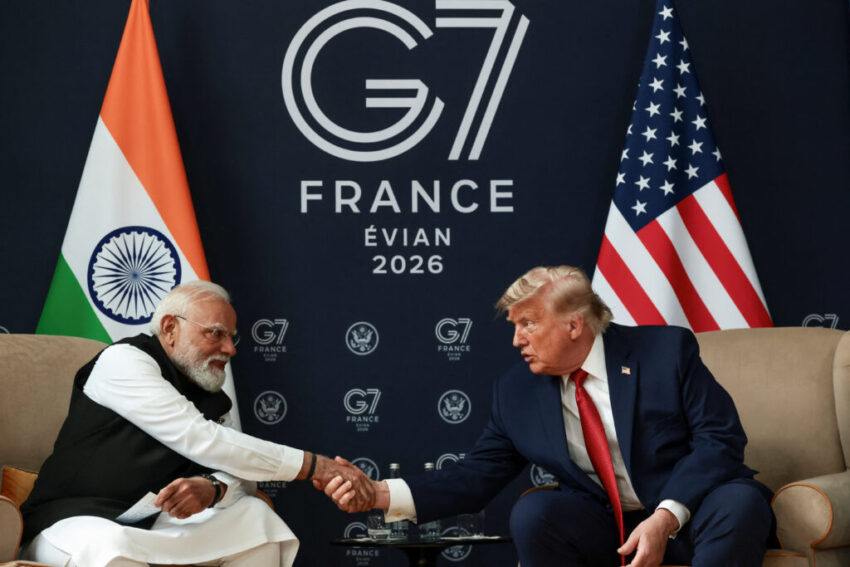
The US-India trade deal is very near completion, a senior State Department official indicated at a press briefing September 24, 2026, but stayed away from concluding that Secretary of State Marco Rubio’s planned October visit to India could be the decisive conclusion.

“I would say stay tuned, which we keep saying, but we are – we are very close – it’s like a 90-percent-plus there and just those final things being worked out, so I hope you’re going to see something very soon on that,” the official said, “And that’s really going to just unleash another level of U.S.-India relations, something that hasn’t really – we haven’t been able to get there in decades when it comes to trade. This has always been the most sticking point in the relationship. And so I think we’re very close and it’s going to be, I think, very, very exciting when we get there.”
The official spoke on numerous issues relating to India and the rest of the countries in South Asia, including the Lindsey Graham bill focused on Russia sanctions, an issue India’s External Affairs Minister S. Jaishankar raised as of great concern to India when he met Secretary of State Marco Rubio on the sidelines of the ongoing UN General Assembly meetings taking place in New York.

Regarding the Graham bill on Russia sanctions, the State Department official indicated it may not necessarily result in a heavy handed treatment of India and that the possibility of a waiver for India exists. The Graham bill gave President Trump “a new tool in his toolbox,” the official characterized it. “That doesn’t necessarily mean he deploys it tomorrow, but he has the opportunity to. His focus is on ending this war. It’s been something he campaigned on and something he’s been dedicated to from the beginning. We’re looking for our friends, especially like India, to help support that effort, but I think you’ll have to stay tuned on how the bill gets implemented. But there is a broad national security waiver, so you can imagine also the President – there’s a scenario the President uses that as well.”
ADVERTISEMENT

The official said they did not want to get ahead of the Rubio India visit, describing it for now as “all part of the continuous growth and attention to the U.S.-India partnership. There’s a lot happening,” in future G20 meetings as well as the Quad partnership of India, Japan, Australia and US.
As you said, we’re also going to have – we’re going to be hosting them for the G20, and so stay tuned for some big announcements on that front. There’s just a lot happening in the relationship. The spokesperson said the Quad meeting later in October may result in “some other exciting things.”
Regarding the India-Middle East-Europe Economic Corridor, IMEC, backed by Washington and New Delhi, the senior State Department Official described it as a huge priority for the two countries but one that is being held up by the volatile situation in the Middle East. President Trump, in a meeting with the Gulf Cooperation Council on the sidelines of the UNGA in New York, indicated he was in favor of the IMEC alternative route for shipping oil to the rest of the world.
The official noted that it was a priority for US and India, but that the countries in the Middle East including Saudi Arabia, UAE, Jordan, as well as Israel, have to iron out issues.
“IMEC is absolutely a huge priority of the United States and of India. The problem – I shouldn’t say the problem. The challenge is that so much of it lies in the Middle East. And that’s where – I think on the India side and on the U.S. side, we’re ready to go. But because of some of the challenges we’ve had over the years, starting from the beginning of the administration – the President came in and we were still dealing with Israel/Gaza. That certainly paused things,” the official said.
“…. when things can stabilize, you’re really going to see IMEC take off,” the official contended.
ADDON from ANI
The IMEC was launched in September 2023 at the G20 Summit in New Delhi, with a founding memorandum signed by India, the United States, Saudi Arabia, the UAE, the European Union, Italy, France and Germany.
The corridor has two main strands – an eastern leg connecting India to the Gulf, and a northern leg linking the Gulf to Europe via West Asia and the Mediterranean.
The project is intended to improve connectivity, cut transport costs, strengthen regional supply chains, widen trade access, and build closer energy and digital ties.
Rather than a single rail line or pipeline, the corridor is envisaged as a linked chain of ports and railways: goods from Indian ports would travel by sea to a Gulf port such as Fujairah, then by rail through Saudi Arabia and Jordan to Israel’s Mediterranean coast — with Haifa as a key hub — before continuing by sea to ports in France, Italy and Greece.
Trump described IMEC in February 2025 as “one of the greatest trade routes in all of history,” but analysts continue to view it as a long-term infrastructure ambition rather than a near-term alternative to existing energy transit routes.