

It used to be conservatives who wanted to tread carefully with new things. These days, it’s progressives sounding the alarm on artificial intelligence. And I’m not just talking about the risk of human extinction.
Two of the country’s largest school systems have dramatically restricted AI access for students this year. They also happen to be bastions of coastal progressivism. Conservative parents, take note.

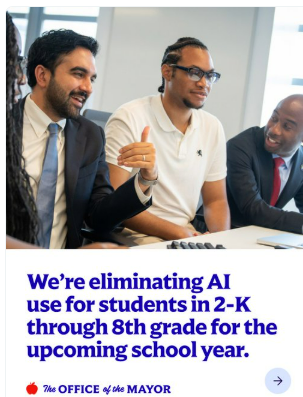
For the 2026–2027 school year, New York City’s Department of Education passed sweeping rules forbidding students from using AI until high school. Learning apps with AI features will be removed from student devices. Companion chatbots will be banned in all grades.
And not only that. Screens of any type will be banned in New York City public schools until third grade. Goodbye to school-issued tablets starting in pre-K and kindergarten, a practice that’s become widespread in the last five years. Hello to limits on screen time, including a 45-minute cap for middle schoolers.
ADVERTISEMENT
The West Coast has taken it a step further. The Los Angeles public school system passed a districtwide moratorium on AI for all grade levels that applies to all school-issued devices.
This is exactly the kind of “common sense” reform that Republicans could use to define themselves heading into the midterm election. Since the Covid pandemic, Republicans have enjoyed an upper hand on education issues. There were the demonstrably harmful and lingering effects of extended school closures, promulgated largely by progressive districts. There were Biden’s efforts to block charter schools, despite their proven successes at boosting student achievement. And there were culture-war arguments that made Democrats appear more concerned about pronouns than whether kids could read.
But for all the emphasis Republicans have put on protecting children, students in Zohran Mamdani’s New York are going to be less screen-soaked than those in Greg Abbott’s Texas – where, per my sons’ experience in the public schools, there’s many a screen-based recess.
The Dallas Independent School District – one of the largest in Texas – has AI guidance for families that reads: “See how AI is enhancing your child’s learning,” and “Sit with your child while they use AI. Treat it like reading a book together.”
Keeping AI out of public schools isn’t going to do anything to slow development of the technology. Nor does it have anything to do with what happens at home; data from Common Sense Media and elsewhere suggest that AI use among teens is already ubiquitous. That’s a problem for another day.
What progressives in New York and LA are saying is that when it comes to educating our nation’s children and teaching them how to think, we are going to do it the old-fashioned way. That’s a message that more conservative districts ought to get behind.
Because the recent experiments we’ve been running in public education aren’t working. The newly released Program for International Assessment (PISA) found that 15-year-old US students’ reading scores have fallen near their lowest level in 25 years, with a 14-point drop in the last three years alone – as is the case across much of the developed world. (The report also says that half of students use AI for education.)
Our domestic tests, such as the Nation’s Report Card, show similar lost ground. Less than half of American students are reading or doing math at grade level.
To be sure, AI and screens are only two of many factors that may have pushed down student scores over the last decade. Others include absenteeism, which rose during Covid and has persisted since; scrapping traditional teaching approaches such as phonics and multiplication tables; and lots of testing with little accountability for underperforming schools, teachers and students. That’s a wide-ranging group of possibilities.
So perhaps AI presents a convenient scapegoat for challenges that are much more difficult for schools to solve. Nevertheless, we should solve what we can. The last thing American students need amid already-sagging scores and declining skills is AI slop in the classroom.
Americans’ satisfaction with the quality of K-12 education in the US has fallen to 32%, a new low in Gallup’s 27-year survey. It’s down 11 percentage points over the past two years. Democrats, Republicans and independents are almost equally disappointed.
Revealingly, schools received the highest marks on preparing students to adapt to new technologies. In contrast, only 4% of Americans believe that schools are preparing students to critically think and solve problems. This is backwards.
A generation of children is no longer learning at school like they need to. There are a lot of reasons for this. But allowing AI to supplant the basics of reading, writing and arithmetic should not be added to the list.
Conservatives of all people should know it – and demand their school districts follow the examples set by New York and Los Angeles. On this issue, anyway.
More From Bloomberg Opinion:
• There’s Only One Way to Make AI Safe for Kids: Abby McCloskey
• A US-China Pact on AI Is Possible, But Not by Posturing: Dave Lee
• AI May Reverse Political Polarization. Don’t Get Excited Yet: Stephen Mihm
This column reflects the personal views of the author and does not necessarily reflect the opinion of the editorial board or Bloomberg LP and its owners.
Abby McCloskey is a columnist, podcast host, and consultant. She directed domestic policy on two presidential campaigns and was director of economic policy at the American Enterprise Institute.