

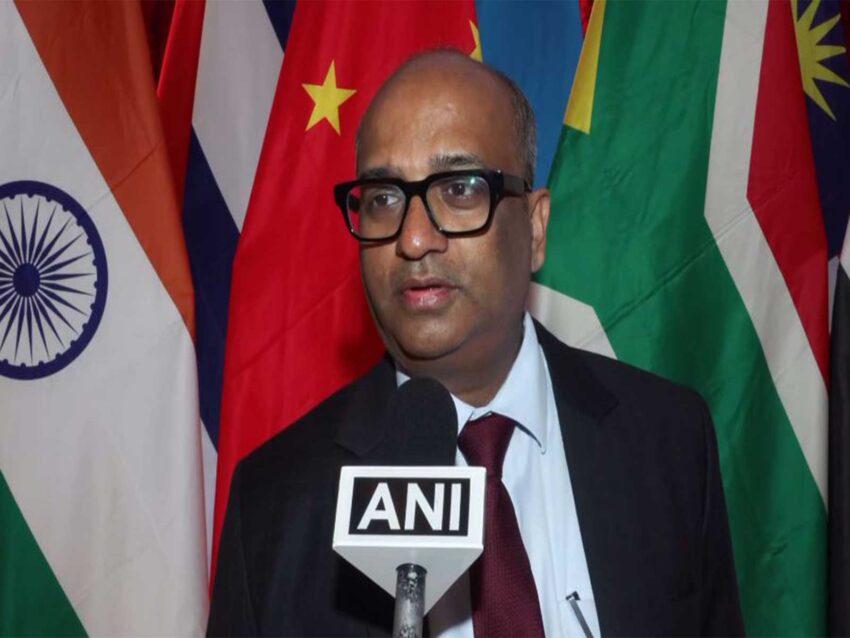
New Delhi [India] September 13 (ANI): The National Testing Agency (NTA) is looking beyond India’s borders, envisioning a future where its indigenous examination framework serves as a scalable digital public good for other nations, including the BRICS bloc, according to NTA Director General Abhishek Singh.
Speaking to ANI on the sidelines of the 18th BRICS Summit in New Delhi, Singh outlined the agency’s dual roadmap, consolidating domestic systems to ensure error-free, fair assessments while laying the groundwork for international technology sharing and cross-border examination services.
Before offering solutions internationally, the NTA’s immediate operational priority remains strengthening its core infrastructure within India.
“Right now we are trying to consolidate our own testing framework. So first is to improve the systems and strengthen the processes within India so that we are able to conduct examinations without any error and in a completely fair manner. And once we have done that, the way we are visualising it is that we should be able to create something that can become like a digital public good that can be adopted by other countries, including the BRICS countries,” said Abhishek Singh.
Addressing ongoing security challenges, the NTA DG emphasised that artificial intelligence (AI) and biometric verification are central to the agency’s fraud-prevention strategy.
“We are currently looking at the use of AI for conducting not only testing but also fraud prevention, trying to look at logs, trying to look at data, trying to look at analytics in order to ensure that examinations are conducted without any error or without any problems,” he said.
In candidate verification, Singh highlighted India’s robust digital infrastructure as a solved problem, “We have Aadhaar based and face authentication method, which you use to verify there. So that is not a problem. With this Aadhaar database and the face authentication system, we have solved that problem and we are using that face authentication framework in almost every examination that we conduct.”
NTA systematically utilizes biometric and Aadhaar-backed facial authentication at exam centres to prevent impersonation and fraud.
Singh reaffirmed that pen-and-paper formats are being phased out in favour of Computer-Based Testing (CBT), including major national entrances like NEET.
“Our examinations are CBT except the NEET examination. And NEET will also be moving to CBT very soon. CBT requires augmenting this testing infrastructure, building up safeguards. So that is the future. Currently, the JEE examination, the UGC NET examination, the CUET examinations, the NIFT examinations all are done in CBT. So CBT is the future, so all our examinations will be CBT in the days to come,” said NTA DG.
NEET is currently pen-and-paper; transitioning to CBT soon. Most major NTA entrance tests (JEE Main, CUET, UGC NET, NIFT) run on CBT. NEET UG remains the primary major paper-and-pencil exam, with ongoing policy initiatives targeting a CBT transition.
While cross-border testing is on the horizon, Singh made it clear that domestic perfection must precede global expansion. “Cross-border examinations are again the next step. Our endeavour right now is to improve our systems so that we are able to conduct Indian examinations in a fair and transparent manner without any malpractice or without any error or without the need of having any review of our own systems. Once we have strengthened our own domestic systems, then we will go for conducting examinations for other global bodies.”
Highlighting global shared learning, he pointed to international practices such as China’s Gaokao exam, “There are multiple ways; there are multiple ways every country faces this challenge. It’s not that examinations are conducted only in India; examinations are conducted globally. Chinese examination, Gaokao, is a parent paper examination about which a lot has been heard, about how they shut down whole cities and conduct the examination. So every examination will require the generation of question papers. So there are areas in which we can discuss with each other, collaborate and share knowledge.”
Chinese “Gaokao” mentioned as a paper-based exam notorious for citywide security lockouts.The National College Entrance Examination (Gaokao) in China is a high-stakes, paper-based test known for citywide traffic rerouting, noise bans, and heavy security deployments.
18th BRICS Summit is hosted by India in New Delhi (Sept 12–13, 2026), with China hosting next in 2027. It aligns with the rotational host calendar of the BRICS grouping following Brazil (2025), putting India as host in 2026 and China in 2027. 2026 marks India’s fourth BRICS Chairship (previously hosting in 2012, 2016, and 2021).
Earlier in the day, Prime Minister Narendra Modi extended his best wishes to China, which will host the grouping’s next summit in 2027, as he said that the world now expects “concrete results” from BRICS as it enters its third decade. (ANI)