

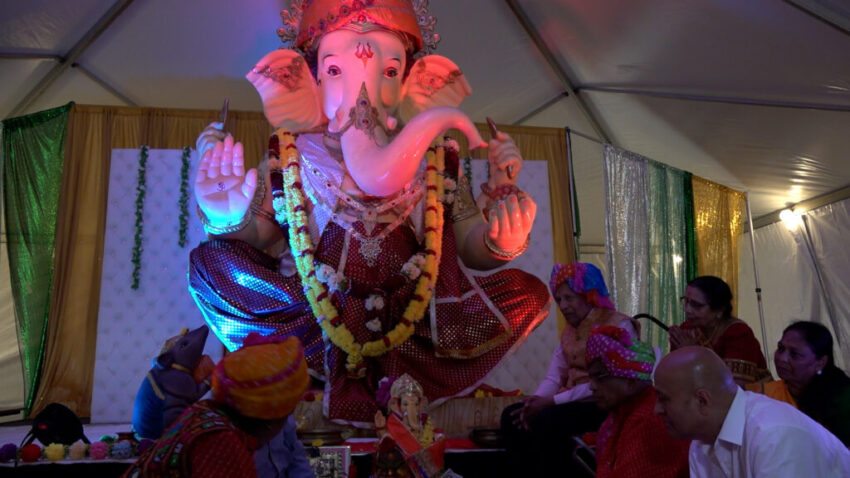

Every year, as the sound of dhols fills the air and chants of “Ganpati Bappa Morya!” echo through streets and homes, I am reminded that Lord Ganesha’s presence is far more than a ritual. For centuries, he has been celebrated as the Vighnaharta i.e. the remover of obstacles, the deity of intellect, humility, and auspicious beginnings. Yet in today’s restless, fast-changing world, his message feels even more urgent. Today the wisdom of Ganpati is not confined to temples or festivals; it is a timeless guide for how we think, how we live, and how we face life’s challenges.
At first glance, his image may appear purely symbolic. But look closer. That elephant head reminds us to think big, to rise above narrow self-interest and cultivate vision. His small eyes speak of focus and concentration in a world drowning in distraction. His wide ears nudge us to listen more than we speak, something that’s desperately needed in this age of constant noise. His curved trunk shows us flexibility, the ability to bend and adapt without losing strength. Even his four hands carry lessons. The modak is sweetness earned through effort. The axe severs harmful attachments. The lotus suggests purity in action. And the blessing hand reassures us that grace and protection are always available.
If one pauses to reflect, every aspect of Ganpati’s form is a coded message for living wisely while balancing intellect with humility, action with reflection, and ambition with simplicity. That symbolism is not meant to end at the puja room door; it is meant to travel with us into the choices we make about how we celebrate him. However, in recent years, the celebration of Ganesh Chaturthi has sparked a vital debate that are we honoring him in essence, or merely in excess?
The festival that once embodied simplicity, community bonding, and devotion has, in many places, been overshadowed by environmental harm in the form of plaster of paris idols that pollute rivers, toxic colors that harm marine life, and plastic waste that piles up after immersions. It should thus be remembered by all that true reverence for Ganpati lies in aligning our practices with his message.
ADVERTISEMENT

Hence, choosing eco-friendly clay idols, planting saplings in his name, using natural colors, or opting for community immersions are not compromises, but deeper expressions of devotion. After all, Ganpati is not a god of consumption but of balance between human needs and nature’s rhythms. An eco-conscious festival also revives the original spirit of Ganesh Chaturthi as envisioned by Lokmanya Tilak which is not that of a private puja, but a collective celebration that unites communities, inspires awareness, and spreads wisdom. Lokmanya Tilak had turned a household ritual into a public gathering to bring people out of their homes and onto shared streets, breaking barriers of caste and class along the way. Choosing sustainability today carries forward that same idea that devotion was never meant to be a private convenience, but a shared responsibility.
Ganpati’s most beloved title is Vighnaharta, which means the remover of obstacles. But his way is not about miraculously eliminating challenges; instead, it is about transforming the way we perceive and tackle them. Life’s obstacles, whether failures, health struggles, broken relationships, or professional setbacks are not punishments but opportunities to strengthen our inner resilience. They are invitations to grow. Ganpati whispers patience when things don’t move at our pace.
He inspires creativity when conventional solutions fail. He reminds us that no obstacle is permanent. Just as his trunk can lift both a needle and a tree trunk, we too must develop the capacity to handle the smallest worries and the heaviest burdens with equal grace.
Perhaps the greatest obstacle we face today is not outside but within us, which is the clutter of stress, ego, fear, and anxiety. And Ganpati’s wisdom gently nudges us inward, reminding us that true victory comes from mastering the self. When we cultivate stillness, humility, and clarity, even the toughest challenges lose their power to overwhelm us. That is why Ganpati’s presence is not seasonal, it is eternal. Each time we stand at a crossroad, each time we wrestle with a choice between right and wrong, each time we are weighed down by life, HE is there. Not as an idol of clay, but as an ideal in our hearts.
So, this year, as we welcome him with lights, music, and devotion, let us also welcome his message into our daily lives. Let us celebrate not only with chants and offerings, but also with choices that reflect wisdom. Because the world still needs Ganpati, not just as a figure in our homes, but as a compass in our restless lives.
