

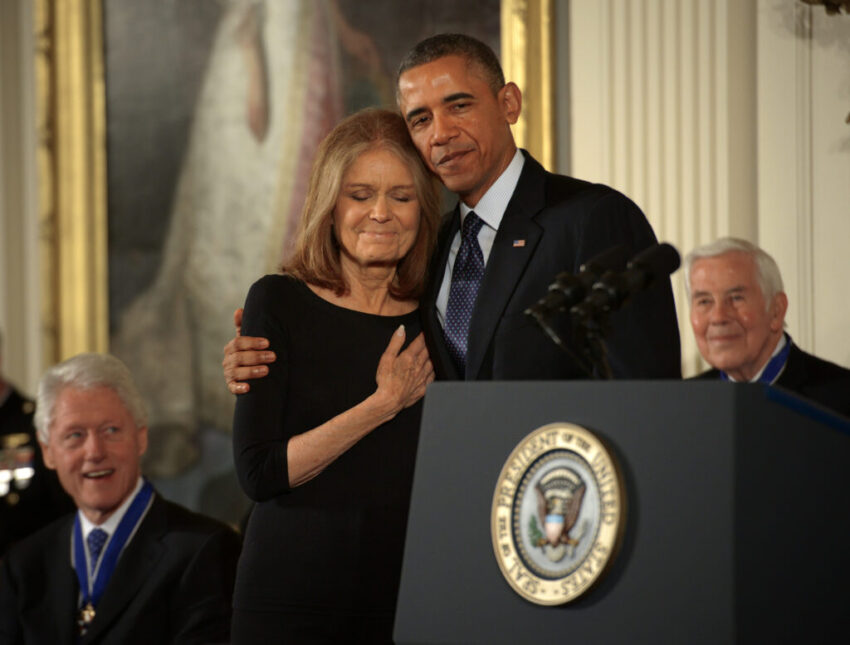

Gloria Steinem, an organizer and activist who, perhaps more than anyone else, helped sustain the women’s movement through the second half of the 20th century and into the 21st, through battles over reproductive rights, economic equality, sexual harassment and other issues that affect the lives of millions of women, died Sept. 2 at her home in New York City. She was 92.
Her death was announced by her foundation, Gloria’s Foundation, on social media. It did not provide a cause of death.
Few, if any, feminist leaders since Betty Friedan, the author of the 1963 manifesto “The Feminine Mystique,” matched Ms. Steinem’s influence on their cause. As a journalist and founder of Ms. magazine, and as a political activist, public speaker and ever-present figure in national affairs, Ms. Steinem became a symbol of second-wave feminism – the expansion of the movement beyond women’s suffrage into a broader campaign for equality in the workplace, in the home and under the law.
“In my heart, I think a woman has two choices,” Ms. Steinem once said. “Either she’s a feminist or a masochist.”
ADVERTISEMENT

Ms. Steinem came of age at a time when, despite the advances made by her predecessors, women were severely limited in the jobs they could pursue, if they were encouraged to work at all; when Roe v. Wade, the 1973 U.S. Supreme Court decision that for generations enshrined the right to an abortion, had not yet been handed down; and when marriage, as Ms. Steinem once put it, was an institution serving “one-and-a-half people.”
With her willowy physique, her fashionable miniskirts and her straight, parted hair, she brought glamour as well as passion to her work, challenging the popular perception of feminists as bra-burning radicals. For years the movement’s most prominent spokesperson, she was credited with helping make feminism more representative of poor and minority women, many of whom had felt excluded from the cause.
Christine Stansell, a history professor at the University of Chicago, once wrote in Glamour magazine that Ms. Steinem “was to the women’s movement what Martin Luther King Jr. was to civil rights: the galvanizer.”
Ms. Steinem burst to the fore in the 1960s not as an activist, but as a high-flying freelance journalist for publications including Esquire, Cosmopolitan and Vogue. She experienced firsthand the sexism that she would later fight on behalf of other women. Ms. Steinem recalled a taxicab conversation between the renowned writers Gay Talese and Saul Bellow, in which she said Talese remarked in her presence, “You know how every year there’s a pretty girl who comes to New York and pretends to be a writer? Well, Gloria is this year’s pretty girl.”
Through her insistence, Ms. Steinem overcame professional prejudices that limited most female journalists to covering topics such as fashion and courtship. Her ease around celebrities – she dated men including filmmaker Mike Nichols, profiled John Lennon, and spent a week with Lee Radziwill for an article on the jet-setting sister of Jacqueline Kennedy – made Ms. Steinem a sought-after celebrity in her own right. By the late 1960s, her name was mentioned in the same breath with writers Tom Wolfe and Susan Sontag.
Ms. Steinem drew particular attention when she donned a cottontail to infiltrate the New York Playboy Club and expose the degradation and poor pay to which Hugh Hefner’s Playboy bunnies were subjected. Her account was published in Show magazine in 1963 and revealed the traits that would define Ms. Steinem in her later incarnation as an organizer: an enterprising spirit, a piercing concern for the vulnerable, and a formidable ability to draw attention to her cause.
For a period, she feared the article had damaged her career prospects by inviting less-progressive editors to see her as a bunny rather than as a writer. Already she fought the perception that she was – as Washington Post columnist Maxine Cheshire described Ms. Steinem in her journalistic heyday – “the miniskirted pinup girl of the intelligentsia.”
But Ms. Steinem ultimately concluded that the article was worth the grief it had brought on her. “After feminism arrived in my life, I stopped regretting” its publication, she wrote years later. She had realized, she said, that “all women are Bunnies.”
A turning point for her came in the late 1960s, when she covered a group of women who had gathered to discuss the indignity and physical danger to which they had been subjected when they sought abortions. Ms. Steinem had undergone an abortion shortly after college but never spoke of it because of the stigma long associated with the procedure.
The meeting, she later reflected, made her see herself as belonging to a victimized group in need of a megaphone, not only regarding reproductive rights, but in all other areas of life in which women were restricted.
“All my empathy and sense of identity had always gone to movements, whether Third World or civil rights,” Ms. Steinem told the Chicago Tribune in 1992. “I identified with the underdog or any discriminated-against group. Which I think happens to women all the time. But we don’t realize that we are one. At the same time, I couldn’t get an apartment” as a single woman, she continued, and “wasn’t being paid equally for a job, all these things.”
In 1971, Ms. Steinem helped start Ms. magazine, where she remained for years as an editor and editor emerita. The publication was previewed in New York magazine before debuting as a stand-alone in 1972.
Ms. Steinem credited Clay Felker, editor of New York, with giving Ms. its start. But even that relationship revealed the minefields professional women navigated at the time. Ms. Steinem gratefully acknowledged that Felker, when he was Esquire editor, had provided her “first serious assignment.” Felker, however, recalled meeting the aspiring journalist and thinking that “she had great legs.” (Her first story, he conceded, was “excellent.”)
The very existence of Ms., as a serious magazine written for women by women, was revolutionary at the time. One of the magazine’s most noted early articles listed prominent women – among them tennis player Billie Jean King and singer Judy Collins, as well as Ms. Steinem – who publicly declared that they had received abortions. “If one in three or four adult women shares this experience,” Ms. Steinem later told The Post, “why should each of us be made to feel criminal and alone?”
Beyond the magazine, Ms. Steinem was a driving force behind the founding of organizations including the National Women’s Political Caucus, which seeks to increase political involvement among women, and the Women’s Media Center, which aims to expand their visibility and influence in news media.
Rarely was she far from public view or unprepared for cultural combat. She condemned Moral Majority founder Jerry Falwell as “an American ayatollah” for his hard-line conservative views on abortion and other issues, defended law professor Anita Hill when she accused then-Supreme Court nominee Clarence Thomas of sexual harassment, and twice championed Hillary Clinton in her White House bids.
The 2008 Democratic primary pitted Clinton, campaigning to be the first female president, against then-Sen. Barack Obama of Illinois, who ultimately became the first African American president. In an op-ed piece published in the New York Times that primary season, Ms. Steinem wrote that “gender is probably the most restricting force in American life, whether the question is who must be in the kitchen or who could be in the White House.”
The article, which argued that a Black woman with Obama’s experience would not have been “a viable candidate,” seemed to reopen old antagonisms between the civil rights and women’s movements and angered many African Americans who perceived that Ms. Steinem was minimizing the pernicious effects of racism.
She replied that her argument had been taken out of context, writing in The Post that “masculine and feminine roles restrict most people – not necessarily more (or less) seriously than race or class or other distortions of individual uniqueness.”
“Racism and sexism are linked,” she observed, “and cannot be ranked except by individuals in their own experience.”
Until the end of her life, Ms. Steinem remained a lodestar for women’s rights activists. When President Donald Trump was elected in 2016, she said she was “not going to disobey the law,” but also would not “pretend he represents me.” She became an honorary co-chairwoman of the Women’s March on Washington the day after Trump’s inauguration.
In 2022, when the U.S. Supreme Court overturned Roe v. Wade, ending nearly five decades during which women were guaranteed the right to an abortion, Ms. Steinem joined other activists in vowing that the campaign for reproductive freedom would continue.
“Women have always taken power over our own bodies, and we will keep right on,” she observed. “An unjust court can’t stop abortion, but it guarantees civil disobedience and disrespect for the court.”
Early life ‘on the road’
Gloria Marie Steinem, a granddaughter of a suffragist, was born March 25, 1934.
Her father, whom she described as a “wonderful, kind, charming, utterly irresponsible man,” ran a dance pavilion in Clark Lake, Michigan, when he was not traveling with the family as an itinerant antiques salesman. Only at age 11 did Ms. Steinem formally enroll in school. She recalled bathing in bus stations and said that she gained from her father a tolerance for being away from home. She titled her 2015 memoir “My Life on the Road.”
Her mother, who had worked for a newspaper before she was married, developed a mental illness that, for a period, caused her to be institutionalized. After her parents divorced, Ms. Steinem was left to care for her mother, and the two lived in poverty in a vermin-infested house in Toledo. Ms. Steinem once suffered a rat bite, she told People magazine, that sent her to the hospital. “What I wanted most in life then,” she said, “was a cage to sleep in, so I’d be safe.”
Ms. Steinem eventually moved to Washington, where she lived with her older sister and graduated from Western High School in 1952. Four years later, she received a bachelor’s degree in political science from Smith College, her sister’s alma mater. She was traveling in London when she had an abortion.
“I used to sit and try and figure out how old the child would be, trying to make myself feel guilty,” she told Britain’s Observer newspaper in 2011. “But I never could! I think the person who said: ‘Honey, if men could get pregnant, abortion would be a sacrament’ was right. Speaking for myself, I knew it was the first time I had taken responsibility for my own life. I wasn’t going to let things happen to me. I was going to direct my life.”
She told the Tribune that she always aspired to be a writer but that she “almost had never seen a woman journalist” and that “nothing in my life, no person in my life led me to believe that you could make a living from writing.”
Turned away by Time magazine, where she said she was told that female applicants were eligible only for research positions, Ms. Steinem received a fellowship to live for two years in India. She traveled through villages affected by caste riots, visited women’s centers and health clinics and studied Gandhian organizing, an experience that would inform her later work as a feminist activist.
In India, “I witnessed the ancient and modern magic of groups in which anyone may speak in turn, everyone must listen, and consensus is more important than time,” she wrote in “My Life on the Road.” “My becoming an itinerant feminist organizer was just a Western version of walking in villages.”
Back in the United States, Ms. Steinem was briefly employed by a student organization that received funding from the CIA to send young, noncommunist but liberal Americans to interfere with communist youth festivals in Europe. She later told The Post that the agency “was completely different from its image; it was liberal, nonviolent and honorable.
“I found the CIA my best journalistic training,” she continued, “because the one instruction one receives from them is to be accurate, whereas publications tell you to find an angle.”
She worked briefly as an assistant to Harvey Kurtzman, the cartoonist who created Mad magazine, before embarking on her own journalism career. Published in Esquire under Felker in 1962, her first bylined piece, “The Moral Disarmament of Betty Coed,” explored changes in sexuality on university campuses. Felker later recruited Ms. Steinem to New York magazine, where her political column, the City Politic, and articles including 1969’s “After Black Power, Women’s Liberation” helped launch her to greater prominence.
Her first book was 1963’s “The Beach Book,” a coffee-table volume that featured a sun reflector on the jacket and that she later self-deprecatingly dismissed as “in demand only by interior designers who want them for beach houses.” The introduction, incongruously, was written by economist John Kenneth Galbraith, a friend, who remarked that he liked “the girl who put it together.”
Ms. Steinem’s later books – more representative of her work – included “Outrageous Acts and Everyday Rebellions” (1983); “Marilyn” (1986), a biography of Marilyn Monroe with photographs by George Barris; “Revolution From Within” (1992); “Moving Beyond Words” (1994); and “Doing Sixty & Seventy” (2006). Obama awarded Ms. Steinem the Presidential Medal of Freedom, the nation’s highest civilian honor, in 2013.
Ms. Steinem had romantic relationships with Ted Sorenson, the counselor to President John F. Kennedy; developer and media magnate Mort Zuckerman; and the writer Norman Mailer. For much of her life, she eschewed marriage. To women who chose otherwise, she admonished, “a liberated woman is one who has sex before marriage and a job after.”
In 2000, Ms. Steinem married David Bale, a South African businessman and the father of actor Christian Bale.
“I didn’t change,” she told a reporter, explaining her decision. “Marriage changed. We spent 30 years in the United States changing the marriage laws. If I had married when I was supposed to get married, I would have lost my name, my legal residence, my credit rating, many of my civil rights. That’s not true anymore. It’s possible to make an equal marriage.”
Bale died of brain cancer in 2003. Information on survivors was not immediately available.
Throughout her life, Ms. Steinem could be relied upon for an incisive quip about men and women – although she denied authorship of the one most frequently attributed to her, the observation that “women need men like fish need a bicycle.”
When a reporter remarked on Ms. Steinem’s 40th birthday that she didn’t “look 40,” she dispatched the journalist with the retort, “This is what 40 looks like. We’ve been lying for so long, who would know?”
The line lived on, and when Ms. Steinem turned 80, she was celebrated at an event billed as the “This Is What 80 Looks Like” party.
“I’m old,” she had remarked several years earlier, “but the movement is young.”