

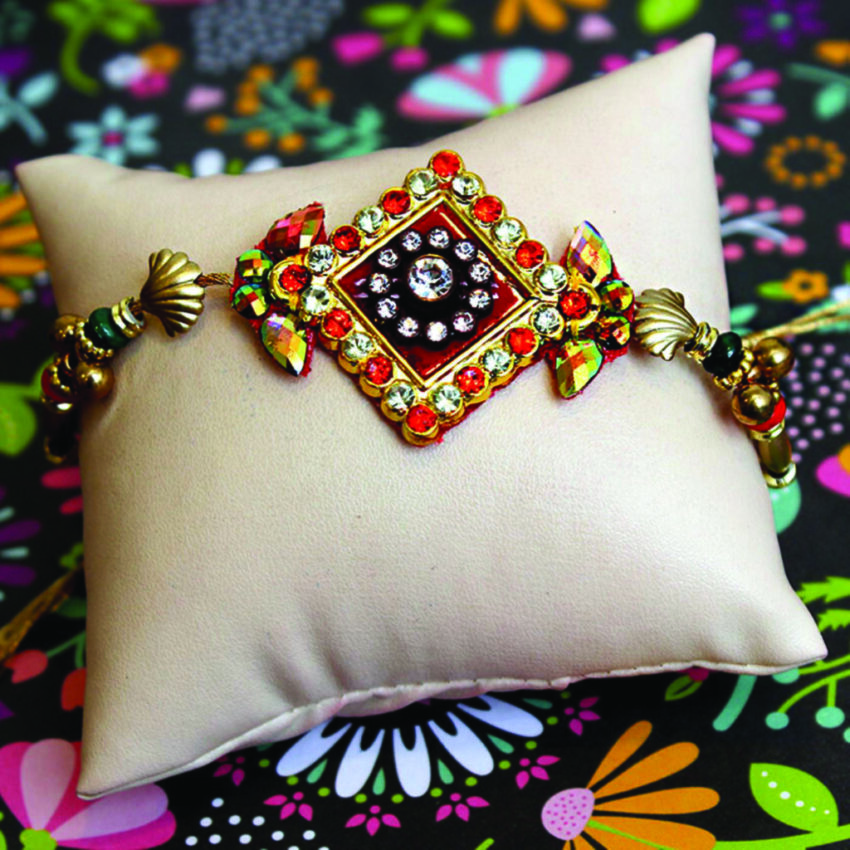

PART 1: Does a Raksha tied to a wrist protect ?
As Raksha Bandhan approaches, have you ever wondered if a brother’s
affection is contingent upon this one single thread tied by the sisters?
Perhaps not. The world has produced many loving brothers and still houses
many caring brothers who do not wait for a blessed thread to give them the
signal for further action.
And yet, the day is very special, Rakhi or not. It is a reminder of the place
where one came from, literally. That, perhaps, becomes the closest bond of
blood between siblings, with a recognition that a sibling may be one person
whom one has known all one’s life, or theirs, making it the longest lasting
bond, after the one with parents. Keeping that bond current and live becomes
important, then, and blessing it and protecting that bond is natural. That, is
the logic behind it, if one ever doubts why a traditional ritual has to be
followed.
Beside the logic is the practical reason. This is one day to get rich. And so,
one can tie Rakhis to not just real brothers, but to cousins, brother’s friends
who are almost like brothers, neighbors, even co-workers. In fact, anyone
who asks what the threads are on any brother’s wrists, can be offered one
tied to their wrist for a special cost.
ADVERTISEMENT

Raksha Bandhan has survived from ancient times, for centuries, stealing
away moments of pure goodwill and deep affection for the person standing
across, and wishing no harm to come to them.
The bargaining began much later. If a Rakhi was tied, the man (usually) was
expected to uphold its worth, and protect the tie-r of it, with every effort,
including with life. That is what the folk stories tell us, making one wonder
if just tying a Rakhi can create a brother out of nowhere, or from the group
around, capable of helping.
The bargaining seems to be reinforced by Hindi films about sisters who
asked brothers to uphold the sacred thread. Films began portraying such
compelling obligation stories of siblings around the mid twentieth century,
predominantly referring to the obligation in films like Chhoti Bahen through
its song “Bhaiya mere rakhi ke bandhan ko nibhana”. Later films picked up
this theme and replayed it several times over in different versions.
Regardless, Raksha Bandhan in the twentieth century became symbolic
gesture of all the goodwill that a sister felt for the brother. The thread was
just a reminder of that.
But, was it how it really began during the Vedic times? Was there really a
Rakhi that sisters tied then?
It existed. A different version or versions of it. In ancient times, Raksha or
‘protection’ was a sacred thread or amulet tied by priests, wives, or mothers
to protect someone from evil, sickness, or war. In the oldest Hindu
traditions, the sacred thread was symbolic of protection. Traditionally, royal
priests or Gurus would tie these threads on kings and community members during the full moon of the Shravan month. This was done to bless them
with health and safety for the upcoming year.
Evolving over centuries, this tradition has maintained some of the basics.
Today, Raksha Bandhan is celebrated with sisters applying a tilak (vermilion
and rice grains) on their brothers' foreheads, tying the sacred rakhi thread on
their wrists, and performing a aarti to pray for their long life and well-being.
Brothers offer sweets, gifts, or tokens of love and promise to protect and
support their sisters. Families dress in traditional clothing, gather for festive
meals, and share sweets like laddu or barfi.
Modern celebrations have evolved significantly to become highly inclusive,
moving beyond strictly traditional blood-sibling relationships to celebrate
bonds of protection, respect, and companionship.
Many women now tie rakhis to their own sisters, female cousins, or close
female friends to celebrate mutual support and lifelong trust. Brands even
sell specialized “Sister Squad” rakhis for this purpose. Originally a Marwari
tradition, the custom of tying a Lumba rakhi to a sister-in-law (bhabhi) has
gained popularity as a symbol of welcoming and protecting women within
the family.
Today, people frequently tie rakhis to trusted co-workers, classmates, and
neighbors as a gesture of platonic camaraderie, safety, and mutual respect. It
is increasingly common for people, including young children, to tie rakhis to
societal protectors, such as society security guards, local police officers, or
military personnel, regardless of their gender.
PART 2: Where it all began: Raksha Bandhan in the Scriptures
The modern festival of tying a Rakhi or Raksha on the wrists has its ancient
roots. The Puranas mention the ritual of tying a protective thread or amulet.
Bhavishya Purana includes a conversation where Krishna explains the
history, significance, and rules of the protective thread or raksha to King
Yudhishthira. It involves narrating the story of the gods losing a 12-year war
against the demons, led by Indra, the king of the gods. On the advice of
Brihaspati, the divine preceptor, Shachi, Indra's wife, tied a consecrated
amulet of thread, a raksha-sutra to Indra's right wrist, fortified with sacred
mantras. Empowered by this thread, Indra defeated the demons and
recovered his kingdom.
In the Bhagavata Purana, the specific, popular sister-brother ritual of
Raksha Bandhan involving Goddess Lakshmi and King Bali is not explicitly
mentioned in the original Sanskrit text (Canto 8).
While the Bhagavata Purana text ends with Vishnu stationed as Bali's
eternal protector, folk tradition and other texts like the Bhavishya Purana
and Vishnu Purana expand the story. Sage Narada advised Lakshmi to seek
out King Bali on the full moon day of the Shravana month, Shravana
Purnima. Lakshmi visited Bali and tied a protective cotton thread, Raksha
Sutra, onto his right wrist, officially adopting him as her brother.
Touched by this sacred gesture, Bali offered her any gift she desired.
Lakshmi revealed her true identity and requested the release of her husband
from his vow so He could return home. Bali happily complied, cementing
the day as the origin point of the modern Raksha Bandhan festival.
The Skanda Purana focuses on the structural, Vedic roots of Upakarma
(changing the sacred thread) and Rishi Tarpanam, alongside protective
worship (Vrata) dedicated to Goddess Lakshmi.
In the Prabhas Khanda and Nagarakhanda of the Skanda Purana, the full
moon of Shravana is marked as Shravani. It explicitly instructs Brahmins
and twice-born (Dvija) individuals to perform the cleansing ritual of
changing their old sacred thread (Yajnopavita).
The replacement thread is treated exactly like a Raksha Sutra (protective
amulet). It is energized with Vedic mantras to protect the wearer's body,
mind, and intellect from evil or negative forces for the upcoming year.
The Skanda Purana also has a story of Lord Shiva describing the
Varalakshmi Vrata, which is celebrated around the same period in the month
of Shravana. During this puja, women fast and tie a sacred, yellow-knotted
thread called the Toradu or Raksha Sutra around their own wrists.
The most famous epic narrative that mirrors the modern Raksha Bandhan is
that of Krishna and Draupadi in the Mahabharata.
During the Rajasuya Yajna in Indraprastha, Krishna's index finger was cut
and began bleeding. Draupadi immediately tore a strip of silk from her
expensive saree and wrapped it tightly around Krishna's bleeding finger to
stop the flow.
Deeply moved by her spontaneous affection, Krishna declared the torn piece
of cloth to be a sacred Raksha Sutra and vowed to repay the debt of every
single thread of that cloth whenever she faced adversity.
Krishna fulfilled this exact protective vow during the Dyuta Sabha when the
Kauravas attempted to disrobe Draupadi who prayed to Krishna. He
seamlessly extended her saree into an infinite stream of cloth, saving her
honor.
Another prominent instance of a Raksha thread in the Mahabharata occurs
just before the tragic death of Arjuna’s son, Abhimanyu, inside the complex
Chakravyuha formation.
Queen Kunti, Abhimanyu’s grandmother, tied a consecrated, mantra-infused
Raksha Sutra around Abhimanyu’s wrist to shield him from mortal danger.
The protective energy of Kunti’s thread was so potent that even the greatest
Kaurava warriors could not pierce Abhimanyu’s defenses. Duryodhana
utilized deceptive tactics to snap the thread from Abhimanyu’s wrist and
once the Raksha thread fell off, his ultimate vulnerability led to his heroic
demise.
In the Narada Purana Poorva Bhaga, Chapter 124, Raksha Bandhan is
mentioned in its ancient, foundational form as a Vedic protection ritual
associated with Shravani Upakarma, the commencement of Vedic studies.
The text outlines the guidelines for the full moon day of the Shravana
month, Shravana Purnima, framing the tying of the protective thread as a
critical ritual component of spiritual education and overall well-being.
These epic stories changed how people view the Raksha thread. In the earlier
Puranas, it was a formal ritual performed by a priest, Purohit, for a king, or a
wife, Shachi, for her husband, Indra. Through Lord Krishna’s interactions in
the Mahabharata, it evolved into a powerful symbol of unconditional love,
mutual duty, and divine protection between siblings and devotees.