

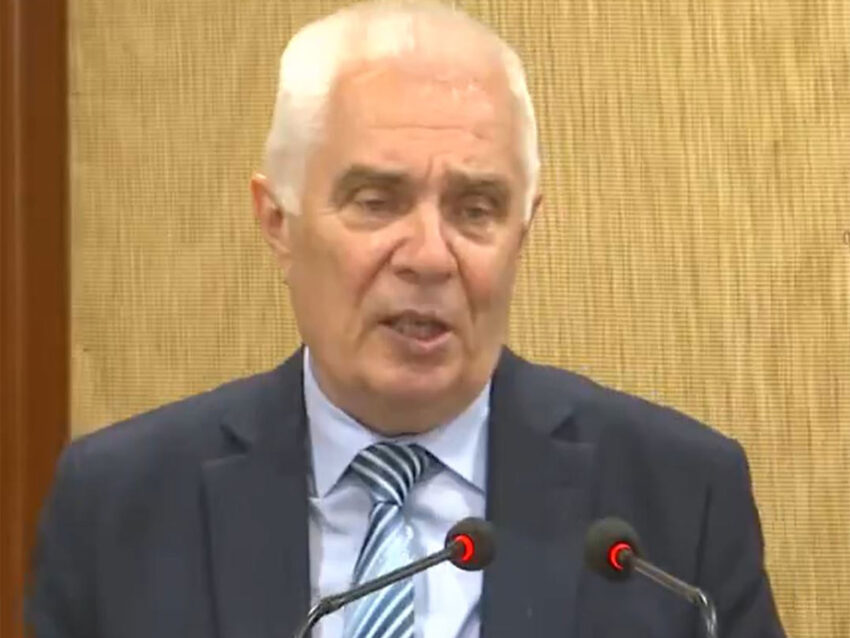
New Delhi [India], August 20 (ANI): Amid concerns over the uncertainty of global conflicts, Polish Ambassador to India Piotr Antoni Switalski on Thursday said that India and Poland have demonstrated that military and totalitarian regimes are temporary, while the human desire for freedom remains enduring, drawing parallels between the two countries’ histories of foreign domination and struggles for sovereignty.
Speaking at the ‘India-Poland People Connect’ event in the national capital, Switalski highlighted the shared resilience of the Indian and Polish people, recalling India’s struggle against colonial rule and Poland’s experience of partitions, occupation and the devastation of World War II.
“Both Poland and India are nations defined by an indomitable spirit of resilience. Both our peoples know exactly what it means to love a homeland so fiercely that no amount of foreign occupation can crush its soul,” the Polish envoy said.
Recalling Poland’s history, he said the country was subjected to the three partitions in the late 18th century and later became the site of immense suffering during World War II.
“In 1939, Poland became the epicentre of the unimaginable horrors of World War II. Six million Poles, including three million Polish Jews, representing 20 per cent of the whole population, were systematically murdered,” Switalski said.
He pointed to Poland’s reconstruction after the war as an example of the country’s resilience.
“But look at Poland today. Warsaw was rebuilt stone by stone, using old paintings and memories to recreate its historic heart,” he said.
Drawing a broader lesson from the experiences of the two countries, the ambassador said, “Both India and Poland proved to the world that brute military empires and totalitarian regimes are temporary and that the human yearning for freedom is eternal.”
Switalski also underlined Poland’s transformation since the fall of communism in 1989, describing its economic rise as an “extraordinarily unstoppable economic triumph”.
“Since the fall of Communism in 1989, Poland has achieved what economists call an economic miracle,” he said, adding that Poland is now the 20th-largest economy in the world.
The envoy attributed the country’s economic transformation largely to human capital, drawing a parallel with India’s growth story.
“It was driven by the exact same resource that drives India’s modern rise: human capital. The Polish workforce is highly educated, intensely hard-working, and structurally innovative–like modern India,” he said.
Switalski said the economic relationship between India and Poland also offered significant scope for expansion, noting that bilateral trade currently stands at around USD 5 billion.
“The trade volume is around USD 5 billion. I would love to see that doubled,” he said, urging Indian businesses to explore Poland as a gateway to the European market.
“I can tell you on behalf of my government, the sky is the limit on the Polish side. Use Poland. Consider Poland, as I said, a friendly gateway to Europe,” the ambassador added.
The Polish envoy also highlighted the historical and cultural links between India and Poland, arguing that geographical distance does not necessarily translate into a lack of closeness between nations.
“Between Poland and India, it is true that there is a great asymmetry in terms of our size… we are separated by thousands of miles. But as we know, geography is a superficial measure of distance. True closeness is measured by the mind, the spirit, and the tongue. Poland and India are not distant strangers–we are, in fact, ancient structural cousins bound by a profound historical and emotional architecture,” he added.
He particularly pointed to linguistic and academic links between Sanskrit and Polish scholarship.
“To an Indian audience, Sanskrit is not merely an ancient tongue. To the average European, Sanskrit feels mystical and distant. But to a Pole, the structural resonance of Sanskrit is startlingly intimate,” he said.
Switalski noted that Poland developed into an important European centre for Indology during the 19th century, with scholars studying Sanskrit, Hindi and classical Indian literature.
“This linguistic alignment is so profound that in the 19th century, Poland became one of the premier centres for Indology in Europe. We established our first academic centres for Sanskrit and Hindi languages in the middle of the 19th century,” he said.
He added that Polish scholars had devoted years to translating major Indian works, including the Upanishads, the Bhagavad Gita and works of the classical Sanskrit poet Kalidasa, into Polish.
“We are literally speaking the same cultural language. But this shared architecture goes far deeper than linguistics. It shapes our historical psychology,” the envoy said.
India and Poland have maintained a long-standing and friendly relationship, with diplomatic ties established in 1954 and the Indian Embassy in Warsaw opening in 1957.
The relationship has historically been shaped by shared opposition to colonialism, imperialism and racism, while the two sides maintained close and cordial ties during the Communist era through regular high-level exchanges and structured trade and economic cooperation. (ANI)