

BusinessWire India
New Delhi [India], August 18: ShareChat and Moj, in partnership with Kantar, unveiled one of India’s first dedicated industry reports on microdrama, State of Microdrama in India. The findings confirm that microdrama is no longer an emerging trend, but has already become a routine part of how India consumes content. The report offers a comprehensive view of the evolving landscape, uncovering how changing consumer behaviour, storytelling preferences and viewing habits are driving the format’s rapid adoption, while highlighting its growing potential for creators, brands and advertisers.
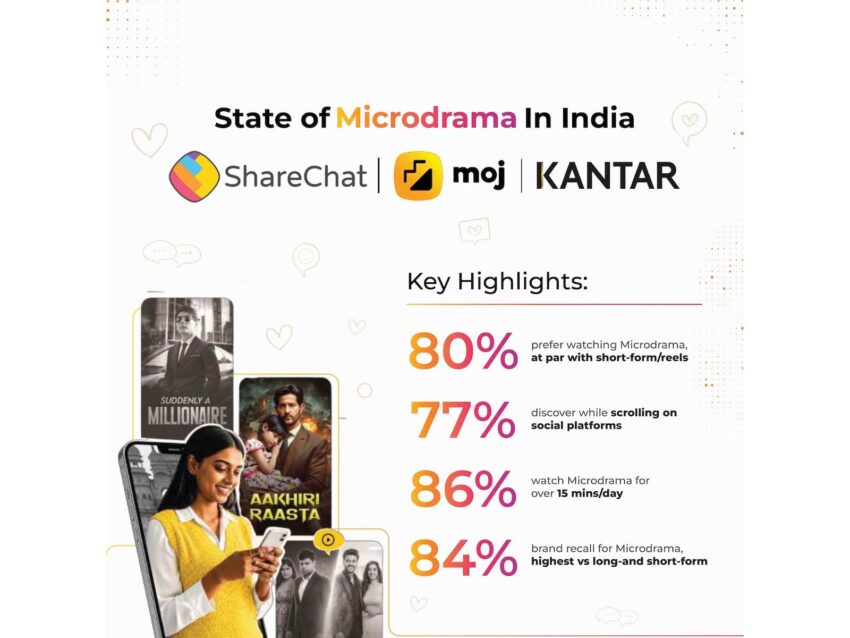
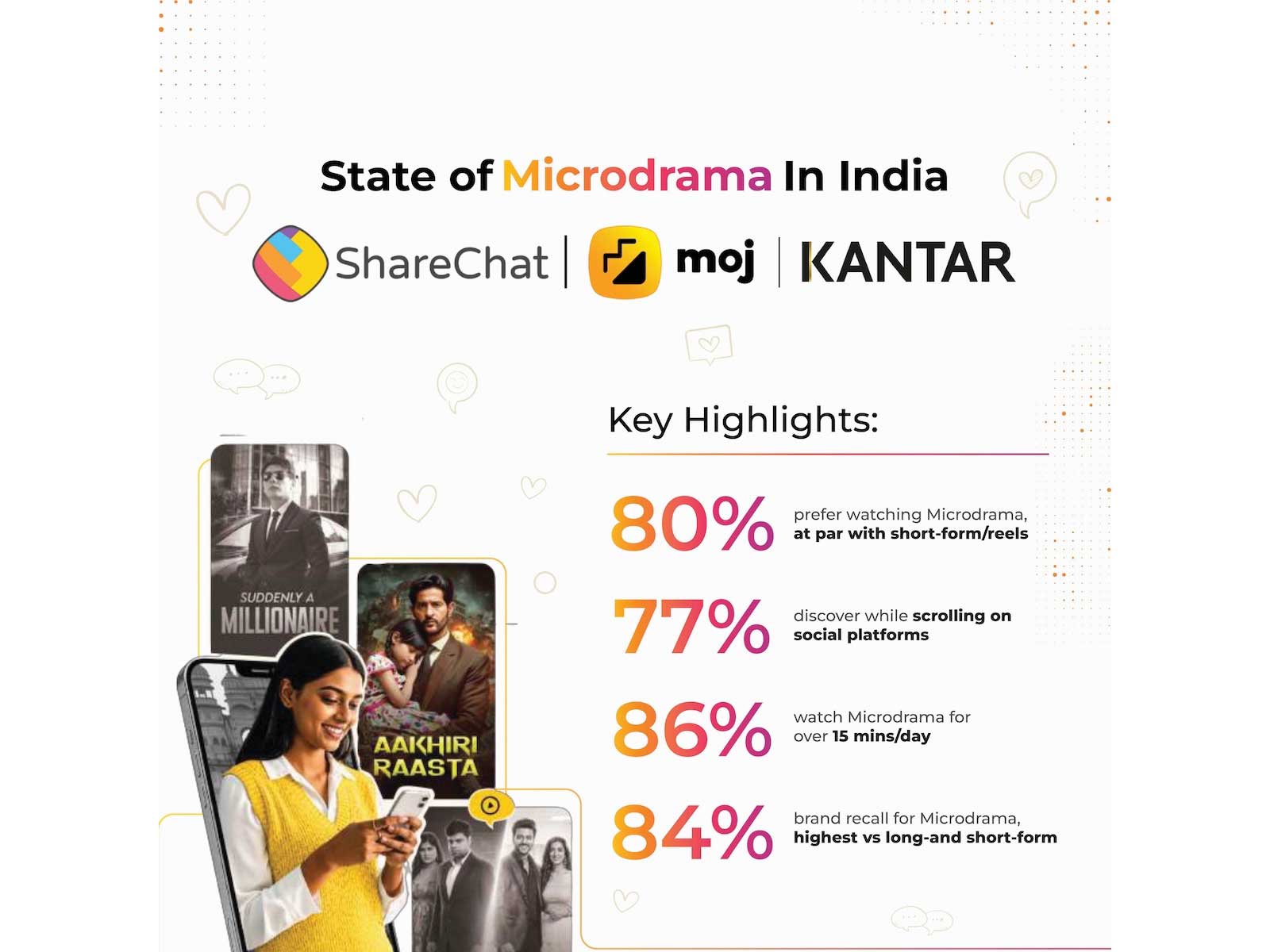
The study finds that 80% of audiences now prefer microdrama, with 86% of viewers spending more than 15 minutes watching every day and 54% returning for a repeat session, evidence that the format has moved firmly from novelty to routine. It further reveals that microdrama creates a high-attention advertising environment, delivering 84% brand recall and 82% purchase intent, outperforming traditional short-form content on key brand metrics.
Commenting on the report, Neha Markanda, Chief Business Officer, ShareChat & Moj, said, “What began as an emerging format has now evolved into a distinct entertainment category. The findings show audiences aren’t simply looking for shorter videos, they’re looking for stories that fit naturally into their mobile-first lifestyles. Microdrama resonates deeply with viewers as it combines the convenience of short-form consumption with the continuity and emotional depth of long-form storytelling, creating an experience that keeps audiences coming back for. As the category continues to evolve, we believe it will open up exciting opportunities for creators to tell richer stories, enable brands to engage audiences through more meaningful narratives, and empower platforms to build stronger, long-term engagement.”
Microdrama is Becoming a Part of Everyday Life and has emerged as India’s Next Mainstream Content Format
As microdramas have become an integral part of everyday entertainment, it’s notable that a majority (77%) of viewers discover microdrama through social media feeds, highlighting the role of social discovery in the format’s growth. The study also finds that microdrama appeals to a broad, high-value audience: 68% of viewers belong to households earning over Rs. 10 lakh annually, dismantling the assumption that the format is limited to low-income or casual viewers.
The report pushes back further on the idea that its reach is confined to any one economic segment. Beyond income, 64% of viewers travel more than twice a year and 63% own a home, evidence of an audience that spans India’s spending spectrum. This breadth extends to engagement depth as well: heavy viewers of the format spend substantially more online each month than light or medium viewers, underlining that the deeper audiences go into episodic storytelling, the more value the format unlocks, for platforms, creators and brands alike.
“During the research phase of the report, we witnessed the rapid emergence of microdramas, reflecting a larger evolution in India’s digital content landscape, where audience attention is increasingly shaped by new formats and viewing behaviours. The findings show that microdrama is building strong engagement by combining frequent, mobile-first consumption with the pull of episodic content. For the industry, this points to an emerging category with the potential to reshape how audiences engage with entertainment and how brands think about capturing attention,” said Ebu Isaac, Head of Media and Analytics, Kantar South Asia.
Explore the complete findings of the ‘State of Microdrama in India’ report HERE.
Report Methodology
The ‘State of Microdrama in India’ report was commissioned by ShareChat and Moj, in partnership with Kantar, to understand the emergence of microdrama as a mobile-first entertainment format and its impact on consumer behaviour, content consumption and advertising effectiveness. The findings are based on a quantitative study conducted among 1,045 respondents across 14 Indian cities between 4th and 25th May 2026, covering smartphone and social media users aged 18-44 years across NCCS A, B and C segments. The study evaluates audience preferences, viewing habits, storytelling behaviour and engagement with microdrama. To assess advertising effectiveness, the report also includes an attention module conducted between 21st and 29th May 2026 with a sample of 450 respondents, comparing audience attention across microdrama, long-form content and short-form videos/reels.
(ADVERTORIAL DISCLAIMER: The above press release has been provided by BusinessWire India. ANI will not be responsible in any way for the content of the same)