

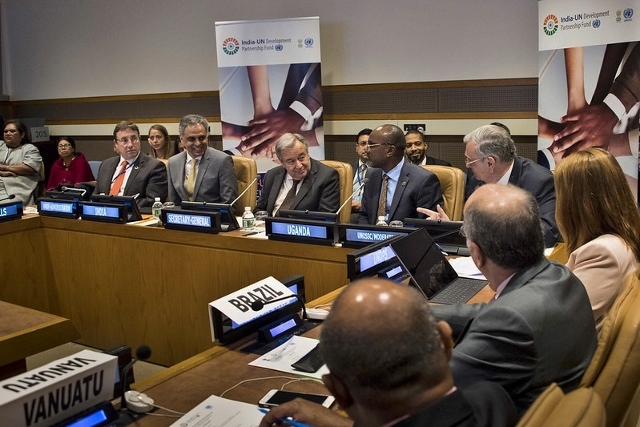
United Nations — In a significant step towards strengthening South-South cooperation, the Government of India has extended a grant of USD 840,000 to support the Climate Insurance and Resilience Program (CIRP) in the United Republic of Tanzania.

The initiative, announced in response to a formal request from the Tanzanian government, will be financed through the Commonwealth Window of the India-UN Development Partnership Fund.
Nature of India’s Financial Support
The financial support is channeled through the India-UN Development Fund via its Commonwealth Window. Structured as a grant-based development assistance, the funding will allow Tanzania to entirely dictate its own project needs. In Tanzania, the project is locally led by the Disaster Management Department under the Prime Minister’s Office, guaranteeing full alignment with national priorities.
ADVERTISEMENT
“The proposed project shall serve as an effective vehicle in dealing with the climate-related hazards threatening lives and livelihoods,” said the Permanent Mission of India in an official statement, stressing India’s partnering with the United Nations Office for Disaster Risk Reduction (UNDRR) on the initiative.
Tanzania’s CIRP project
Climate Insurance and Resilience Program (CIRP) is a multi-year global framework backed by the United Nations, including the UN Office for Disaster Risk Reduction (UNDRR). Its core objective is to promote climate and disaster risk reduction financing at local, sectoral, and national levels.
In Tanzania, the project specifically supports the implementation of the country’s National Disaster Risk Financing Framework and Implementation Plan (NDRFFIP). Key elements include:
- Shifting Strategy – The project will ensure fiscal stability when climate hazards strike. It will provide a structured, pre-arranged financial framework instead of scrambling for funds post-disaster
- Protecting Vulnerable Groups – The project will work to safeguard low-income communities, women, and people with disabilities who are disproportionately affected by droughts, floods and other climate-related hazards.
- Risk Layering & Insurance Solutions: The project will introduce Climate and Disaster Risk Financing and Insurance (CDRFI) mechanisms, such as parametric insurance and risk-transfer solutions, to protect livelihoods, particularly in agriculture and rural sectors.
India – UN Development Partnership Fund
The India-UN Development Partnership Fund is a dedicated facility established to support Southern-owned and led, demand-driven, and transformational sustainable development projects across the developing world.
India established the India-UN Development Partnership Fund in June 2017 to reinforce its commitment to South-South cooperation and assist fellow developing nations in achieving the 2030 Agenda for Sustainable Development and its 17 Sustainable Development Goals (SDGs).
The fund places a strong emphasis on national ownership, leadership, equality, and mutual benefit, frequently prioritizing Least Developed Countries (LDCs), Landlocked Developing Countries (LLDCs), and Small Island Developing States (SIDS).It is managed by the United Nations Office for South-South Cooperation (UNOSSC) in collaboration with the UN system.
The Commonwealth Window
Established as a specialized sub-facility under the main fund, the Commonwealth Window specifically targets developing countries that are members of the Commonwealth of Nations.It leverages shared histories, common values, and similar institutional frameworks to foster resilience, technical capacity, and shared growth among Commonwealth developing nations.
How India Provides the Funding
The funding is provided directly by the Government of India through financial commitments disbursed via multilateral channels.
India initially pledged $100 million over a decade for the core India-UN Development Partnership Fund.In April 2018, India committed an additional $50 million specifically dedicated to the Commonwealth Window over a five-year period.This brings India’s total cumulative commitment to the fund to $150 million.
The resources are utilized collaboratively with UN agencies to design and execute projects ranging from climate resilience and clean energy to healthcare, education, and digital governance tailored to the specific needs of recipient countries.
Objectives of the India – UN Development Partnership Fund
The primary objectives and motivations behind the establishment of the fund include:
Promoting South-South Cooperation – Rooted in India’s foreign policy framework of solidarity with the Global South, the fund operates on the core principles of mutual benefit, collective self-reliance, equality, and national ownership.
Demand-Driven and Country-Led Projects – Unlike traditional donor-recipient aid models tied to specific donor conditions, the projects are entirely demand-driven. Partner governments propose projects based on their unique national priorities and needs, ensuring local leadership and long-term sustainability.
Focusing on Vulnerable Nations – The fund places special emphasis on supporting Least Developed Countries (LDCs), Small Island Developing States (SIDS), and Landlocked Developing Countries (LLDCs), which are often most vulnerable to systemic crises, economic shocks, and climate change.
Leveraging Multilateral Systems – Managed through the United Nations Office for South-South Cooperation (UNOSSC) and implemented in partnership with the broader UN system, the fund benefits from multilateral neutrality, transparency, and global credibility, keeping it insulated from bilateral political friction.
Sharing Cost-Effective Innovations -The fund frequently leverages India’s own domestic development experiences—such as advancements in digital public infrastructure, healthcare, and sustainable agriculture—to offer scalable, practical solutions tailored to the constraints and capacities of developing nations.