

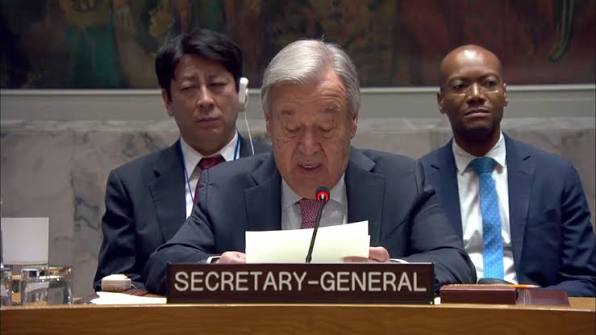

“Natural Resources Governance: the Foundation of Peace, Security and Prosperity,” UN PHOTO
United Nations — in a firm defense of national sovereignty, India underlined the exclusive right of nation-states to manage their natural wealth during a UN Security Council open debate on resource governance, cautioning against viewing resource management strictly as a security issue.
Speaking at the debate, titled “Natural Resources Governance: the Foundation of Peace, Security and Prosperity,” India’s Permanent Representative to the UN, P. Harish, emphasized that sovereign states hold the fundamental right and responsibility over their natural resources. Harish argued that a purely security-driven approach neglects local economic needs and deepens regional conflicts.
In the interest of preventing external interference, India called for natural resource governance frameworks to be transparent, accountable, and nationally owned, ensuring that domestic authorities retain jurisdiction over their resources rather than external bodies dictating terms.
“Provinces that are resource rich but development poor become centers of insecurity that radiate instability beyond their borders,” Harish stated, urging the international community to strengthen local institutions to turn natural resources into domestic prosperity.
ADVERTISEMENT

India argued that natural resources should primarily serve as an engine of national development and domestic prosperity rather than being dictated by external conflict dynamics.
Addressing the council earlier, UN Secretary-General António Guterres had echoed concerns over resource exploitation, calling for an end to the “predatory extraction” of critical minerals and natural wealth that continues to fuel global conflicts.
Guterres had warned that revenues from the illicit extraction and smuggling of resources—ranging from gold and cobalt to lithium—directly empower armed groups, criminal syndicates, and corrupt actors in conflict zones such as Sudan and the Democratic Republic of the Congo. He urged the international community to dismantle traditional extraction models where raw materials are taken, value is captured elsewhere, and local populations bear the economic and environmental burden.
India Proposes 3-Point Global Framework
To prevent resource-related disparities and support sustainable stability, India presented a three-pronged global strategy:
- Local Value Addition: Transition developing nations from raw material exporters to active participants in global value chains by developing local processing capabilities.
- Responsible Investment: Foster international technology partnerships alongside ethical investment frameworks.
- Supply Chain Transparency: Establish transparent global supply chains backed by enhanced due diligence.
Harish also criticized the Security Council for overreaching its mandate, asserting that broader issues like economic development, climate action, and resource governance belong under the purview of bodies such as the General Assembly, ECOSOC, and the UN Peacebuilding Commission.
Guterres had similarly outlined four key priorities for the international community, including ensuring justice for resource-rich nations through local processing, curbing illicit financial flows, strengthening diplomatic resolution of resource disputes, and integrating climate action into conflict prevention.
Tensions over Water Rights
The debate exposed sharp regional frictions when Pakistan’s Permanent Representative, Ambassador Asim Iftikhar Ahmad, accused India of “weaponizing water” by placing the 1960 Indus Waters Treaty in abeyance, alleging it jeopardized the water security of over 240 million Pakistanis.
Harish firmly rejected the allegations, stating that Pakistan was misusing the platform to promote a false narrative. Harish stated that meaningful bilateral cooperation relies on mutual trust, which cannot exist while cross-border terrorism is used as an instrument of state policy. Reaffirming that Jammu and Kashmir remains an integral and inalienable part of India, Harish advised Pakistan to address its domestic challenges rather than bringing unsubstantiated accusations to international forums.