

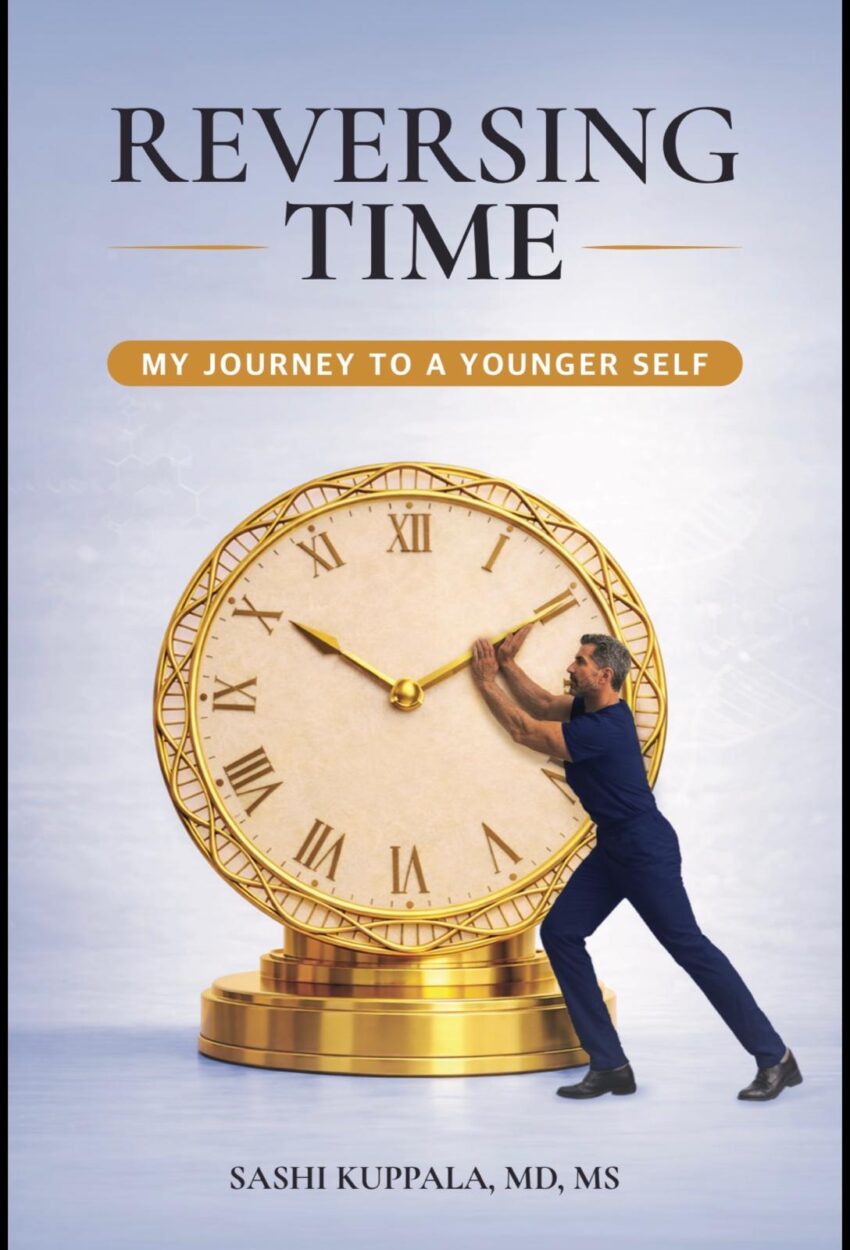
A personal health wake-up call has led a U.S.-based physician to author a new book detailing how middle-aged professionals can measure, slow, and potentially reverse their biological aging process.

In Reversing Time, Dr. Sashi Kuppala, a specialist in pediatrics, neonatology, and anti-aging and regenerative medicine, shares the results of a two-year self-experiment.
The project began in 2023 when Kuppala discovered his biological age was three and a half years older than his chronological age. After going through denial and frustration, he utilized recent longevity research to implement targeted lifestyle changes. Within 12 months, he reduced his biological age by four years, a gain he successfully maintained through the following year, he states in the book.
ADVERTISEMENT

Grounded in medical science but written as a personal story rather than theory, Kuppala’s book stands as a practical roadmap for anyone who wants to improve their health by reducing their biological age.
The book explains why “biological age” or how old your body really is, and not your “chronological age” or your calendar age, is important for long-term health. Structured chapter by chapter, Reversing Time takes readers from basic concepts to step-by-step actions.
It introduces the methods Kuppala used to prove his hypothesis, the SAFE framework: Strength, Alignment, Flexibility and Endurance, as a simple guide to building physical fitness. The book looks at nutrition through the lens of our emotional and mental relationship with food, and suggests ways to repair that relationship. Stress is presented as a spectrum, with practical tips to stop it from getting out of control.
Citing recent research on how biological age is emerging as a stronger predictor of disease and lifespan, Kuppala states the inspiration for lifestyle changes came after reading Lifespan by Dr. David Sinclair and The Telomere Effect by Elizabeth Blackburn and Elissa Epel. These books explain how aging works at the cellular level, especially through telomeres, the protective ends of chromosomes that shorten over time and with stress, leading to aging. Reading these books also made Kuppala curious about his own biological age.
Through his book, the lay reader also learns what the key tools are for measuring “invisible” aging: the epigenetic clocks, particularly DNA methylation tests, developed by Steve Horvath and Gregory Hannum. These tests read chemical tags on DNA and can estimate biological age with notable accuracy.
Although meant for lay readers, the book, however, follows the pattern of a scientific research paper. Providing a literature review, the book discusses studies which show that people whose biological age is higher than their chronological age face a greater risk of earlier death. The book also shows that biological age predicts mortality better than traditional factors such as smoking, cholesterol, or obesity.
Kuppala speaks of existing data that proves a correlation between biological age and rise of chronic diseases, specifically, data that proves the existence of at least one chronic condition in older adults in the US.
Somewhere in the book, he also offers a solution to it based on his hypothesis that biological age can be reversed. He stresses the importance of stopping a chronic disease before it starts. Ultimately, Kuppala asserts, our goal is to have a lifestyle which keeps us out of the hospital. Pursuit of this goal can lead to individual choices which shape how one ages and dies, he explains.
Kuppala shares with readers an important finding in previous research, including one by Dr. Kara Fitzgerald, the fact that biological age, unlike chronological age, is not fixed. It can move faster or slower depending on how people live. Fitzgerald’s clinical trial had already yielded results which proved that some aspects of cellular aging may be reversible in a short time.
In other studies, calorie restriction, vitamin D supplements, plant‑based diets, regular aerobic exercise and quitting smoking were all linked to slowing the biological clock to varying degrees.
Faced with his own results and this scientific evidence, Kuppala concluded that he needed a clear plan, a framework not only to slow his biological aging, but, if possible, to reverse part of it, and went after it.
Kuppala describes how changes in exercise, food habits, stress management and the use of certain supplements helped him lower his biological age in measurable ways. He is upfront about each method, clearly stating what worked for him, what did not, and the reasons behind it.
Reversing Time offers results of Kuppala’s own self experiment as proof that aging is not just a natural decline but a process that can be measured, slowed, and possibly reversed. The book will definitely inspire a few people to make lifestyle changes.