

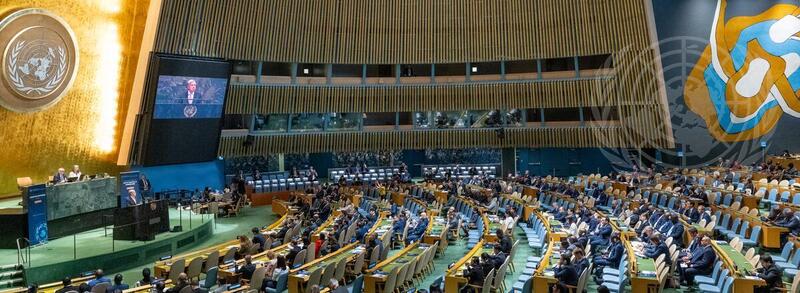
United Nations — India has delivered a sharp criticism to the United Nations General Assembly (UNGA), declaring that global counter-terrorism strategies will remain ineffective without a binding international legal framework.

Speaking during the adoption of the Ninth Review of the Global Counter-Terrorism Strategy (GCTS), India urged member states to stop playing politics with global security.
India’s Permanent Representative to the UN, P. Harish, demanded the immediate passage of the long-delayed Comprehensive Convention on International Terrorism (CCIT) and called for a major shift toward concrete state accountability, updated technology regulations, and an end to what he termed “geopolitical hypocrisy and double standards.”
Harish was speaking at the week-long conference, the UN Counter-Terrorism Week (CT Week), a major biennial meeting convened by the UN Office of Counter-Terrorism (UNOCT) at the UN Headquarters in New York. The Fourth UN Counter Terrorism Week was held June 26 to July 2, 2026.
ADVERTISEMENT

The week-long conference focused on the theme “A Future Free from Terrorism: Consolidating the Global Commitment to Multi-Stakeholder Approaches to Counter Terrorism through Member States’ Leadership and Action.” It coincided with the 20th anniversary of the GCTS’s original 2006 adoption and concluded with the General Assembly formally adopting the Ninth Review Resolution of the strategy.
Demanding the CCIT
The central argument of Harish’s address was the prolonged delay of the CCIT, a universal, legally binding treaty that India first proposed to the UN nearly 30 years ago in 1996. “The absence of a universally agreed legal framework weakens global counter-terrorism efforts,” he said.
Expressing deep frustration over a lack of “political will” among member states to adopt a universal definition of terrorism, he noted that the CCIT was introduced a full decade before the UN adopted its current, non-binding GCTS.
India warned that without a strict legal framework compelling all nations to prosecute or extradite terrorists, disrupt financing networks, and deny safe havens, global counter-terrorism efforts will not see any results.
Rejecting ‘Good vs. Bad’ Terrorist Narratives
India pointed out that terrorism cannot be “good” or “bad”, sharply criticizing the tendency of certain nations to differentiate between “good” and “bad” terrorists based on political alignments.
Stating, “We can combat the menace of terrorism only if there is no distinction between good or bad terrorists,” Harish called for an absolute, zero-tolerance policy, rejecting any attempt to justify or excuse terrorist acts based on political context, historical grievances, or strategic calculations.
Counter-terrorism efforts are systematically undermined by “false equivalences”, such as balancing the unlawful actions of terrorist groups against the legitimate defense operations of sovereign states, he pointed out.
India firmly asserted that because terrorism destroys the fundamental right to life, it constitutes the ultimate violation of human rights. Therefore, robustly combating terrorism is an act of protecting human rights.
Condemning Religious Selectivity
India further challenged the UN’s approach to religious bias, arguing against what it described as “a selective blind spot in international diplomacy”. While condemning hatred directed against specific groups, including Islamophobia, Christianophobia, and anti-Semitism, Harish criticized the UN for the narrowness of its lens.
India demanded that the international community formally acknowledge and treat prejudice against all global faiths equally, including non-Abrahamic religions such as Hinduism, Buddhism, and Sikhism, to prevent a “hierarchy of victimhood.” “Till this is done, such international days will never achieve their objectives. There cannot be double standards on religiophobias,” Harish said.
Addressing Tech-Driven Terror
India also expressed its frustration with the UN’s bureaucratic pace, particularly regarding the regulation of modern technology, in the face of growing appendage of technology by global terrorist groups.
In his statement, Harish vocalized India’s dissatisfaction that key elements of the Delhi Declaration, a framework addressing the misuse of advanced technologies like artificial intelligence, deep fakes, drones, encrypted messaging, and crypto currencies by terrorist networks, were omitted from recent UN documents due to administrative and political disagreements among member states.
Urging the UN to make a strategic move from abstract, biennial paperwork exercises toward practical execution, India called for the universal integration of technology-focused threats, including terror funding, victim-centric policies and global South’s non-adherence to Western political frameworks.
Calling for Meaningful Consensus
Harish firmly criticized the traditional UN obsession with diplomatic consensus, arguing that a unanimous agreement is counterproductive if it results in a diluted, unenforceable text.
Anchoring India’s position in its national policy, Harish cited Prime Minister Narendra Modi’s maxim that “terror anywhere threatens peace everywhere,” highlighting the resolution of the legal gridlock as a moral imperative for generational security.
Adopting the Landmark Resolution
Before the end of the Conference, Member States ultimately united to renew their unwavering commitment to international cooperation despite deep-seated disagreements among some nations throughout the drafting process. In a powerful closing consensus, the Assembly condemned terrorism in the strongest possible terms, explicitly targeting violence fueled by religion, belief, xenophobia, racism, or any other form of intolerance.
The UNGA officially adopted a landmark resolution reaffirming the UN Global Counter-Terrorism Strategy as the primary global blueprint for combating extremist threats. The resolution strongly urges Member States to make every effort to finalize a comprehensive convention on international terrorism, establishing a definitive global standard for how nations balance national security with human rights and civilian protection.