

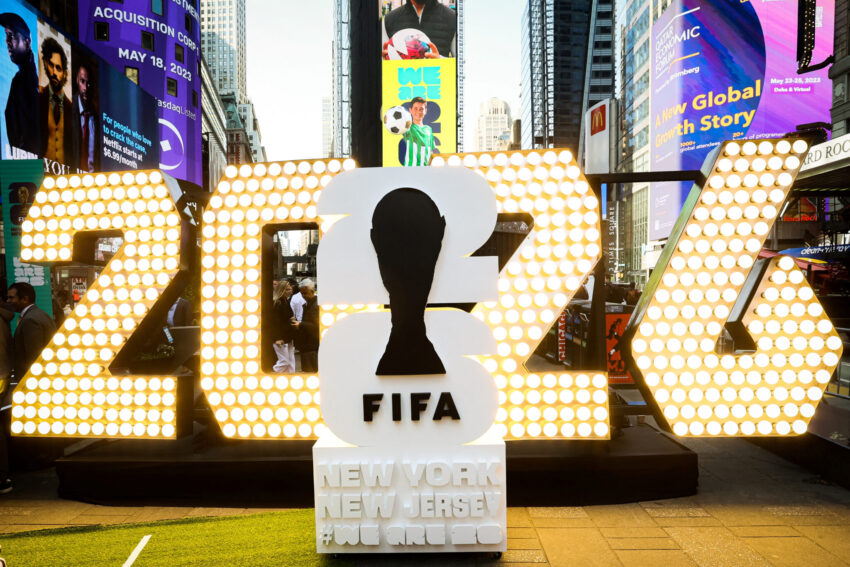
Millions of soccer fans are expected to crowd into U.S. stadiums, bars and restaurants to cheer on the 48 nations competing in the World Cup, which will be played on American soil for the first time in 32 years.

But as the tournament kicks off this week, the quadrennial soccer celebration also has emerged as the latest battleground over immigration in the United States and the Trump administration’s mass deportation agenda.
More than 2,000 workers at SoFi Stadium in Los Angeles voted Friday to authorize a potential labor stoppage unless they receive assurances that U.S. Immigration and Customs Enforcement will not be permitted to conduct deportation operations inside or outside the venue.
Fans from countries that require U.S. travel visas – including those from the four tournament-qualifying nations included on President Donald Trump’s travel ban list – say they are facing unnecessary complications in obtaining the proper paperwork and, in some cases, have given up on trying to watch the games in person.
ADVERTISEMENT

And some fans who live in the United States remain wary that ICE will carry out arrests at stadiums during the World Cup. Tournament organizers have said federal officers will not be conducting broad immigration sweeps around the matches. But Homeland Security Secretary Markwayne Mullin has not ruled out enforcement actions involving people suspected of criminal activity, leaving questions about how officers will operate in and around the venues.
The mounting trepidation within immigrant communities in the 11 U.S. host cities reflects the pervasive fear that exists among ethnic groups with the largest number of soccer fans, including Latinos, after more than a year of Trump’s mass deportation campaign. Advocates said the administration’s policies are threatening to dampen enthusiasm and participation from targeted communities as the U.S. plays co-host, along with Mexico and Canada, to an international showcase of the world’s most popular sport.
“We want the World Cup to happen because it’s a meeting of countries across the world, an exchange of cultures, a unifying moment around the beautiful game,” said Rich André, a senior policy adviser at the American Immigration Council. “When you’re shutting out would-be fans who want to come and support their team or just be in the stadium or bars cheering for Brazil or Argentina or another team, something is really lost.”
The Department of Homeland Security has traditionally helped provide security at major sporting events in the U.S., including the Super Bowl. But the World Cup, with matches in the U.S. over 38 days, offers a unique test for Mullin, who became secretary in March and has pledged to restore public confidence in the agency amid a backlash to Trump’s deportation agenda.
A significant majority of Americans – roughly 65 percent – opposes ICE presence at U.S. stadiums, according to a Washington Post-University of Maryland poll conducted in mid-May.
In a video last month, Mullin suggested large crowds could breed criminal activity and said ICE and Homeland Security Investigations would be “out there every day fighting against the counterfeit tickets, human trafficking, drug smuggling.”
On June 1, Mullin joined federal and local officials for a tour of AT&T Stadium in Dallas, where nine matches will take place. He compared the task of securing the World Cup games in the U.S. to planning for 78 Super Bowls in 38 days.
“The first game for the U.S. is June 12 in L.A. We’ll be there,” he told reporters, making no mention of immigration-related operations.
Immigrant rights groups have sought to prepare communities for potential enforcement sweeps during the tournament.
In Dallas, for example, El Movimiento is activating a rapid response network that was established last year during increased ICE enforcement operations in the city. Activists said they are providing know-your-rights training to immigrants in vulnerable neighborhoods and setting up hotlines to track and report ICE activity. They also plan to send legal observers to FIFA-sponsored fan events, said Azael Alvarez, an organizer with the group.
“Unfortunately, a lot of people I’ve talked to are scared to leave their own house, especially in big apartment complexes that are known to have ICE presence,” he said. “It’s already instilled a fear that, ‘Oh, they could be out there,” whenever they set foot outside their homes.
Immigration concerns, along with high ticket prices, have contributed to indications that sales are lagging and the expected financial windfall could fall short. The American Hotel & Lodging Association released a survey last month that found 80 percent of respondents said bookings in the host cities were running below projections. The respondents attributed the sluggishness primarily to U.S. visa restrictions and broader geopolitical concerns.
Under mounting pressure, FIFA, the sport’s international governing body, has avoided criticizing the Trump administration or making blanket statements about the role ICE is expected to play. Some local organizers in the World Cup host cities have sought to reassure the public by emphasizing that federal immigration officers will assist only with general security operations.
In mid-May, a State Department official said the U.S. would suspend the visa bond fees for fans from Senegal and three other nations on the travel ban list that qualified for the World Cup – Haiti, Iran and Ivory Coast. Under the temporary suspension, those fees, ranging from $5,000 to $15,000, would be waived for fans who had purchased tickets by April 15 directly through FIFA and used FIFA Pass, an app aimed at expediting visa processing, according to guidance on the State Department’s website.
But many fans did not buy their tickets that far in advance, in part because the bonds had made it prohibitively expensive to go. That included Aliou Ngom of Senegal. Ngom had requested help paying for his travel from the nation’s Sports and Culture Ministry, which typically provides financial assistance to fans to purchase tickets and travel abroad.
But the ministry denied his request in April, expressing regret that the government could not assist him. An official explained that “recent visa restrictions imposed by the U.S. government – specifically the requirement to post a bond ranging from $5,000 to $15,000 – risk jeopardizing the presence of most of our supporters alongside their National Team.”
Asked about the matter, the Senegalese Embassy said in a statement that the visa fees “are part of broader U.S. immigration policies” and referred questions to the Trump administration.
“I really want to go because since 2012 I have been part of the football world,” said Ngom, who attended the World Cup in Qatar in 2022 and Russia in 2018 and has amassed nearly half a million TikTok followers as “Paco” the Senegal superfan.
Even those who are willing to pay the extra fees for a visa remain fearful that they could be denied entry at U.S. airports, said Marie Christine Lebondo, owner of the Finest, a concierge service in Ivory Coast. Their anxiety stands in contrast to the ease and confidence with which she booked tours for fans traveling to Qatar for the 2022 World Cup.
This year, Lebondo said, clients are worried that “even if you get a visa, you can get to the airport in the U.S. and still get sent back to your country. They are asking me the question: ‘Are you sure I can get in?’ I say, ‘I’m not sure because I’m not working at the airport.’”
Asked to clarify ICE’s role, the Department of Homeland Security said in a statement Friday that the agency would work with federal and local partners “in line with federal law and the U.S. Constitution – as we do with every major sporting event.” The agency added that “international visitors who legally come to the United States for the World Cup have nothing to worry about. What makes someone a target for immigration enforcement is whether or not they are illegally in the U.S. – full stop.”
In Los Angeles, Unite Here Local 11, which represents some 2,000 workers at SoFi Stadium, has threatened a labor strike unless it receives guarantees from stadium food service operator Legends Global and FIFA that ICE will not be permitted to conduct enforcement at the venue.
Workers protested in front of the stadium, drawing support from billionaire Tom Steyer, a Democratic candidate for California governor, who joined them at the demonstration.
Yolanda Fierro, who helps staff luxury suites, said in an interview that the Trump administration “thinks we have only criminals here, working, visiting, coming to games, but they’re not. These are hardworking people who take care of their families. We don’t want [ICE] here. We want to feel safe, we can take care of ourselves, and, most of all, we want our guests to feel safe.”
Democratic city leaders in Houston, another host city, have tangled with Texas Gov. Greg Abbott (R) over $110 million in security grants. Much of the money is intended to help with operations for the seven World Cup games at NRG Stadium, officials said.
Abbott threatened to withhold the grants unless Houston leaders amended a city law that restricted local police from indefinitely detaining migrants.
Facing Abbott’s threat, the Houston City Council voted 13-4 in April to lift that restriction, while keeping in place a separate provision requiring police to report any calls to ICE and document how long immigrants are detained for. Council member Alejandra Salinas, who voted against the amended language, expressed frustration at her colleagues.
Salinas said World Cup organizers promised that ICE will not be conducting immigration enforcement at the stadium, but she remains wary.
“It is incumbent on all of us – the press, the council and the public – to hold them to account,” she said. “It is not fair if the people visiting the country, the people enjoying the games, are being unlawfully or improperly harassed.”