

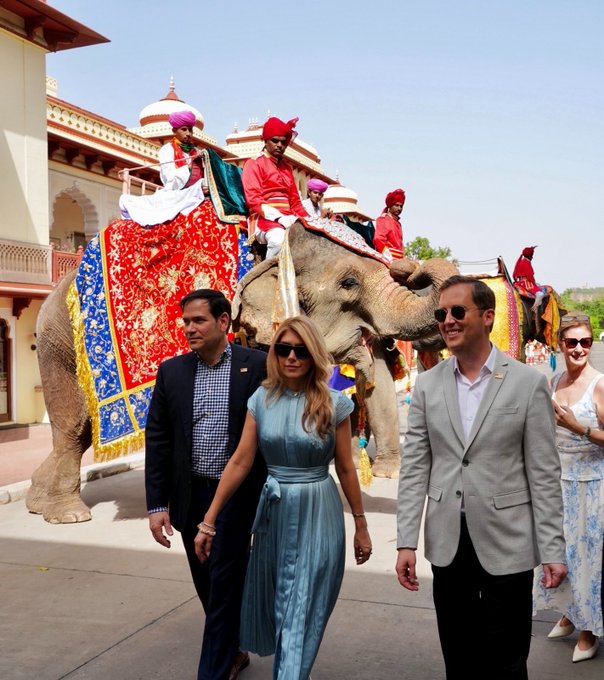

NEW DELHI – In the span of four days, Secretary of State Marco Rubio lit prayer candles with the nuns of Kolkata, gripped hands with India’s prime minister in New Delhi, toured the Taj Mahal in 100-plus degree heat and cheered on folk musicians performing atop elephants in Jaipur.

The dizzying array of cultural and political events is aimed at mending a relationship with the world’s largest democracy that has soured by dint of President Donald Trump’s sweeping tariff agenda, overtures to China and high-profile embrace of archrival Pakistan, which India has long sought to isolate.

The hurt feelings surfaced publicly on Rubio’s second stop when an Indian journalist told him that Trump’s second term has diverged from “25 years of very significant progress in India-U.S. ties,” introduced a “transactional” approach to the relationship and sent “mixed signals on Pakistan and China” that left many in India feeling that momentum has been “lost.”
Rubio rejected the premise, saying “the relationship continues to be strong,” but U.S. officials across the departments of commerce, state and defense acknowledge that Washington is digging itself out of a hole with India and hopes to return to the warmer bilateral rapport of Trump’s first term.
ADVERTISEMENT
“This is a damage-control trip,” said Husain Haqqani, a senior fellow at the Hudson Institute, a conservative think tank in Washington.
“U.S.-India relations have really gone down as a result of a clash between Trump’s vanity and Modi’s pride,” he added, referring to Indian Prime Minister Narendra Modi.
In recent years, Washington’s investment in New Delhi reflected a bipartisan consensus that the United States needed India as a counterweight to China. Rubio continued that tradition on Tuesday, convening his counterparts from India, Japan and Australia in New Delhi, where they endorsed a “common vision for a free and open India-Pacific.”
But technocratic cooperation has been overshadowed by more high-profile feuds.
Indian officials have been angered by Trump’s tariffs on Indian exports, alarmed by the president’s public fondness for Pakistan’s top military leader, Asim Munir, whom he calls his “favorite field marshal,” and embittered by the administration’s decision to elevate Pakistan as an intermediary during the Iran conflict. Trump’s embrace of Pakistan on the heels of his friendly visit to China has prompted comparisons to President Richard M. Nixon, who aligned with Islamabad over New Delhi and brokered a watershed rapprochement with Beijing.
“Nixon, like Trump, believed that resetting relations with China was in paramount American interest. Nixon, like Trump, led a White House and establishment that was instinctively unsympathetic to Indian concerns,” Samir Saran, the president of the Observer Research Foundation, a New Delhi-based think tank, wrote in the Indian Express. “And Nixon, like Trump, viewed the Pakistani military leadership through rose-tinted glasses.”

Rubio has looked to inject warmth and reassurance into the relationship, attending a big budget U.S. Embassy party in New Delhi that featured 1,500 guests, a performance of “YMCA” by a reconstituted version of the Village People and a phone call from Trump in which he said “I love India,” over an amplified speakerphone.
He stressed during remarks to reporters that the tariff disputes with India were not unique to New Delhi and reflected Trump’s determination to change global trade policy.
“The president did not say, ‘Let’s figure out a way to create friction with India over trade,’” Rubio said. “The United States was being deindustrialized. We pursued trade policies that left us in a place where all the means of production had been outsourced in such a way that left us vulnerable, that had to change.”
Michael Kugelman, a South Asia analyst at the Atlantic Council, acknowledged that the relationship was in a “tough spot,” but said a few green shoots have emerged in recent months, including India’s agreement to reduce some purchases of Russian energy as a part of broader trade discussions and the Justice Department’s recent decision to drop criminal fraud charges against Indian billionaire Gautam Adani.
“It’s provided a boost, especially given that it’s an open secret that Adani is close to Modi,” Kugelman said.
Another figure seeking to improve the relationship is the U.S. ambassador to India, Sergio Gor, a longtime Trump ally at the White House and architect of Rubio’s expansive visit.
Kugelman called Gor “essentially the India whisperer from within the Trump administration,” saying the ambassador had helped “set a positive tone in the relationship.”
Still, critics lamented that U.S. efforts appeared more focused on transactional matters, such as increasing Indian purchases of U.S. oil and gas rather than a coherent Indo-Pacific strategy to blunt China’s influence.
“It appears to many that the secretary of state is talking more about how much oil can be sold to India rather than cooperation against China or how to maintain a free and open Indo-Pacific,” said Haqqani.
But if anyone can help play up Washington’s concern about China, it’s Rubio, one of the most hawkish U.S. figures when it comes to Beijing, said Kugelman.
“There’s been a pretty strong perception across the Indian policy community for quite some time that Trump is not willing to pursue a robust competition with China,” said Kugelman. “But Rubio is arguably best positioned to make the case that the two sides have common ground on this issue.”