

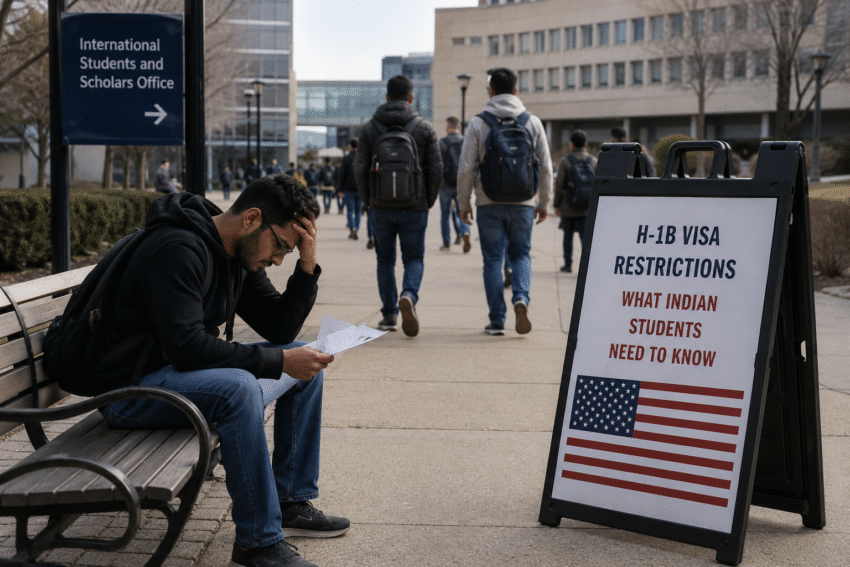

WASHINGTON — A Republican-backed bill seeking a three-year pause on new H-1B visas has raised concerns among Indian students and professionals who rely on the program to move from U.S. education to employment.

The bill, introduced by Rep. Eli Crane, R-Ariz., would pause H-1B issuance for three years, reduce the annual cap, replace the lottery with a wage-based system, set a $200,000 minimum salary requirement and end Optional Practical Training, or OPT. It has not become law.
The proposal could have a major impact on Indian graduates in the United States, especially those completing master’s degrees in science, technology, engineering, business and health-related fields. Many international students use OPT after graduation to gain work experience while seeking employer sponsorship for an H-1B visa.
U.S. colleges also view OPT as central to attracting foreign students. A 2025 Institute of International Education snapshot found that 92% of surveyed U.S. institutions said international students would likely choose other countries if OPT were unavailable.
ADVERTISEMENT

India would be among the most affected countries. USCIS data show that 71% of approved H-1B petitions in fiscal 2024 were for beneficiaries born in India.
For Indian students, the uncertainty may change the financial calculation of studying in the United States. Families often invest heavily in U.S. degrees with the expectation that graduates will have a chance to work, repay loans and build careers. If OPT is removed and H-1B access is paused or narrowed, students may increasingly consider Canada, Britain, Australia, Germany or other countries with clearer work pathways.
The bill is unlikely to affect current rules unless it passes Congress and is signed into law. But even as a proposal, it signals growing political pressure on the H-1B system and may make U.S. employers more cautious about hiring foreign graduates who need visa sponsorship.