


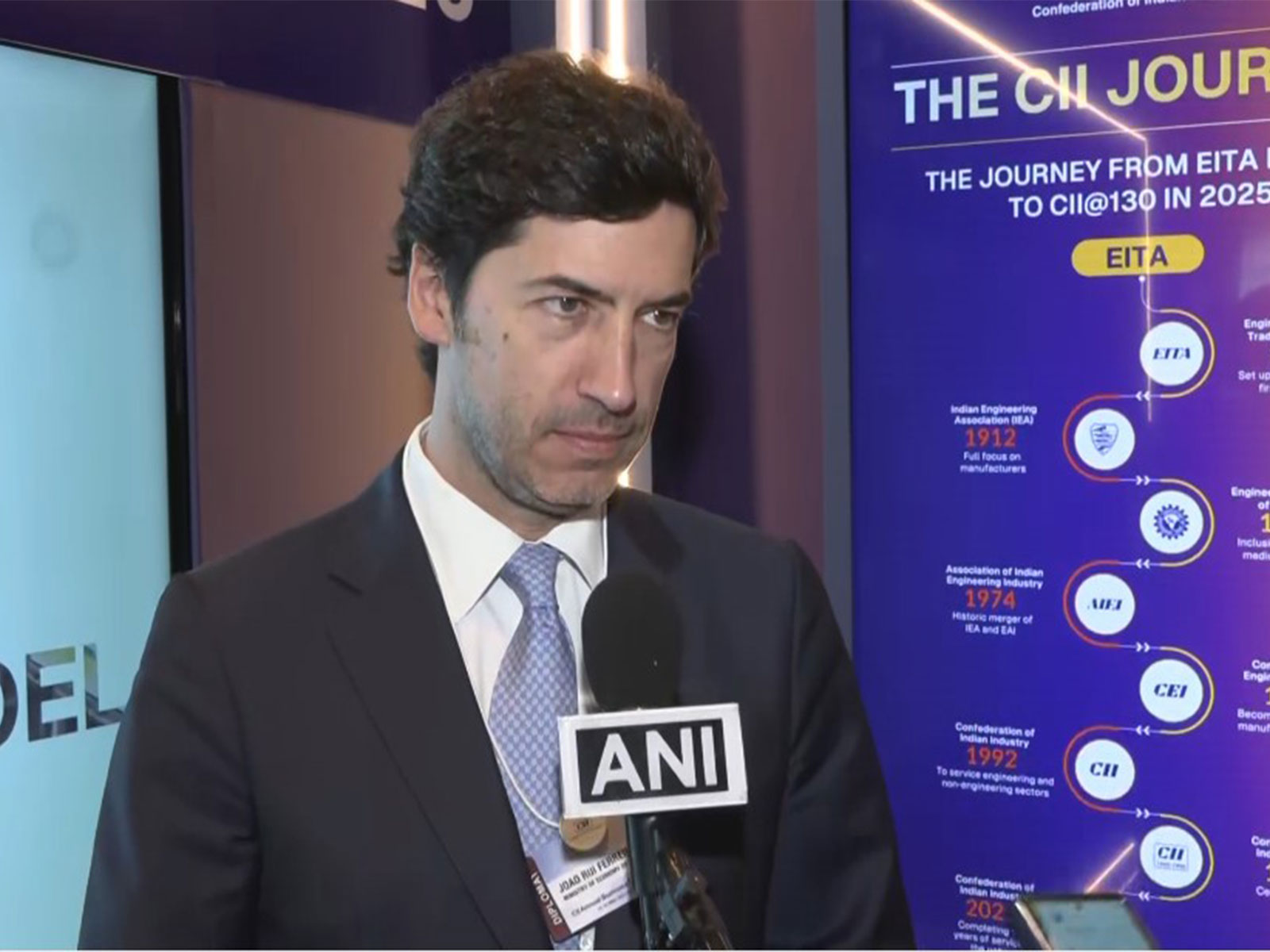
New Delhi [India], May 11 (ANI): Portugal is moving to establish a robust commercial bridge with India, focusing on a “win-win” synergy between European specialised technology and the massive scale of the Indian economy.
Speaking with ANI, João Rui Ferreira, Portugal’s Secretary of State for Economy, confirmed that the primary objective of his current mission is to build a regulatory framework that allows companies from both nations to anchor their operations in each other’s territories.
Ferreira emphasised that his primary mission is to build a regulatory bridge allowing companies from both nations to integrate operations seamlessly.
“My focus right now is on establishing business and creating the framework for Portuguese and Indian companies to establish their operations. That is what I am focusing on,” he said.
Ferreira highlighted that the relationship between Lisbon and New Delhi is defined by “complementarity,” a term he used to describe how Portuguese high-tech “know-how” can fuel India’s rapid industrialisation.
Ferreira identified a unique synergy between the two nations, noting that Portugal’s specialised talent is perfectly positioned to support India’s rapid infrastructure development and industrialisation.
“The objectives of the agenda are being fully accomplished. We wanted to really feel and connect. While I have an institutional agenda, it was very positive. The word I will take from this is ‘complementarity.’ Portugal and India have a clear complementarity where Portuguese know-how, competencies, and technology can provide knowledge to the Indian scale. The plans for Indian infrastructure and the industrialisation of the country are very much aligned with Portuguese knowledge, talent, and skills in these areas. Portuguese businesses and companies have a significant opportunity here,” he said.
A central pillar of this burgeoning relationship is the India-European Union Free Trade Agreement (FTA). Ferreira expressed optimism that the agreement, currently in its final stages of discussion, could be implemented as early as next year.
“Furthermore, the free trade agreement will clearly open the door to more trade among our countries, positioning India as a global market for Portuguese companies looking to expand their business. It is very positive that the agreement has been finalised this year; we are now in the final discussions regarding the details. Portugal has been pushing for this agreement since the beginning, and we hope to have it in place as early as possible next year. This will clarify the complementarity of the two blocs,” he said.
The Secretary highlighted that the FTA would offer India access to 450 million European consumers, while simultaneously allowing European firms to boost their global competitiveness by tapping into the Indian market. Moreover, Portugal’s expertise in machinery and tooling aligns with India’s “Viksit Bharat 2047” agenda.
“It is not only about tariffs; it is about creating a predictable and stable regulatory framework so that companies from both sides understand exactly the rules and standards of the field they are playing in. This will be clearly complementary. On one side, it offers access to a global market of 450 million consumers in Europe with the right standards and conditions. On the other side, to answer the 2047 agenda, it allows for a global impact on European economies by opening up to the scale of the Indian market. Together with European companies, we can strengthen and raise competitiveness in areas like renewable energies and digital transition,” he said.
Ferreira also touched upon the necessity of the green transition amidst global geopolitical chaos. He argued that moving toward renewable energy is not just an environmental goal but a strategic necessity to reduce dependency on fossil fuels caused by international conflicts.
“Clearly, in energy, 80% of Portugal’s energy consumption comes from renewable sources. We have a lot of knowledge, competencies, and skills in this area, and we can be very supportive of India’s goals. There is also a group of companies in tooling, machinery, and equipment that can be partners in the industrialisation of the country. I see a clear win-win situation. We are also discussing tourism, as Portugal is becoming more and more interesting for Indian tourists travelling to Europe. Portugal serves as a gateway to access the single market and the Portuguese-speaking countries,” he said.
Addressing the current climate of global conflict, Ferreira urged a shift toward energy independence as a means of ensuring economic stability. He noted that while global tensions create “uncertainty and a lack of predictability,” the transition to green energy remains a vital tool for economic resilience.
“The whole world is expecting global conflicts to come to an end because we need stability and a peaceful environment to develop business. One clear focus must be to move more and more toward renewable energies to reduce dependency on fossil fuels. Portugal has done great work on this, but globally, these conflicts have negative impacts on economies. They create uncertainty and lack of predictability. We hope that the conflict reaches a peaceful resolution in the next few days or weeks,” he said. (ANI)