

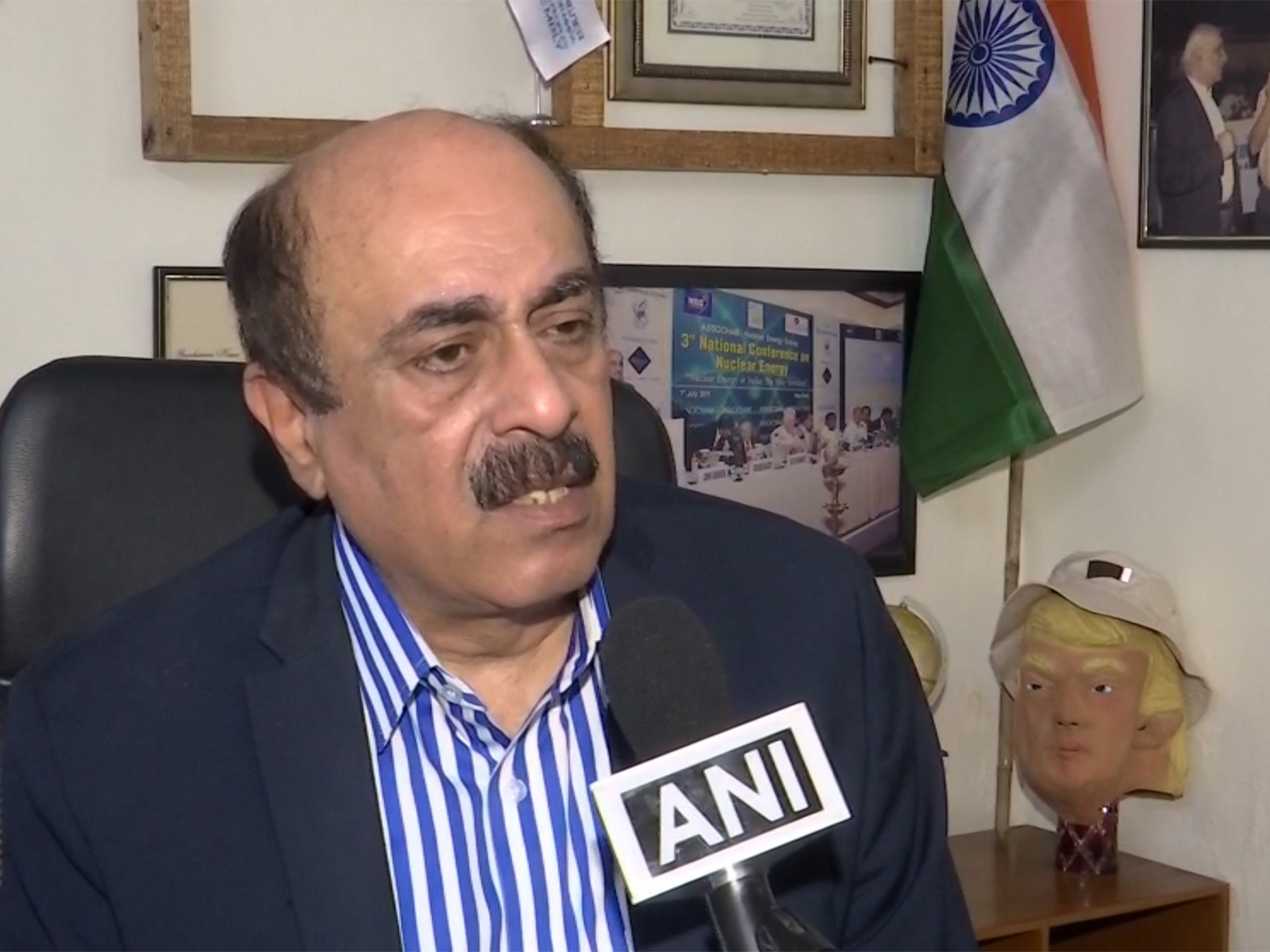
New Delhi [India] May 8 (ANI): Foreign affairs expert Robinder Sachdev has characterised the escalating tensions between the United States and Iran as a “theatre of the absurd,” describing a paradoxical state of “Schrodinger’s War” where a ceasefire and active combat appear to exist simultaneously.
Speaking with ANI, Sachdev suggested that the current cooling of hostilities is less a move toward permanent peace and more a calculated “ploy” by US President Donald Trump to clear his diplomatic calendar ahead of a high-stakes visit to China next week.
According to Sachdev, President Trump is downplaying recent ceasefire violations to ensure his upcoming meetings with Chinese President Xi Jinping are not overshadowed by Middle Eastern turmoil.
“In some ways, this is the theatre of the absurd, which we are seeing with respect to the Iran war. Many things are happening which do not seem logical, but they are happening simultaneously. For example, there is a ceasefire, yet there is a war. President Trump seems to be downplaying any violations of the ceasefire because he really wants a deal with Iran before going to China,” he said.
Sachdev said that by pushing for a temporary “pause” in the Iran conflict, Trump aims to clear the diplomatic runway for his high-stakes visit to Beijing, which is scheduled for May 14-15, 2026.
“He would like the Iran matter solved, or at least at a pause, so that his meetings in China with Xi Jinping next week do not happen under the shadow of the Iran conflict. Otherwise, too much time will be spent talking about Iran when Trump wants to talk to China about agricultural exports, technology, and the trade deficit,” he said.
Trump delayed this China trip once already (originally set for March) because of the Iran war. He is reportedly determined to avoid a repeat. If the Gulf is in active flames next week, his meetings with Xi Jinping will inevitably be consumed by crisis management and the global energy shock rather than his preferred agenda.
However, Sachdev warned that this de-escalation may have an expiration date. “Right now, holding the ceasefire is likely a strategy or a ploy to avoid being distracted from the China meetings. After those meetings are over, they could start bombing again,” he said.
Sachdev said that the crux of the deadlock remains Iran’s stockpile of enriched uranium. While Trump has made the physical removal of the material a cornerstone of his demands, Sachdev believes Tehran views this as a non-starter. Trump demanded the physical removal of Iran’s enriched uranium (nearly 10 tons). Iran views this as a “surrender” and will, at most, agree to a moratorium or dilution.
“The bottom line in this deal is the matter of enriched uranium. Trump claims Iran is on the way to a nuclear weapon, and he needs to remove that uranium from the country. It has become a matter of saving face because he has repeatedly talked about taking away their enriched uranium, whether it be 400 kilograms or the nearly 10 tons Iran actually possesses. I do not think Iran will ever agree to that condition,” he said.
Sachdev argues that a one-page MoU (Memorandum of Understanding) will fail because both sides have reached existential limits.
“Consequently, discussions are shifting toward opening the Strait of Hormuz. There were clashes yesterday, and the Iranians seem to be fighting back rather than being cowed, even though they are being hit effectively. A one-page MoU or draft agreement will not resolve these multiple matters. Trump is currently pushing for time and trying to corner them into a pause so the conflict does not overshadow his China visit,” he said.
Iran has realised that the Strait of Hormuz is its ultimate leverage. Despite “fire and fury” from the US and Israel, Iran’s ability to control this energy chokepoint remains intact, and they are unlikely to negotiate away their dominance there.
“Trump has been applying psychological, military, diplomatic, and economic pressure. Economic pressure is the main force he is using against Iran. While Iran has been hurt and damaged badly and would very much want a deal, they have red lines they will not cross. One is the enriched uranium; they might agree to a moratorium or some dilution, but allowing the physical material to be taken out of the country would be seen as a surrender. Another red line is the Strait of Hormuz, which has emerged as a ‘super weapon’ during this war. Iran has realised its value, seeing that American and Israeli fire and fury cannot destroy this leverage. Iran will never give up its dominance over the Strait,” he said.
Trump’s “deal” requires Iran to limit its missile program and proxy influence, concessions Iran has consistently refused, even under heavy economic and military pressure.
“Iran also refuses to limit the scope of its missile program, which is another major condition. Trump originally withdrew from the Obama-era agreement because it focused only on nuclear progress and ignored the range of missiles Iran was developing or their use of proxies. These remain the biggest demands for both the U.S. and Israel, leaving many gaps to be filled. Even if a deal is made, it will likely be half-baked because the entire Gulf region is in turmoil,” he said.
Sachdev said that even with a deal, there will be simmering tensions beneath.
“Israel has not achieved its objectives, such as regime change or the total elimination of the nuclear and missile programs. Even with a deal, the region will remain under a high degree of stress,” he said.
The expert notes that while Trump intends to press Xi to stop supplying dual-use components (drone motors, sensors, solid fuel), China’s cooperation is far from guaranteed.
“Iran is repeatedly showing that it is fighting back and testing America to see how far it will bend under provocation. This low-intensity skirmishing could continue for the next couple of weeks as Trump prepares to travel. He wants to de-escalate operations in the Gulf for at least 30 days, so his visit is not mired in conflict. During the meeting with Xi Jinping, Trump’s agenda will include pressing China to stop supplying dual-use components to Iran, such as motors for drones, sensors, batteries, and solid fuel,” he said.
China knows Trump is desperate for a “win” before the summit. Xi Jinping is expected to demand a high price for any reduction in support for Iran, such as the lifting of US sanctions on high-end machinery and semiconductor chips
“China is playing an important role in the background. Recently, the Chinese and Iranian foreign ministers held a joint call with the Saudi foreign minister. Remember, China brokered a peace agreement between Saudi Arabia and Iran three years ago, though that agreement currently seems weak. China knows that if the situation in the Gulf escalates, it will weaken Trump’s ability to negotiate. If Trump asks Xi to stop exports to Iran, Xi will likely demand his own piece of the bargain, such as lifting American sanctions on chips and high-end machinery transfers to China,” he said.
He said that China wants Iran to survive because if Iran falls, it will create a long-term energy security problem for China.
“Ultimately, China wants Iran to survive and thrive. If Iran falls to American demands and becomes like Venezuela, it creates a long-term energy security problem for China. If the U.S. controls the region, Iranian oil–like Venezuelan oil–becomes unavailable to China. By closing these taps, the U.S. threatens China’s energy security. Therefore, China will never want Iran to collapse. While China projects itself as a balanced statesman on the world stage, it continues to engage in its own strategic manoeuvres behind the scenes to protect its interests,” he said.
https://x.com/IRIMFA_SPOX/status/2052757812825002016?s=20
The comments come as Spokesperson of the Ministry of Foreign Affairs of Iran, Esmaeil Baqaei, appeared to mock Trump by saying that disjointed, delusional tweets no longer hold any sway over reality.
In a post on X, he said, “Vermin-like nocturnal scheming and naive euphemisms such as ‘a light slap” can do nothing to erase the profound disgrace born of narcissism, greed, reckless miscalculation, and lawless irresponsibility.
The consequences of this whimsical adventurism and roguish behaviour have now become clear to the entire world. Disjointed, delusional tweets no longer hold any sway over reality–though, as ever, “the deeper they sink into folly, the more inventive they become in justifying it.” (ANI)