

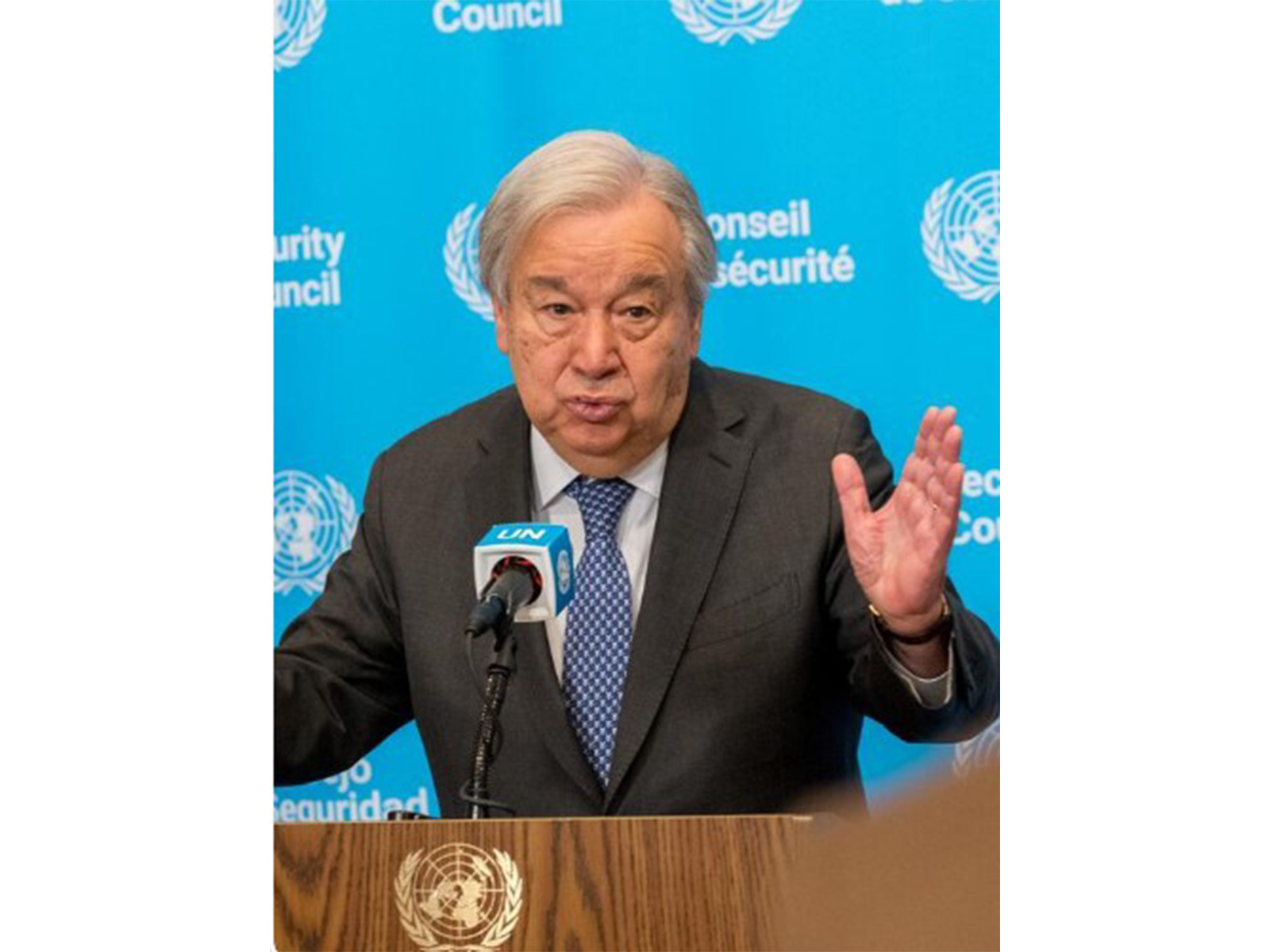
New York [US], May 1 (ANI): United Nations Secretary General Antonio Guterres has urged the reopening of the Strait of Hormuz, saying that the longer it is choked, “the higher the cost to humanity.”
“My message is clear: Open the Strait. Let all ships pass. Let the global economy breathe again,” he said on Thursday.
The world may face the “spectre of a global recession” if the freedom of navigation through the Strait of Hormuz is not restored by the end of this year, UN chief Guterres told media personnel in New York.
In the scenario where “severe disruptions persist through the end of the year, inflation skyrockets past 6%, growth plummets to 2%, immense suffering takes hold, especially among the world’s most vulnerable populations,” the UN Secretary General said.
“And we confront the spectre of a global recession with dramatic impacts on people, on the economy, and on political and social stability,” he said
“The longer this vital artery is choked, the harder it will be to reverse the damage,” Guterres noted.
Setting out three possible trajectories, he said that even if restrictions on shipping and trade were lifted immediately, “supply chains will take months to recover,” with global growth falling from 3.4 to 3.1 per cent, inflation rising to 4.4 per cent and trade slowing sharply.
“And a world still reeling from the shocks of a pandemic and the war in Ukraine will endure further economic distress. This is the best-case scenario,” he said.
“The Middle East crisis is lumbering into its third month,” Guterres told reporters at the news conference at UN headquarters in New York. “Despite a fragile ceasefire, the consequences grow dramatically worse with each passing hour.”
He said he is “deeply concerned about the curtailment of navigational rights and freedoms in the area of the Strait of Hormuz,” warning it is “impeding the delivery of oil, gas, fertilizer, and other critical commodities” and “strangling the global economy.”
“As with every conflict, the whole of humanity is paying the price – even if a few are reaping huge profits,” he said, adding that “the pain will be felt for a long time to come.”
He explained a second scenario, where disruption drags on through midyear, would push 32 million people into poverty, cause fertilizer shortages, reduce crop yields, and leave 45 million more people facing extreme hunger.
With no end in sight to the shipping stand-off in the Strait of Hormuz and as Brent crude oil prices hovered at around $118 in trading on Thursday, the prospect of running out of fuel, gas and more has focused attention in the world’s capitals on finding solutions, quickly, the UN said.
Southeast Asia and South Asia were first to be impacted by the most severe energy crisis in a generation, said Dario Liguti from the UN Economic Commission for Europe (ECE), and but he warned that “it is an unfolding energy crisis,” with motorists in Europe already bracing themselves every time they fill up the tank.
Guterres highlighted diplomatic efforts underway by the head of UN Project Services (UNOPS) who is leading the UN Task Force on the strait to provide a possible humanitarian corridor.
The head of the UN maritime organization, IMO, is likewise developing a framework to evacuate ships and seafarers if safe passage can be guaranteed, he said.
Meanwhile, the International Monetary Fund (IMF) had in a report published last month said that “a longer or broader conflict, worsening geopolitical fragmentation, a reassessment of expectations surrounding artificial-intelligence-driven productivity, or renewed trade tensions could significantly weaken growth and destabilize financial markets.”
“The closing of the Strait of Hormuz and serious damage to critical facilities in a region central to global hydrocarbon supply raise the prospect of a major energy crisis should hostilities continue,” it said.
US and Israel launched attacks on February 28 with Iran retaliating by attacking energy facilities across West Asia, which is a major producer of the world’s oil and gas, while Israel attacked energy sites in Iran. Although the US and Iran agreed to a two-week cease-fire, temporarily halting military attacks, traffic through the Strait of Hormuz has continued to be restricted. (ANI)