

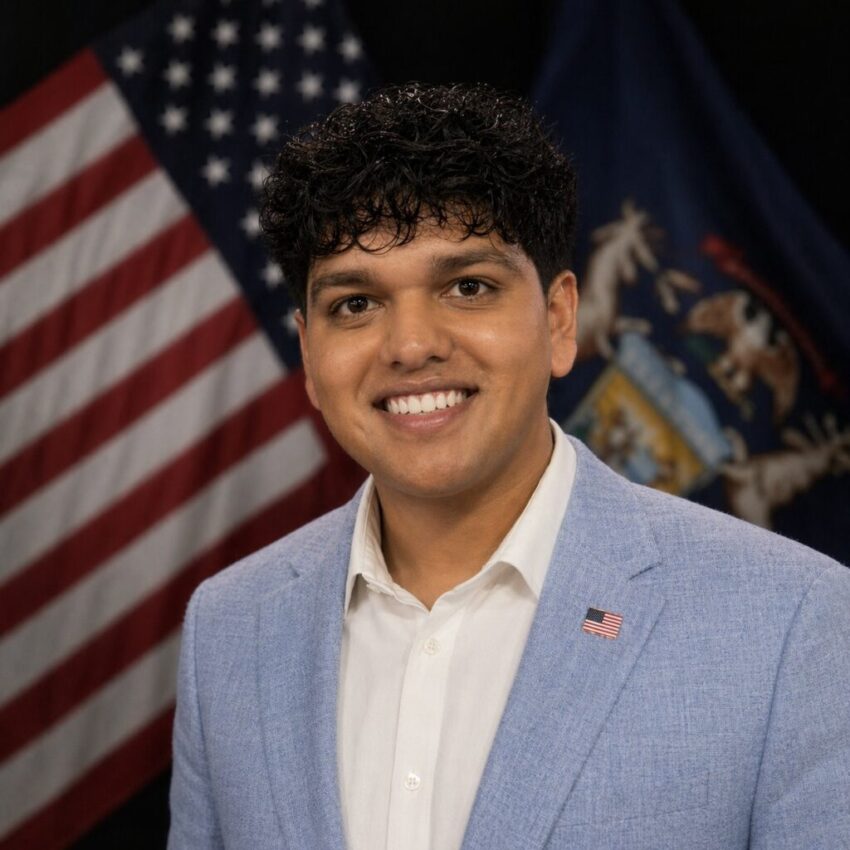
Indian Americans may well be witnessing the emergence of a Gen Z politician in Michigan with the growing visibility of Krish Mathrani, Youth Chair of the Michigan Republican Party.

He may well be the youngest in the community to be elected to a Republican statewide political position in the United States, according to a profile provided by him.
Mathrani founded the political consulting firm Electify while still a teenager (17), to as he says it, ‘modernize how campaigns operate.” Electify has since then, worked on races across more than 20 states working with leaders including members of Congress, governors, and senators, his profile notes.
But Mathrani says the goal was never just business. “I didn’t get into this to play the same game better,” he says. “I got into it because the system isn’t working for people the way it should.”
ADVERTISEMENT

He entered politics asking why so many people feel ignored by both parties and why the same problems never seem to get solved, he says.
While still in high school, Mathrani became actively involved in political advocacy, and concluded that politics too often rewards messaging over results.
In his role as Michigan GOP Youth Chair he operates on that principle, positioning himself “as a voice for a generation that feels overlooked, overpromised, and underdelivered for.”
During his run for the statewide position, Mathrani recalls being told that his name and his Hindu faith could be liabilities. He leaned into that instead of backing away from it.
He often referenced a line from the Bhagavad Gita: “If you fall upholding dharma, you will attain heaven. If you are victorious, the world is yours.” For Mathrani, it reinforced a simple idea: stand on principle, regardless of the outcome.
Mathrani describes himself as a bridge builder, “but one who refuses to ignore hard truths.” He says he calls out both Republicans and Democrats, arguing that too many leaders benefit from problems staying unsolved.
“I think both parties have failed young people,” he says. “Too often, the incentive isn’t to fix problems, it’s to keep them around as talking points and fundraising tools.”
His political identity, he explains, is rooted in personal experience. As the son of legal immigrants, he watched his family follow the rules, wait their turn, and trust the system.
“My parents did everything the right way,” he says. “When that process gets ignored, it sends a message that the rules only apply to some people.”
He adds that his views on immigration are rooted in both principle and fairness, arguing that it is possible to oppose illegal immigration policies while still respecting the people involved. “You can believe in enforcing the law without losing your humanity,” he says. “Compassion and accountability aren’t opposites; they have to go together.”
That experience, he says, shaped his alignment with conservative principles, particularly around rule of law, economic opportunity, and personal responsibility. But Mathrani is equally clear that those values require consistency, not convenience.
“I’m a Republican because I believe in those principles,” Mathrani says. “But if we’re serious about them, we have to apply them across the board, not just when it’s politically easy.”
For Mathrani, the goal isn’t simply to win elections, it’s to restore credibility to leadership.
“I’m not in this for a title,” he says. “I’m here to give a voice to young Michiganders who’ve been told to accept the status quo. We don’t have to accept it.”
Alongside his public role, Mathrani continues to lead Electify as a full-service campaign operation, helping candidates build and execute campaigns from the ground up. The firm integrates communications, fundraising, field strategy, and campaign planning into one unified structure designed for speed and accountability, he says.
Its in-house print operation eliminates middlemen, lowers costs, and allows campaigns to deploy materials in real time, a practical advantage in competitive races where timing can be decisive, he points out.
Looking ahead, Mathrani believes the political landscape is shifting. Voters, especially younger ones, are no longer willing to accept scripted messaging or recycled promises.
“People can tell when something isn’t real,” he says. “They’re looking for leaders who actually mean what they say and follow through.”