

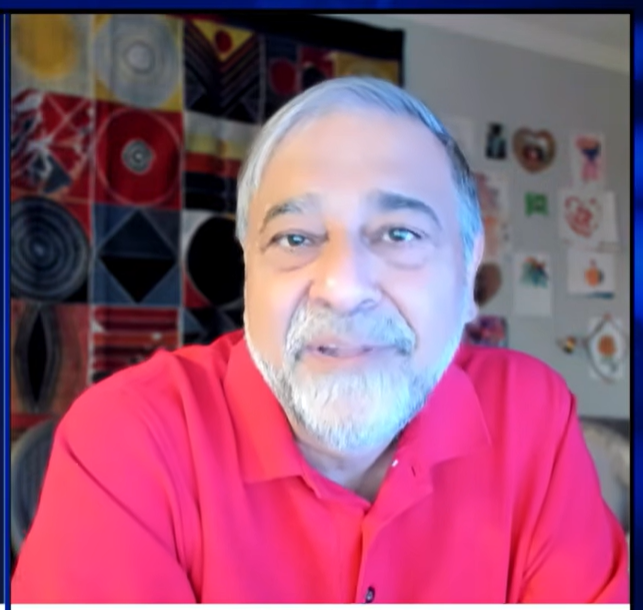
Indian American tech entrepreneur Vivek Wadhwa responds to Indian billionaire Sridhar Vembu’s appeal to Indians in the US to return and strengthen their country of origin.

APRIL 28, 2026 : When my old friend Sridhar Vembu first came to the United States, he was part of a very small wave of Indian engineers and entrepreneurs who ventured into unfamiliar territory, learned from the world’s most advanced innovation ecosystem, and then, in his case, returned to build something extraordinary. What he built with Zoho Corporation is a model of what disciplined, long-term thinking can achieve.
At that time, India looked at people like him with awe. The diaspora represented success, capability, and access to a world that was far ahead. Returning to India was both a sacrifice and a mission.
But that world no longer exists.
ADVERTISEMENT

Homegrown entrepreneurs have gotten ahead
Over the past two decades, at Duke, Harvard, and UC Berkeley, my teams have studied the movement of talent between the United States and countries like India and China. In my early work, I described this as “brain circulation”—a dynamic system in which talent moved across borders, carrying knowledge, networks, and capital with it.
In recent research, in collaborations with colleagues at the Indian Institute of Science, we documented a far more profound shift: India’s domestic startup ecosystem had matured to the point that homegrown founders were now outperforming returnees on key measures such as funding, valuation, and revenue. The old foreign-educated advantage had weakened; local knowledge, domestic networks, and embeddedness in India’s markets had become more important. In effect, the liability of localness had flipped into the liability of foreignness.
The new reality is that India is not waiting to be built by its diaspora, it is building itself. And increasingly, it is the diaspora that needs India—not the other way around.
Living in India is no longer a professional handicap
When Indian engineers and entrepreneurs came to the United States in the 1980s and 1990s, they were not just chasing opportunity, they were escaping a system. India’s socialist policies had choked ambition, limited enterprise, and kept the country mired in poverty. merica offered the exact opposite: it had the best labs, the most advanced companies, the deepest pools of capital, and a culture that rewarded risk-taking. If you wanted to build something world-class, there was only one place to go, and that was the United States.
But technology has changed everything. Today, an engineer in Bengaluru or Chennai has access to the same knowledge, the same tools, and increasingly, the same ambition. The constraints that once forced talent to migrate are weakening and, in many cases, have disappeared.
The US is turning hostile
At the same time, something else has happened, something deeply troubling for the United States: it has begun pushing away the very people who helped build its technological dominance.
The rhetoric against foreign students has intensified and the H-1B visa program, once a gateway for the world’s best and brightest, has become a political punching bag. Anti-immigrant sentiment has moved from the fringes into the mainstream. And for Indian professionals in particular, the system has become toxic.
Highly skilled engineers and researchers wait not years, but decades, for green cards. They build companies, lead teams, and drive innovation — yet remain in a state of permanent uncertainty, which is literally indentured servitude. Their children age out of dependent visas, families live with constant anxiety, and the promise of stability keeps slipping further away. Now, even birthright citizenship, long a cornerstone of America’s identity, is being questioned.
This is not just bad policy, it is self-destructive.
Decline is a gradual process
Countries don’t lose their edge overnight. They erode it slowly by making it harder for talent to stay, to grow, and to feel that they truly belong. Sadly, that is what is happening in America today. It breaks my heart to say this because I consider myself American and always will. But like so many others, I am increasingly feeling helpless as I watch the very foundation of this country’s strength being chipped away.
And as this erosion accelerates, something predictable is occurring.
Indians are not returning because they are being called back — they are returning because they are being pushed out, and because, for the first time, they have somewhere equally compelling to go.
Indians are returning because it’s a rational decison
In our research, we found that returnees were not making emotional decisions, they were making rational ones. They saw faster career growth in India; opportunities to lead, to build, to have impact; and they saw ecosystems that, while still imperfect, were dynamic and expanding. Most importantly, they saw that they could win.
That is the key difference between then and now.
In Sridhar’s time, returning to India meant giving up something. Today, it often means gaining something.
I am seeing this firsthand in my own work in India.
At Vionix Biosciences, we are building one of the most ambitious diagnostic platforms in the world. This is deep science—physics, chemistry, and machine learning—coming together to solve some of humanity’s hardest problems, from early disease detection to real-time environmental monitoring.
We are not just developing another device; we are building a new way of understanding biology and chemistry through high-dimensional spectral intelligence, combining advanced instrumentation with AI to extract patterns that traditional systems miss. It is the kind of interdisciplinary, systems-level work that requires not just expertise, but the ability to think across boundaries and challenge established approaches.
When I began scaling this effort in the United States, I encountered a reality that surprised me: I could not find the depth of interdisciplinary talent I needed at the scale required. The expertise existed, but it was fragmented, expensive, and often siloed. And then when I looked to bring in talent from abroad, I realized that it would not be possible to get visas for these highly skilled engineers and scientists because of the flawed immigration system.
In India, I found engineers who move fluidly across domains, physicists who collaborate naturally with clinicians, and teams unburdened by rigid hierarchies or narrow specialization, along with a deeper hunger—a willingness to take on problems others consider too complex or too risky.
Cross-border collaboration makes physical presence redundant
This is the reality many in the diaspora are beginning to recognize, and it reflects a broader shift: in today’s world, you do not have to choose, because companies can be built across borders, teams can collaborate across time zones, and innovation is no longer tied to geography, making the idea that one must physically return to contribute increasingly outdated.
And yet, Sridhar’s letter calls on Indians in America to return out of a sense of duty. I understand the sentiment and respect the intent. But the premise is outdated.
India’s rise will not be driven by appeals to patriotism, but by the continued strengthening of its ecosystems: its universities, its companies, its research institutions, and its ability to create opportunity at scale. Sridhar has already contributed meaningfully to this transformation, and I would encourage him to push even further.
In short, India will rise because it has earned its place, and America will decline only if it turns its back on the very talent that made it great.
(Vivek Wadhwa is CEO of Vionix Biosciences and has held academic appointments at institutions, including Harvard Law School, Stanford and Duke University.)