

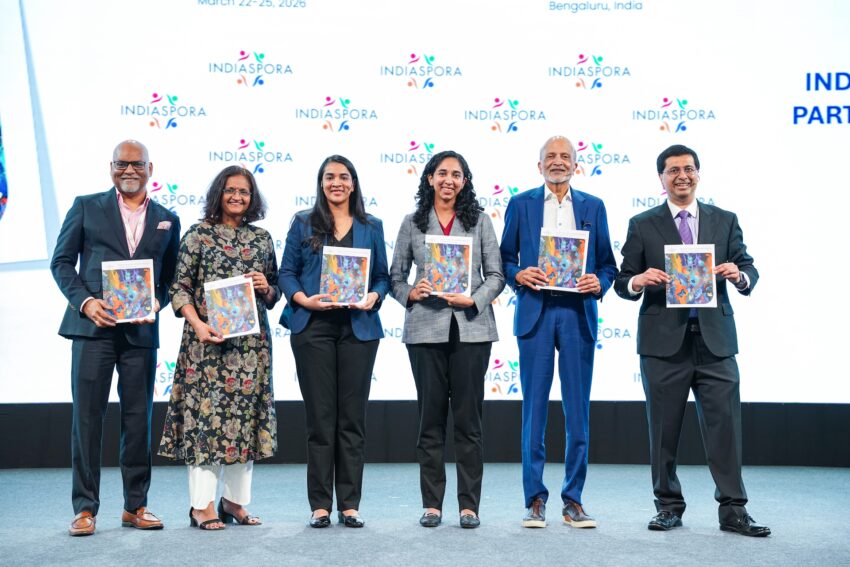

Against the breathtaking backdrop of Nandi Hills outside Bengaluru, leaders from 23 countries, technologists, investors, philanthropists, artists, policymakers, and scholars, gathered for the Indiaspora Forum 2026. Over four days, they engaged with India’s own changemakers in conversations that reflected a simple but powerful truth: India and its diaspora need each other, and the world needs both.
This is not a new idea for us at Indiaspora. Since our founding in 2012, we have believed that when this relationship is intentionally cultivated, it creates value far beyond borders. What was once a thesis is now increasingly visible as reality.
The timing could not be more critical. The world is at an inflection point. Geopolitical tensions are rising, economic alignments are shifting, and the global rules-based order is under strain. As economist Gita Gopinath noted at the Forum, geopolitics and economics are now deeply intertwined in ways that directly impact India. She highlighted a striking reality: a third of the Indian diaspora lives in the Middle East, which also accounts for a third of India’s remittances. Yet her broader point was even more important, the Indian diaspora is not only thriving globally but contributing meaningfully both where it resides and back to India.
For too long, those contributions have been viewed narrowly through remittances. At the Forum, we released a landmark report that reframes this narrative. The diaspora’s impact spans technology, political influence, cultural diplomacy, research, and philanthropy. It is not just about capital, it is about ideas, institutions, and influence.
ADVERTISEMENT

As Dr. Mohanbir Sawhney, Professor at Northwestern School of Business observed, “The Indian diaspora helped build many of the world’s leading technology companies, while India’s digital public infrastructure has become a global model for inclusive innovation. With artificial intelligence reshaping every industry, India and its diaspora have a once-in-a-generation opportunity to lead.”
As Ursula von der Leyen, President of the European Commission noted in her address prior to the EU-India Free Trade Agreement, “India can play a unique role as a bridge between the Global South and the rest of the world.” And we believe the diaspora can be a key part of that role.

Technology was a central theme throughout the Forum. Nandan Nilekani underscored how India’s digital infrastructure, from Aadhaar to UPI, has created scalable solutions with global relevance. These are not just national achievements; they are global public goods in the making.
That momentum carried into the Global AI Summit, where Indiaspora, in partnership with Zinnov, a global management and strategy firm, released two major reports: India’s Top 100 AI Startups and the evolving role of Global Capability Centers. The message was clear: India is no longer just executing ideas, it is co-creating them at the frontier of innovation.
But what makes this movement truly distinctive is not just technological ambition, it is intellectual and cultural breadth. As Dr. Priyamvada Natarajan, Chair, Department of Astronomy at Yale University, and Indiaspora Board Member noted, Indiaspora’s strength lies in convening diverse leaders committed to sharing knowledge across generations. This is a community grounded in purpose.
That spirit was reflected in a powerful plenary featuring Sri Sri Ravi Shankar and Smriti Irani, alongside cultural icons like Usha Uthup and Ricky Kej. Their presence underscored an often-overlooked truth: the diaspora’s connection to India is not only economic or political, it is deeply cultural and emotional. Culture is diplomacy. Art is infrastructure.
Bengaluru was a fitting host. As India’s technology capital, it represents the country’s ambition and momentum. With a young population, expanding innovation ecosystem, and a bold vision of becoming a developed nation by 2047, India stands at a defining moment.
The diaspora has an indispensable role to play in that journey, not as benefactors, but as partners. It brings global networks, expertise, capital, and perspective. India offers scale, dynamism, and a living laboratory for solving complex global challenges.
This is not transactional. It is a relationship, one with deep roots and vast potential.
At Indiaspora, our role is to nurture that relationship: to create spaces where trust is built, ideas are exchanged, and action follows. The Forum in Bengaluru was a powerful reminder of what is possible when intention and capability are aligned.
The world is watching. And together, India and its diaspora are ready to lead and serve as a force for good.

M.R. Rangaswami is the Founder and Chairman of Indiaspora, a nonprofit organization dedicated to inspiring the global Indian diaspora to be a force for good.

Sanjeev Joshipura serves as Indiaspora’s Executive Director.